black stallion welding jacket
You feel it the moment the first sparks arch off the grinder and land on your forearm. A jacket that breathes and moves with you is the difference between finishing the weld clean and flinching halfway through the bead. If you have been hunting for a black stallion welding jacket that protects without turning your torso into a portable sauna, you already know the brand shows up in almost every serious conversation. Black Stallion, made by Revco Industries, has spent years building gear that shop welders actually keep reaching for, and its BSX sub-brand pushes that reputation toward a lighter, more athletic fit. This guide walks you through the lineup, tells you which one fits your work, and names the honest flaws so you buy once instead of twice.
What a Black Stallion welding jacket actually is
A Black Stallion welding jacket is a flame-resistant torso and arm covering designed to stop spatter, sparks, and radiant heat during welding, grinding, and cutting. Black Stallion is the flagship line from Revco Industries, and BSX is its enthusiast-leaning branch built around contoured cuts and lighter materials. The jackets fall into two broad families. The first is flame-resistant (FR) cotton, which is treated woven fabric that resists ignition and self-extinguishes, prized for breathability and range of motion. The second is leather, usually pigskin or split cowhide, which absorbs heavy spatter and blocks radiant heat far better than cloth. Some models blend the two, placing leather on the high-heat zones and FR cotton everywhere else. According to the American Welding Society, protective clothing should resist ignition and shield skin from ultraviolet and infrared radiation, and OSHA requires employers to protect welders from the hazards of the process. That safety baseline is exactly what these jackets are engineered to meet, with the specific material dictating how much heat you can throw at it.
The one to buy first: BSX BX9C
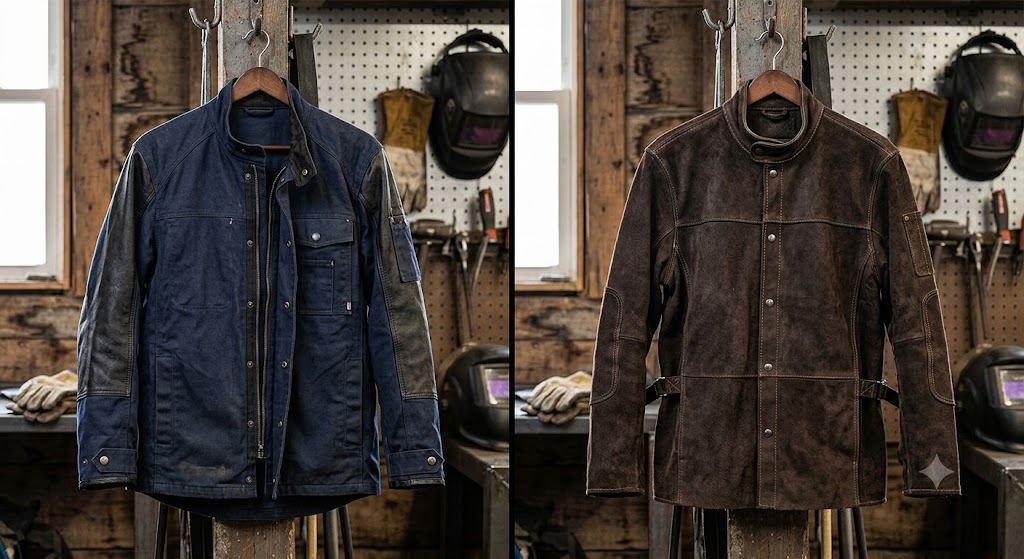
If you want a single recommendation, start with the BSX BX9C. It is a 9 oz contoured FR cotton jacket cut for movement, and it is the model most hobbyists and working pros reach for when they want breathability without giving up real protection. The contoured fit hugs the shoulders and tapers through the torso, so it does not billow into your work the way a boxy jacket does. For MIG, light to moderate stick, and long shop sessions in warm weather, it hits a rare balance.
BSX Black Stallion BX9C contoured FR cotton welding jacket
The named flaw: FR cotton simply does not shrug off heavy stick spatter the way leather does. Sustained overhead work with large-diameter rods will pit and eventually burn through the fabric faster than a cowhide shell. Who should skip it: if you run heavy structural stick all day, or you weld overhead where slag rains straight down, this is not your jacket. Reach for leather instead.
The hybrid middle ground: FRB9-30C
The Black Stallion FRB9-30C is the compromise for welders who live between light and heavy work. It pairs FR cotton across the back and lower body with cowhide leather on the shoulders, chest, and sleeves where spatter concentrates. You get better heat resistance on the zones that take the most abuse while keeping the breathable panels that make a full shift bearable.
The named flaw: a hybrid is heavier and warmer than the all-cotton BX9C, and the seams where leather meets cloth can be a wear point over years of hard use. Who should skip it: pure hobbyists doing occasional garage MIG will find it more jacket than they need, and anyone who prioritizes maximum airflow will still prefer the BX9C.
When you need leather: 30PWC and 36WC
Two leather options carry the line up to a higher protection tier. The Black Stallion 30PWC is a pigskin leather jacket, and pigskin stays supple, handles oil and moisture well, and resists stiffening after it gets wet. The Black Stallion 36WC is a split cowhide leather jacket, thicker and tougher, built to absorb aggressive spatter and radiant heat.
The named flaw for the 30PWC: pigskin is durable but thinner than heavy split cowhide, so for the most brutal high-amperage stick it gives up a margin of protection. Who should skip it: welders who want the single toughest shell should look at the 36WC.
The named flaw for the 36WC: split cowhide is hot and stiff, and it fatigues you faster in warm shops. Who should skip it: anyone doing light, fast, high-volume work in summer heat, because you will overheat long before the jacket ever earns its keep.
FR cotton or leather: how to choose
The decision comes down to how much heat you throw and how long you wear the jacket. NIOSH documents the burn, ultraviolet, and infrared hazards welders face, which is why material choice is a safety decision, not just a comfort one. Match the shell to your process and duty cycle rather than buying the toughest option by default and then leaving it on the hook because it is miserable to wear.
| Model | Material | Protection level | Breathability | Best for |
| BSX BX9C | 9 oz contoured FR cotton | Light to moderate | High | MIG, light stick, long warm sessions |
| FRB9-30C | FR cotton and cowhide hybrid | Moderate | Medium | Mixed-duty shop work |
| 30PWC | Pigskin leather | High | Low | Heavier spatter, wet or oily conditions |
| 36WC | Split cowhide leather | Highest | Lowest | Heavy stick, overhead, high amperage |
Fit and sizing tips
Black Stallion and BSX contoured cuts run trimmer than old-school boxy welding coats, which is the point, but it means you should account for a base layer underneath. Size so the sleeves reach your glove cuffs with your arms extended in a welding position, not standing relaxed. A jacket that rides up when you reach exposes your wrists exactly where sparks like to find skin. If you are between sizes and plan to layer in cold shops, size up on the leather models and stay true to size on the BX9C.
Care and lifespan
FR cotton keeps its flame resistance through normal laundering when you follow the manufacturer instructions, but harsh bleaches and fabric softeners can degrade performance, so skip them. Leather jackets should be kept dry when possible and wiped clean rather than soaked. Inspect any welding jacket regularly for burn-through, thinning, and failed seams, and retire it once the protective layer is compromised. A jacket that has been pitted down to the weave is no longer doing its job.
The verdict
For most welders reading this, the BSX BX9C is the smart first buy: breathable, well cut, and protective enough for the majority of MIG and light stick work. Step up to the FRB9-30C hybrid if your work drifts heavier, and move to the 30PWC pigskin or the 36WC split cowhide when spatter, amperage, and overhead work demand a leather shell. Buy for the work you actually do most days, not the worst hour of your worst job, and you will reach for the jacket instead of dreading it.
Frequently asked questions
Is a Black Stallion FR cotton jacket safe for stick welding? Yes, for light to moderate stick it is fine, but heavy high-amperage stick and overhead work throw more spatter than FR cotton is built to absorb over time. For that duty, choose the 30PWC or 36WC leather.
What is the difference between Black Stallion and BSX? Both come from Revco Industries. Black Stallion is the flagship line, and BSX is its enthusiast-focused branch known for contoured, more athletic cuts and lighter materials like the BX9C.
Does FR cotton lose its flame resistance after washing? Quality FR cotton retains its flame resistance through normal laundering when you follow the manufacturer care instructions. Avoid bleach and fabric softeners, which can degrade the treatment.
Pigskin or cowhide for a welding jacket? Pigskin (30PWC) stays supple, handles moisture and oil well, and resists stiffening after getting wet. Split cowhide (36WC) is thicker and tougher for the heaviest spatter and radiant heat, but it runs hotter and stiffer.
Will the BX9C keep me cool in summer? It is one of the more breathable options in the lineup thanks to the 9 oz FR cotton and contoured fit, so it is a strong warm-weather pick. If you need maximum airflow, it beats the leather models easily.
How should a welding jacket fit? Trim enough that it does not billow into your work, with sleeves that reach your glove cuffs when your arms are extended in a welding position. Account for base layers, especially with the leather models in cold shops.
References
- Revco Industries (Black Stallion and BSX), product and material documentation
- Occupational Safety and Health Administration (OSHA), welding, cutting, and brazing protective equipment requirements
- American Welding Society (AWS), safety guidance on protective clothing for welders
- National Institute for Occupational Safety and Health (NIOSH), welding hazard and health information