Kevlar Welding Gloves
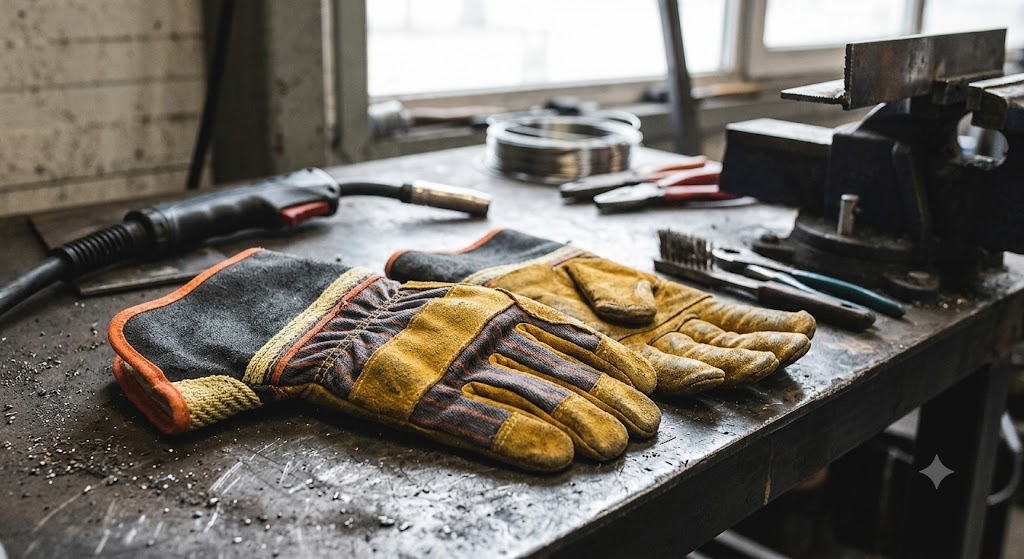
Ask a welder about Kevlar and half of them will point at the stitching, the other half at the lining, and both are right. Kevlar shows up in welding gloves in two very different jobs, and the marketing rarely explains which one you are actually buying. Kevlar welding gloves use the aramid fiber DuPont trademarked as Kevlar, either as the thread that sews the glove together or as a knit liner that adds cut and heat resistance. Knowing the difference stops you from overpaying for a feature you already have.
What Kevlar does in a welding glove
Kevlar is an aramid fiber that does not melt or ignite and only chars at very high temperatures, while also being extremely strong and cut resistant. In welding gloves it plays two roles. The first and most common is stitching. Nearly every quality leather welding glove is sewn with Kevlar thread, because cotton or nylon thread burns through at the seams the moment a spark lands on the stitch line. When you see Kevlar stitching advertised, that is the baseline of a serious glove, not a premium add-on.
The second role is as a knit lining or a full knit glove. Here Kevlar adds cut resistance and heat resistance beyond what the leather alone provides, which matters if you handle sharp or hot stock between welds. A full Kevlar-lined glove trades some of that protection story against dexterity and cost.
Which Kevlar gloves should you buy
If what you want is a leather welding glove with bulletproof seams, you already have your answer in almost any Tillman or Black Stallion glove, since both sew with DuPont Kevlar thread as standard. The Tillman 1350 cowhide glove and the Black Stallion GM1611 both use Kevlar stitching, so you are not missing out by choosing them over a glove that shouts about Kevlar on the label.
If you want a heavy, heat-resistant glove that leans on Kevlar for extra protection, the TOPDC 16 inch leather welding glove uses Kevlar stitching with a thick insulated leather build rated to high temperatures, aimed at forge and heavy heat work. Its flaw is bulk: at sixteen inches with heavy insulation, it is an oven mitt, not a precision glove, so it is a poor pick for fine work.
For forge and MIG crossover use, the YESWELDER 16 inch forge welding glove offers a similar heavy Kevlar-stitched leather build at a lower price. The trade is inconsistent sizing and a stiff break-in period, so order a size up if you are between sizes.
Stitching versus lining
| Kevlar use | What it adds | Found in |
| Stitching (thread) | Seams that resist heat and abrasion | Almost all quality gloves |
| Knit lining | Extra cut and heat resistance | Heavy-duty and forge gloves |
| Full knit glove | Cut resistance, no spatter protection | Handling, not welding |
The key thing to understand: a full Kevlar knit glove with no leather is a cut-resistant handling glove, not a welding glove. It will not stop spatter or sustained radiant heat the way leather does. For actual welding, you want leather with Kevlar stitching, and optionally a Kevlar liner for extra cut protection.
Is Kevlar stitching worth paying extra for?
No, because you should not have to. Kevlar stitching is the standard on any glove worth buying, so if a glove advertises it as a special feature at a premium price, that is marketing. Spend your money on the right leather and the right thickness for your process, and treat Kevlar stitching as the floor, not the ceiling.
Frequently asked questions
What is Kevlar in welding gloves? Kevlar is an aramid fiber used either as heat-resistant stitching thread or as a cut-resistant knit lining. Most quality gloves use Kevlar thread as standard.
Are Kevlar welding gloves better? Kevlar stitching is essential, but it is already standard on good gloves. A Kevlar liner adds cut resistance but is only worth it if you handle sharp or hot stock.
Does Kevlar melt when welding? No. Kevlar does not melt or ignite and only chars at very high temperatures, which is exactly why it is used for stitching near the arc.
Can I weld in a full Kevlar knit glove? No. A full knit Kevlar glove is a cut-resistant handling glove. It does not stop spatter or radiant heat the way leather does.
Do all good welding gloves use Kevlar stitching? Nearly all do. Tillman, Black Stallion, Caiman, Miller, and Lincoln all sew with Kevlar or equivalent aramid thread.
Is Kevlar the same as Nomex? No. Both are DuPont aramid fibers, but Nomex is used mainly for flame-resistant linings and clothing, while Kevlar is prized for its strength and cut resistance.
References
- DuPont Kevlar technical overview, dupont.com
- John Tillman & Co. product specifications, jtillman.com
- Black Stallion (Revco) product data, blackstallion.com