kevlar welding sleeves
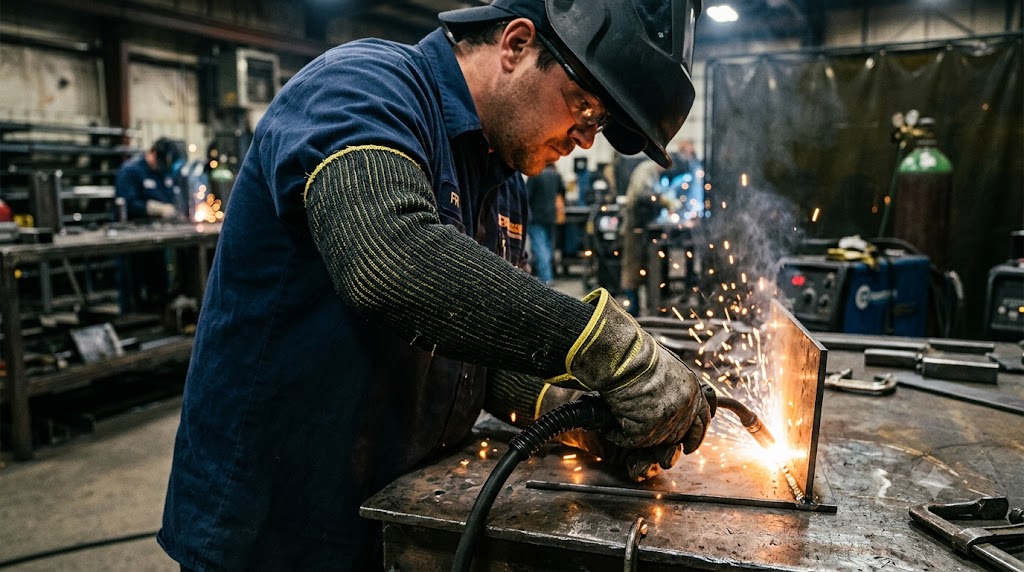
Picture your forearms after a full shift of MIG tacking in a hot shop. The skin on the inside of your wrists is tight and red, your shirt sleeves are peppered with tiny burn holes, and a stray sheet edge has left a thin white scratch across your arm. That is the exact gap that kevlar welding sleeves are built to close. They wrap the vulnerable stretch between your glove cuff and your bicep in aramid knit or leather, so radiant heat, light spatter, and sharp metal edges meet the sleeve instead of you. Choose the right pair and you forget they are on. Choose the wrong pair and you either cook or leave yourself exposed.
This guide walks you through what Kevlar knit sleeves actually do, where they stop being enough, and which specific pairs are worth putting on your arms.
What kevlar welding sleeves actually are
Kevlar is DuPont’s brand of aramid fiber, a synthetic that resists heat and does not melt or drip the way nylon or polyester does. In a welding context, “kevlar welding sleeves” usually means one of two things. The first is a knit tube made from aramid yarn (Kevlar or the Twaron equivalent) that slides over your forearm, often with a thumb slot to keep it anchored. These knit sleeves breathe, flex, and deliver strong cut resistance, commonly rated ANSI A3 on the ANSI/ISEA cut scale. They shrug off radiant heat and the occasional light spark.
The second meaning is a hybrid leather sleeve, typically goatskin paired with flame resistant (FR) cotton, sewn with Kevlar thread so the seams survive heat that would melt ordinary stitching. These are heavier, less breathable, and built to take direct spatter. Understanding which of the two you need is the whole game, because a light knit sleeve and a leather sleeve solve different problems.
Which one you should buy first
If you do light MIG or TIG work, handle sharp sheet stock, and mostly need heat comfort plus cut protection, start with a double-ply aramid knit sleeve. If you burn heavy stick or flux-core and get showered with hot spatter, start with leather. Most fabricators end up owning both and swapping based on the job. Below are two verified picks, one from each camp, plus one knit alternative worth naming.
Tillman 9818 Kevlar knit sleeves for heat and cut protection
The Tillman 9818 18 inch double-ply Kevlar knit sleeves are the pair to reach for when your main enemies are radiant heat and sharp edges rather than a spatter storm. The double-ply 100 percent Kevlar knit gives you ANSI A3 cut resistance, and the thumb slot keeps the cuff from riding up when you reach into a fixture. They breathe far better than leather, so your arms stay drier across a long day, and at 18 inches they cover well past the elbow.
Named flaw: the open knit lets fine, persistent spatter through. Sustained showers of hot beads will find the gaps and reach your skin, and aggressive sparks can singe the fibers over time.
Who should skip it: heavy stick and flux-core welders throwing constant spatter, and anyone who wants a true barrier against molten metal. You need leather for that duty.
Tillman 9215 goatskin and FR cotton sleeves for spatter
When the sparks fly, the Tillman 9215 goatskin and FR cotton welding sleeves put a real leather shield between the arc and your arm. Goatskin is supple and abrasion resistant, and the FR cotton back panel keeps the sleeve from turning into a sweatbox the way full-grain cowhide can. They are built for light to medium welding where spatter, not just heat, is the concern.
Named flaw: breathability still lags behind knit. In a hot shop, or during long grinding and prep stretches with no arc, your arms will feel the heat build up under the leather.
Who should skip it: TIG welders doing clean, low-spatter work who mostly want cut resistance and airflow. A knit aramid sleeve will be more comfortable and enough for that job.
An aramid knit alternative worth naming
If you want a second knit option to compare, the Black Stallion Twaron/Kevlar knit A3 cut resistant sleeves cover the same use case as the Tillman 9818, using Twaron aramid to hit the same A3 cut tier. Treat this as a name to research, not a recommendation with a verdict, since the focus here is on the two picks above.
Kevlar knit versus leather: how to choose
The honest answer is that these are not competitors, they are teammates. Knit aramid wins on comfort, airflow, cut resistance, and dexterity. Leather wins on stopping hot spatter and physical abrasion. Match the sleeve to the arc, not the other way around.
| Factor | Kevlar knit (Tillman 9818) | Goatskin / FR cotton (Tillman 9215) |
| Best for | Light MIG, TIG, material handling | Light to medium welding with spatter |
| Spatter protection | Low (fine spatter passes through) | High (leather blocks hot beads) |
| Cut resistance | ANSI A3 | Good via leather, not rated to A3 knit scale |
| Breathability | High | Moderate |
| Dexterity | High, flexible knit | Moderate, stiffer leather |
| Anchoring | Thumb slot | Elastic ends |
How to size and wear them
Measure from your wrist to just below your armpit to confirm an 18 inch sleeve reaches where you need it. Tuck the lower end under your glove cuff so there is no exposed skin gap, and use the thumb slot on knit models to stop ride-up. Overlap the top of the sleeve with your jacket or FR shirt sleeve so heat cannot funnel in at the seam. Inspect aramid knit regularly, because scorching, glazing, or stiff spots mean the fibers have taken heat damage and the sleeve should be retired.
Care and lifespan
Follow the manufacturer’s care guidance rather than guessing. Aramid knit generally tolerates washing but degrades if you bleach it or expose it to prolonged UV, which weakens the fibers. Leather sleeves should be kept dry and conditioned lightly so the hide stays supple. Any sleeve that shows burn-through, broken stitching, or a large abraded patch has lost its protective value and belongs in the bin, not back on your arm.
The bottom line
Buy for the arc in front of you. Reach for the Tillman 9818 Kevlar knit sleeves when heat comfort, airflow, and A3 cut resistance matter most, and accept that fine spatter will get through. Reach for the Tillman 9215 goatskin and FR cotton sleeves when spatter is the real threat, and accept a bit more heat under the leather. Own both, keep them inspected, and pair them with proper gloves and an FR layer so there is no unprotected skin between the two.
FAQ
Are Kevlar knit sleeves enough for all welding? No. Knit aramid handles radiant heat and cut hazards well, but it is light duty against spatter. Heavy stick or flux-core work that throws hot beads needs leather sleeves like the Tillman 9215.
Will Kevlar melt on my arms? Aramid fiber does not melt or drip the way nylon and polyester do. It chars at high heat instead. That is a core safety reason to prefer aramid or leather over synthetic sleeves near an arc.
What does ANSI A3 cut resistance mean? A3 is a middle tier on the ANSI/ISEA cut resistance scale, indicating solid protection against cuts from sharp sheet metal and edges. It is not a rating for spatter or flame.
Do I need the thumb slot? It is a practical touch, not a legal requirement. The thumb slot anchors the sleeve so it does not slide down your forearm when you reach, which keeps your wrist covered during the work.
Can I machine wash Kevlar sleeves? Usually yes, but follow the manufacturer’s instructions. Avoid bleach and prolonged sunlight, since both weaken aramid fibers and shorten the protective life of the sleeve.
How long do welding sleeves last? There is no fixed date. Retire any sleeve that shows burn-through, glazing, stiff scorched patches, broken stitching, or heavy abrasion, because at that point it no longer protects you.
What should I wear under the sleeves? Pair sleeves with flame resistant clothing and appropriate welding gloves so there is no gap of exposed skin. OSHA guidance on protective equipment supports covering skin against arc hazards.
References
- Tillman (manufacturer product specifications for the 9818 and 9215 sleeves)
- DuPont (Kevlar aramid fiber heat and cut performance information)
- OSHA (occupational eye and body protection guidance for welding)
- AWS (safety guidance on protective clothing for arc welding and cutting)
- NIOSH (research on welding hazards and personal protective equipment)