Leather Welding Gloves Guide: Goatskin vs Cowhide vs Pigskin
Walk into any welding supply store and the glove wall looks like a leather goods shop, because it basically is. Goatskin, cowhide, pigskin, and elkskin all show up, and the label rarely explains why you would pick one over another. Leather welding gloves are the standard for a simple reason: leather chars instead of melting, so it protects your hands from sparks and heat in a way no synthetic knit can. The catch is that each leather trades heat protection against dexterity differently, and picking the wrong one makes your welding harder than it needs to be.
Why leather at all
Leather welding gloves are made from animal hide specifically because hide resists ignition and radiant heat while staying flexible. When a spark lands, leather scorches and holds where a synthetic material would melt onto your skin. The natural fiber structure of hide also insulates against the sustained heat coming off the arc and the workpiece. That is why even high-tech gloves keep a leather palm: nothing synthetic matches leather at this job for the price.
Within leather, the differences come down to thickness, softness, and how the hide reacts to heat and moisture. Understanding those three variables is all you need to choose well.
Which leather should you choose
Start with your process, then pick the leather that fits it.
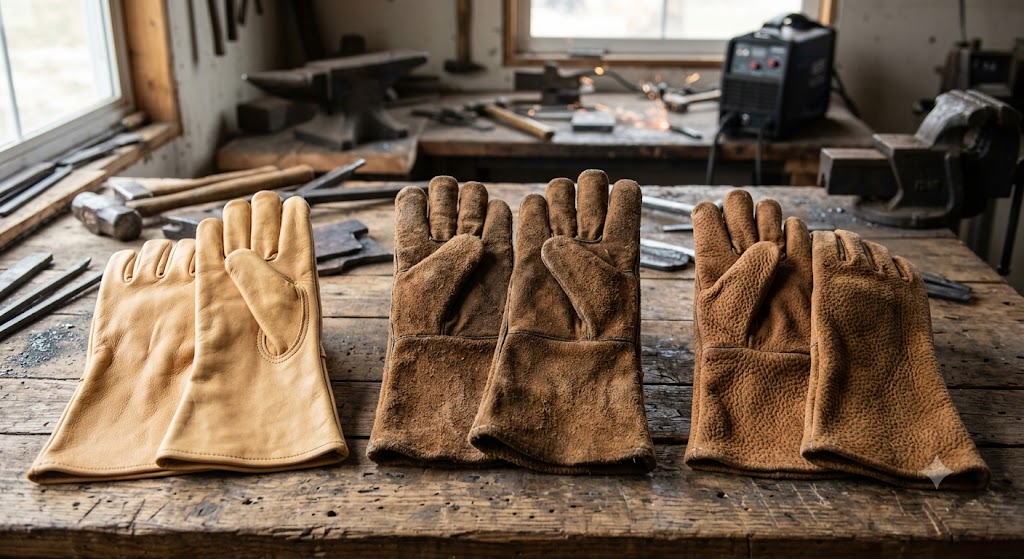
Cowhide is the all-rounder and the most common. It is thick, durable, heat resistant, and cheap, which makes it the default for MIG and stick. Its weakness is that it stiffens when wet and dries hard, and it offers less finger feel than goatskin. The Tillman 1350 top grain cowhide glove is a clean example, rated ANSI Level 4 for abrasion. Skip cowhide if your priority is delicate TIG feel.
Goatskin is the dexterity champion. Natural lanolin keeps it soft and supple, giving it the best finger feel, which is why nearly every TIG glove is goatskin. The Tillman 1328 goatskin TIG glove shows off the strength. Its flaw is that thinness means less heat protection, so it is a poor choice for stick or heavy MIG.
Pigskin breathes better than any other leather and stays flexible after getting wet, because its porous structure lets moisture pass through and dries soft. That makes it ideal for hot, sweaty, or damp conditions. The trade is a coarser texture and slightly less refined feel. Many general purpose gloves like the Miller 263340 Arc Armor glove use a pigskin palm for exactly this reason.
Elkskin resists heat shrinkage better than any of the above, staying soft instead of curling after repeated heat cycles, which is why premium stick gloves like the Black Stallion 850 use it. The downside is price. Elkskin costs more and is overkill for light work.
Head to head
| Leather | Feel | Heat resistance | Wet behavior |
| Goatskin | Best | Moderate | Stiffens |
| Cowhide | Moderate | High | Stiffens hard |
| Pigskin | Moderate | High | Stays soft |
| Elkskin | Good | Highest | Stiffens |
The pattern is simple: goatskin for feel, cowhide for value and durability, pigskin for wet or hot conditions, elkskin for the highest sustained heat. Most welders end up owning two: a goatskin TIG glove and a cowhide or elkskin glove for everything else.
Caring for leather gloves
Whatever leather you choose, keep it dry and let it air dry if it gets wet. Never machine wash leather welding gloves. Heat and detergent strip the natural oils, and the leather comes out stiff, shrunken, and cracked. Store them flat in a dry spot, and rotate two pairs if you weld daily so each pair has time to dry out between sessions.
Frequently asked questions
Which leather is best for welding gloves? There is no single best. Goatskin gives the best feel for TIG, cowhide is the durable value choice for MIG and stick, pigskin handles wet conditions, and elkskin resists heat shrinkage for heavy stick work.
Why is goatskin used for TIG gloves? Goatskin is naturally soft thanks to its lanolin, giving the finger dexterity TIG welders need to feed filler rod.
Is pigskin good for welding? Yes, especially in hot or damp conditions. Pigskin breathes well and stays flexible after getting wet, unlike cowhide.
Does elkskin really resist heat better? Elkskin resists heat shrinkage better than cowhide, staying soft after repeated heat cycles, which is why premium stick gloves use it.
Can I wash leather welding gloves? No. Machine washing strips the oils and ruins the leather. Wipe them down and air dry only.
How many pairs of gloves do I need? Most welders own at least two: a thin goatskin glove for TIG and a thick cowhide or elkskin glove for MIG and stick.
References
- John Tillman & Co. leather glove specifications, jtillman.com
- Black Stallion (Revco) product data, blackstallion.com
- Miller Electric Arc Armor product data, millerwelds.com