Sheet Metal Welding Gear Guide: Helmet, Gloves, and Sleeves
Sheet metal fabrication punishes the wrong gloves in under an hour. Heavy MIG gloves built for overhead stick welding give you so much dead space between your fingers and the leather that you lose track of the filler rod entirely. You end up dragging the tungsten into the puddle, contaminating the electrode, and stopping to regrind every third pass. The right gear for thin sheet — 18 gauge, 22 gauge, automotive skin — is thinner, more fitted, and designed around touch rather than bulk protection.
Sheet metal welding, particularly TIG on thin gauge panels, is a precision activity that rewards dexterity over raw heat resistance. The temperatures involved are lower, the arcs are shorter, and the work requires you to feel the filler rod between your fingers and guide it accurately. That changes the entire PPE calculus. Spatter protection matters less. Tactile feedback matters more.
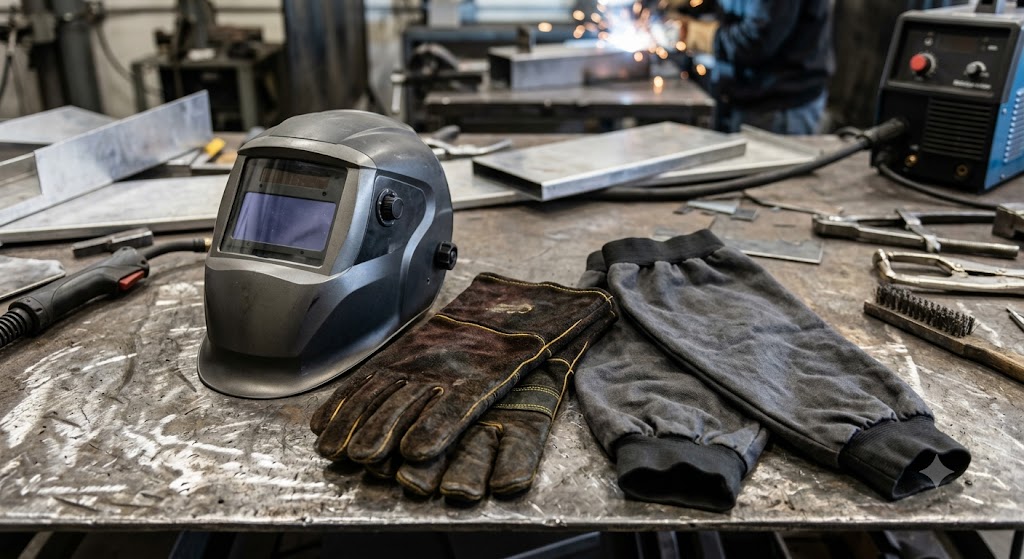
For sheet metal and light TIG work, the gear that actually serves you is: thin goatskin TIG gloves rather than cowhide MIG gloves, a helmet with a clear true-color lens and a shade range that goes down to 9, and sleeves that protect your forearms from UV and light spatter without being so rigid that they restrict arm movement during fine work.
Gloves for Sheet Metal TIG: Why Goatskin
Goatskin leather is the standard material for TIG welding gloves for one reason: it’s thin, soft, and conforms to your fingers without bulk. A well-fitted pair of top-grain goatskin TIG gloves gives you close to bare-hand sensitivity while still protecting against the incidental heat of a low-amperage TIG arc and the sharp edges of cut sheet metal.
Cowhide is more heat resistant but it’s stiffer. Chrome-cowhide MIG gloves have too much material layered at the fingertips to feel a filler rod properly. Pigskin sits between the two but is harder to find in a thin profile. For sheet metal TIG, goatskin is the right call.
Specific features to look for in sheet metal TIG gloves:
- Seamless index finger construction (a seam at the fingertip creates a pressure ridge that fatigues your grip)
- Wing thumb design for natural hand position at the gun or torch handle
- Kevlar stitching so the seams outlast the leather
- Extended cuff of 4 inches minimum to protect the wrist from UV without the bulk of a full gauntlet
Tillman 1328 Top Grain Goatskin TIG Gloves
The Tillman 1328 is the benchmark goatskin TIG glove for most welding instructors and fabricators who work in thin material. The top-grain goatskin (as opposed to split leather, which is rougher and thicker) gives you immediate tactile feedback. These gloves are ambidextrous, which keeps cost down and simplifies reordering, and the pull-on closure keeps the cuff from bunching at the torch handle.
They run thin by design — that’s the point. You feel the torch, you feel the filler rod, and you feel the heat of a puddle that’s getting too fluid before it becomes a blow-through. The tradeoff is that they won’t survive aggressive MIG or stick welding. They’re a TIG and light sheet metal glove, not an all-process glove.
The flaw: the ambidextrous design means they fit neither hand perfectly. Right-handed welders used to purpose-cut gloves will notice the slight difference, particularly in how the thumb sits at the torch handle. They also wear through faster than a thicker leather glove when used for grinding or material handling.
A verified live listing: Tillman 1328 TIG Welding Gloves
YESWELDER Premium Goatskin TIG Welding Gloves
The YESWELDER goatskin TIG gloves give you a comparable thin profile to the Tillman 1328 at a lower cost. Top-grain goatskin, reinforced seams, wing thumb design, and a 4-inch cuff. They’re not ambidextrous — you get a dedicated left and right glove — which improves fit at the thumb.
For welders doing longer TIG sessions on sheet metal where grip fatigue is a real concern, the YESWELDER’s slightly more padded palm adds a bit of comfort without meaningfully degrading feel. They’re a solid choice for training shops and small-volume fabricators who need a quality goatskin glove without paying for the Tillman name.
The flaw: the quality control on the YESWELDER goatskins is less consistent than the Tillman. Some pairs arrive with a seam that’s slightly off-center on the index finger, which you won’t notice until you’ve welded for thirty minutes and the pressure point has worn a hot spot on your finger. Inspect before the first use.
A verified live listing: YESWELDER Goatskin TIG Gloves
Glove Comparison for Sheet Metal TIG
| Feature | Tillman 1328 | YESWELDER Goatskin |
|---|---|---|
| Leather type | Top-grain goatskin | Top-grain goatskin |
| Fit | Ambidextrous | Left/right dedicated |
| Cuff length | Short to medium | 4-inch extended |
| Seamless index | No | No |
| Best for | General TIG, consistent quality | Budget TIG, better thumb fit |
| Named flaw | Neither-hand fit on thumb | Inconsistent QC |
Helmet Setup for Sheet Metal Fabrication
Sheet metal TIG runs at low amperages — often 30 to 80 amps on 18 to 22 gauge material. At those levels, a standard auto-darkening helmet with a shade range starting at shade 9 is appropriate. What matters more than shade range for thin sheet is how well the lens shows the puddle. You’re working close to the material, the heat-affected zone is small, and you need to see the exact moment the puddle begins to grow toward a blow-through.
The ESAB Sentinel A50 is a strong choice for sheet metal fabrication for the same reason it’s good for aluminum TIG: the True Color ADF provides better puddle contrast at low amperages than a standard green-tint lens. At 40 amps on 22-gauge steel, the color difference between a sound puddle and an overheated one is visible in the lens rather than hidden behind a flat green cast.
If your shop runs a mix of sheet metal TIG and MIG or light stick, the same helmet covers everything. Set the shade for your lowest amperage process; the auto-darkening handles the rest.
A verified live listing: ESAB Sentinel A50
Sleeves for Sheet Metal Work
Welding sleeves protect your forearms from UV exposure and light spatter without the heat retention of a full jacket. For sheet metal TIG, where you’re often positioned close to the work with your forearms inside the arc envelope, UV protection matters more than spatter resistance.
Look for sleeves in a flame-resistant (FR) material rather than plain leather or cotton. FR cotton is comfortable for full-shift wear, blocks UV, and won’t catch if a spark lands on the fabric. Leather sleeves are overkill for TIG on thin sheet and restrict movement at the elbow.
A full welding jacket is often counterproductive for precision sheet metal TIG. The bulk at the shoulder restricts the fine arm movements that thin-gauge work demands. Sleeves with a t-shirt underneath give you the protection where you need it (forearms, wrist) without the restricted range of motion.
FAQ
What gloves are best for thin sheet metal work? Top-grain goatskin TIG gloves are the right choice for thin sheet metal work. They provide the tactile sensitivity needed to feel a filler rod accurately while protecting against the UV exposure and incidental heat of a low-amperage TIG arc. Avoid cowhide MIG gloves for this work — the extra leather bulk costs you feel.
Do you need thicker gloves for sheet metal welding? No. Thicker gloves are for higher-heat processes like stick and heavy MIG. Sheet metal TIG runs at low amperage, produces minimal spatter, and requires precision grip. Thicker gloves make it harder, not safer.
What helmet setup works best for sheet metal fabrication? A true-color auto-darkening helmet with shade range 9-13 and four arc sensors is the best setup for sheet metal fabrication. The true-color lens shows puddle behavior more accurately at low amperages, which matters when the difference between a good bead and a blow-through is a second of overrun.
Can I use MIG gloves for TIG welding on sheet metal? You can, but you shouldn’t for precision work. Heavy MIG gloves reduce your feel for the filler rod and can make tungsten contact more likely, especially on thin gauge material where control tolerances are tight.
Do I need a full welding jacket for sheet metal TIG? For most shop TIG work on sheet metal, FR sleeves over a cotton shirt provide adequate protection without the range-of-motion restriction of a full jacket. If you’re welding near others or in a situation where full coverage is required, use a jacket — but for precision TIG at the bench, sleeves are more practical.
What sleeve material is best for TIG on thin metal? FR cotton or FR treated fabric is most comfortable for TIG work. It blocks UV, resists ignition from light spatter, and breathes better than leather over a full shift. Leather sleeves are appropriate for MIG and stick but add unnecessary heat retention for TIG on sheet.
How long do goatskin TIG gloves typically last? With regular TIG use on thin material and proper care (keeping them dry, not using them for grinding), quality goatskin TIG gloves typically last two to four months in a production shop. Occasional-use fabricators can get a year or more from a single pair.
References
- https://www.aws.org/magazines-and-media/welding-digest/2025/november/wd-nov-2025—complete-welding-lens-shade-chart—safety-guide-for-eye-protection/
- https://www.osha.gov/laws-regs/regulations/standardnumber/1915/1915.153
- https://www.esab.com
URL slug: sheet-metal-welding-gloves-gear-guide Excerpt: Sheet metal TIG demands thin goatskin gloves, a true-color auto-darkening helmet, and FR sleeves for forearm protection. Thick MIG gloves kill your feel and your welds. Here’s the gear that actually serves you.