Timberland PRO Welding Boots Full Review
A steel-toed boot that doesn’t account for metatarsal protection is doing half the job on a welding floor. Most foot injuries in metal fabrication aren’t toe impacts - they’re the result of something dropping on the top of the foot, between the toe cap and the ankle. That’s exactly the gap a metatarsal guard addresses, and it’s the reason welders who’ve worked under a press or near a crane start paying attention to met-guard boots in a way they didn’t when they were starting out.
Timberland PRO has been making met-guard work boots for long enough to have worked out most of the fit problems that plagued early designs. Their current External Met Guard model (style TB140000001) is the practical choice for welders who need ASTM-rated metatarsal protection without the bulk of older met-guard boots. The Boondock, their composite-toe waterproof boot, rounds out their welding lineup for environments where ankle support and dry feet matter as much as toe protection.
OSHA’s foot protection standard, 29 CFR 1910.136, requires that employers ensure employees use protective footwear where there is a danger of foot injuries from falling or rolling objects, or from electrical hazards. Metatarsal protection is specifically called out when the metatarsal bones are at risk of injury. The standard points to ASTM F2413 as the benchmark for safety footwear performance.
Timberland PRO External Met Guard (TB140000001)
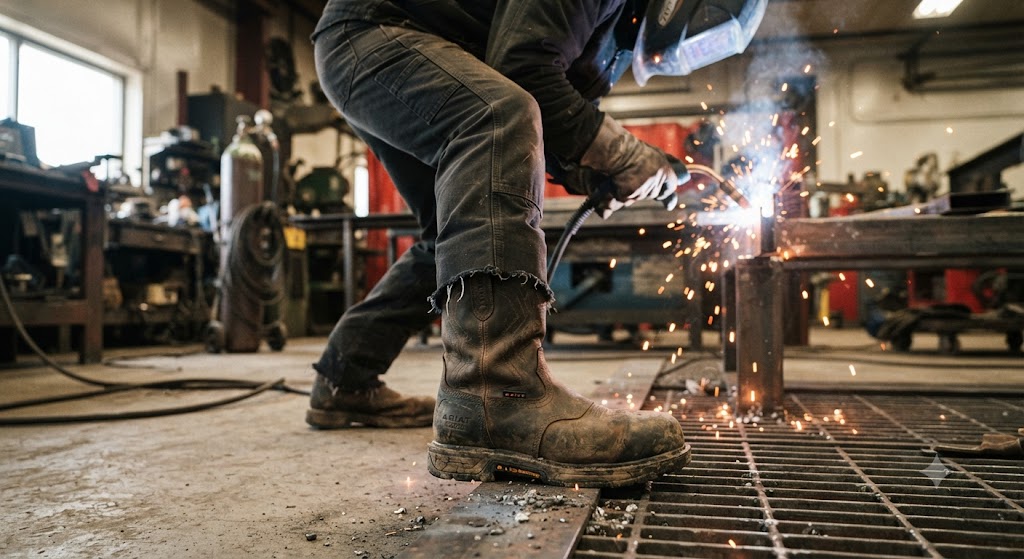
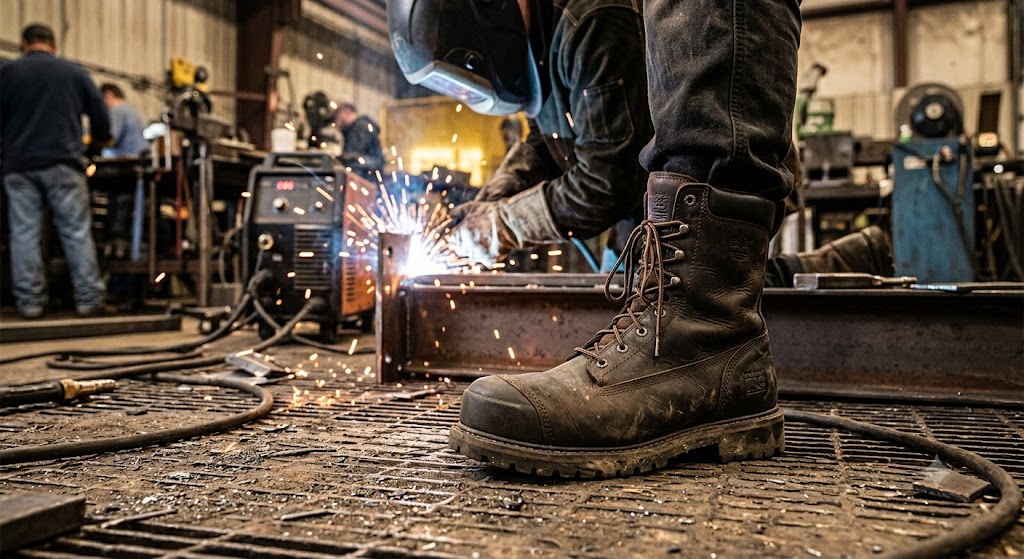
The External Met Guard boot uses Ever-Guard leather on the upper - a highly abrasion-resistant material that Timberland PRO specifies for their hardest-use boots. The external metatarsal guard is hinged, which is the detail that separates this boot from older, rigid met-guard designs. A hinged guard flexes when you squat or kneel, staying in contact with the top of the foot rather than riding up and leaving a gap. For welders who spend time crouching to reach welds at floor level, that flex matters.
The steel safety toe and metatarsal guard both meet ASTM F2413 standards. Electrical hazard protection is included, rated to provide a secondary layer of protection against accidental contact with live electrical circuits. The outsole is heat-resistant rubber rated to 500C (932F), non-marking, oil-resistant, and slip-resistant - the combination that a welding shop floor demands. Heat-resistant thread on the upper and welt prevents stitch failure from spark contact, which is a failure point that cheap boots with synthetic threads develop rapidly.
The 24/7 Comfort System technology in the footbed is Timberland PRO’s proprietary anti-fatigue design. It works reasonably well for an eight-hour shift, particularly on concrete floors. The limitation is that the footbed is not removable for replacement, so if your feet need a specific orthotic support, you’re working around the built-in footbed rather than with it.
The named flaw: the shaft height on the External Met Guard is 6 inches, which is low for a dedicated welding boot. A 6-inch shaft protects the ankle but leaves the lower leg exposed to spatter above the boot line more quickly than an 8-inch boot would. For high-amperage Stick work or flux-cored welding where spatter volume is significant, you’ll want gaiters or leggings, or you’ll need to look at an 8-inch option.
Who should skip it: welders who do significant overhead Stick or flux-cored work in positions where spatter falls on the lower leg will want an 8-inch shaft or a separate spatter gaiter. The 6-inch boot is best suited for production MIG, light Stick, and shops where spatter volume is manageable.
Timberland PRO Boondock
The Boondock is not a met-guard boot, but it earns its place in this review because it’s the boot Timberland PRO welders reach for when they need all-day comfort, waterproofing, and composite safety toe protection without the weight of a steel toe.
Composite toes are non-conductive, which matters in electrical hazard environments where a steel toe cap, while individually safe, adds a conductive element. The Boondock’s composite toe meets ASTM F2413 impact and compression requirements at a lighter weight than steel.
The waterproof leather upper with waterproof membrane is relevant in shops where coolant, cutting fluid, or wash-down water is present on the floor. Anti-Fatigue Technology in the midsole uses an inverted cone geometry that absorbs shock at the heel and converts it to energy return through the toe - a design aimed at reducing the cumulative foot fatigue that develops over a full production shift.
The ExoSpine technology provides a rigid external heel cup that keeps the foot from rolling laterally during extended standing. This is the structural feature that separates boots designed for all-day industrial use from boots designed primarily for walking.
The named flaw on the Boondock: the waterproof membrane reduces breathability enough that in a hot shop, your feet will run warm. This is a real limitation on summer production days or in shops without climate control. The insulated Boondock version amplifies this; in any environment above 65F, choose the non-insulated model.
Who should skip the Boondock for welding: anyone who needs metatarsal protection. The Boondock’s composite toe protects the toes, not the metatarsal arch. In environments where overhead lifting, crane work, or material handling creates a drop-on-top-of-foot risk, the External Met Guard boot is the appropriate choice.
Are Timberland PRO Boots Good for Welding?
Yes, with the right model selected for the right application. The External Met Guard is one of the more practical met-guard boot designs currently available - the hinged guard, heat-resistant thread, and abrasion-resistant upper address the specific demands of a welding environment directly. The Boondock is a strong choice for welders in machine shops or mixed-use facilities where waterproofing and all-day comfort are the priority and met-guard protection isn’t required.
Neither model is optimized for very high heat environments like foundries or furnace work, where purpose-built foundry boots are more appropriate.
Comparison Table
| Feature | External Met Guard (TB140000001) | Boondock |
|---|---|---|
| Toe protection | Steel, ASTM F2413 | Composite, ASTM F2413 |
| Metatarsal guard | Yes, external hinged | No |
| Shaft height | 6 inches | 6 or 8 inches |
| Waterproof | No | Yes |
| EH protection | Yes | Yes |
| Heat-resistant outsole | Yes (500C/932F) | Yes |
| Best for | Welding, met-guard required | All-day industrial, waterproofing needed |
| Flaw | Short shaft for heavy spatter | Warm in hot shops |
FAQ
Are Timberland PRO boots good for welding? Yes. The External Met Guard model specifically addresses the hazards common to welding environments: metatarsal protection, heat-resistant outsoles, EH protection, and abrasion-resistant upper materials. Match the model to your specific hazard profile.
What does the Metguard feature do? A metatarsal guard protects the metatarsal bones on the top of the foot between the toes and the ankle. This is the area most at risk from falling objects like steel plate, pipe, or tooling. ASTM F2413 includes a metatarsal (Mt) test standard that the Timberland PRO External Met Guard meets.
Are Boondocks or Palisades better for welders? The Boondock has more welding-relevant features (composite safety toe, EH protection, Anti-Fatigue Technology, ExoSpine heel support) compared to the Palisade, which is more oriented toward general construction work. For welders, the Boondock is the stronger choice within Timberland PRO’s non-met-guard lineup.
What ASTM/ANSI safety rating do Timberland PRO welding boots carry? Both the External Met Guard and the Boondock are rated to ASTM F2413, the standard for performance requirements for protective footwear. The External Met Guard includes the Mt (metatarsal) rating in addition to the standard safety toe, EH, and SR ratings.
What is the model number for the Timberland PRO met-guard boot? The current external hinged metatarsal guard model is style TB140000001. Earlier model numbers like 53580 were previous generations of Timberland PRO met-guard boots and are no longer current production.
How do these boots hold up to weld spatter? The heat-resistant thread on the upper and welt reduces the most common failure point on boots exposed to regular spatter. The leather upper is more resistant to occasional spatter contact than synthetic materials. Regular spatter exposure will mark the leather but is unlikely to cause rapid failure under normal conditions.
References
- https://www.osha.gov/laws-regs/regulations/standardnumber/1910/1910.136 (29 CFR 1910.136, foot protection requirements)
- https://www.astm.org/f2413-18.html (ASTM F2413 standard for protective footwear)
- https://www.timberland.com/en-us/p/timberland-pro/mens-footwear-10171/mens-met-guard-steel-toe-work-boot-TB140000001
- https://www.timberland.com/en-us/c/timberland-pro/pro-by-category/welding-footwear-and-gear-68508
Slug: timberland-pro-welding-boots-full-review Excerpt: The Timberland PRO External Met Guard’s hinged metatarsal guard and heat-resistant outsole make it a strong choice for welders who need ASTM foot protection. Here’s how it stacks up against the Boondock and what each model actually covers.