Welding Boots and Pants Combo Guide: Closing the Gap That Burns You
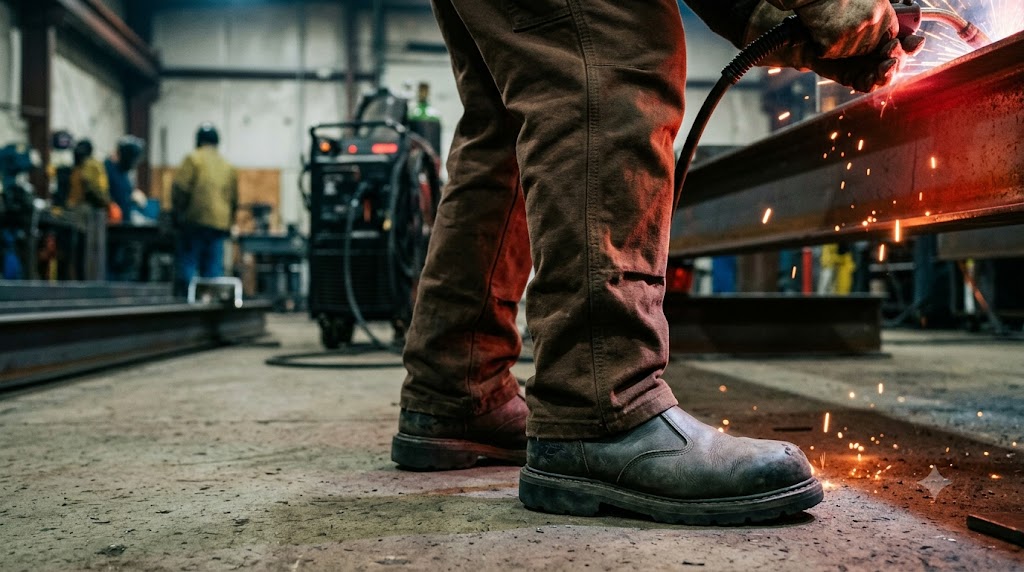
There is a gap nobody talks about enough. It sits right above your boot collar and below your pant cuff, and on any active welding day it becomes a funnel for every spark that gravity pulls downward. Ask any welder who has had a stray slag ball find that two-inch opening at the ankle - they remember exactly how it felt. This guide is about choosing welding boots and FR pants together as a system, so that gap disappears and your lower body gets the layered protection it deserves.
Why the Lower Body Gets Overlooked
Helmets, gloves, and jackets dominate the PPE conversation because eyes and hands are obviously in the danger zone. But the legs and feet absorb an enormous amount of abuse: radiant heat from the puddle, spatter bouncing off the workpiece, scale falling from overhead work, and the chronic low-level heat that degrades synthetic fabrics over months of use.
Chronic exposure to radiant heat below waist level also adds up. Regular denim has almost no heat resistance. A spark that extinguishes harmlessly on FR canvas will smolder into standard jeans for several seconds before you notice. By then you may already have a contact burn on the skin beneath.
The lower-body solution is a combo approach: FR pants that hang low and unobstructed combined with boots that seal the ankle zone. When you buy them separately without thinking about the overlap, you often end up with a gap anyway.
What Makes a Welding Boot Worth Buying
Not every steel-toed work boot doubles as a welding boot. There are specific properties that matter.
Full-grain leather upper. Leather chars rather than melts. Split leather works at moderate exposure, but full-grain provides more consistent protection as it ages. Suede and nubuck are acceptable for light shop work but lose surface integrity faster around spatter.
Heat-resistant outsole. Standard rubber outsoles soften and delaminate at temperatures you will encounter on a hot plate or near cutting operations. Look for boots rated to at least 248°F (120°C) outsole contact tolerance. Nitrile rubber and polyurethane compounds designed for welding hold up far better than standard work-boot rubber.
Steel or composite safety toe, ASTM F2413-rated. Composite toes eliminate any concern about heat conduction through a metal toe cap, which matters when you are standing close to an induction heat source. Steel toes offer more impact resistance but can become uncomfortable in high-heat environments over a full shift.
No external lace hardware below mid-boot height. Metal D-rings and eyelets become tiny heat sinks. Boots with recessed or internally stitched lacing channels near the toe box stay cooler and collect fewer sparks.
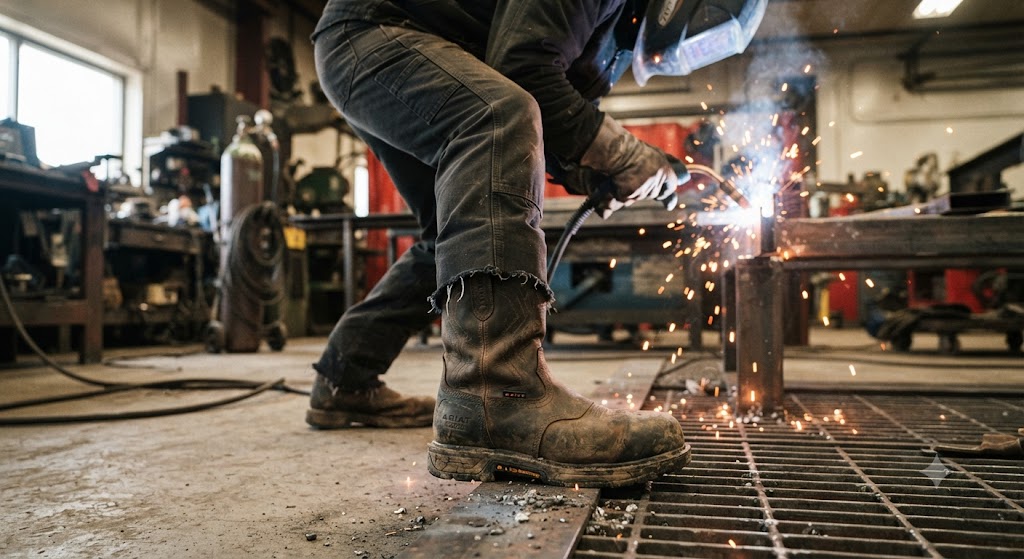
High collar, 6 to 8 inches. This is the dimension that directly determines overlap with your pants. A 6-inch boot on a welder with a standard 30-inch inseam pant works if the pant sits naturally over the boot collar. An 8-inch boot provides a larger margin when you crouch or bend and the pant leg rides up.
What Makes Welding Pants Actually Protective
Flame-resistant fabric, not just denim. Standard blue jeans comply with almost no welding PPE standard. Flame-resistant cotton (FR cotton) and FR denim are the baseline. True FR cotton such as Westex Ultrasoft or Indura ignites reluctantly and self-extinguishes when the ignition source is removed. Leather chaps or full leather pants provide the highest protection for structural and heavy-fabrication work.
No cuffs. Ever. This cannot be stated strongly enough. Cuffed pants create a perfect collection point for sparks and molten slag. A single slag ball in a cuff can smolder unnoticed against your ankle for long enough to cause a serious burn. FR pants for welding should have a clean hem that falls over the boot rather than a rolled cuff.
Proper inseam length. The pant hem should reach the vamp of the boot, not the top of the collar. If your pants are hemmed at ankle height and your boot collar extends 7 inches up from the insole, you still have a gap. When fitting FR pants for welding, size the inseam so the hem falls an inch or two lower than you would wear street clothes - enough to drape over the boot opening when you are standing straight and to maintain some coverage when you crouch.
Weight and weave. Lighter FR fabrics (5 to 7 oz per square yard) are comfortable for MIG and light fabrication but offer marginal heat mass. Heavier weights (9 oz and above) provide better radiant heat insulation. FR denim in the 10 to 12 oz range handles most shop-welding environments without becoming oppressively hot.
Building the Combo: Overlap Is Everything
The single functional goal of wearing boots and pants together is to eliminate exposed skin and non-FR material at the ankle zone. Here is how to test whether your combo achieves it.
Stand up straight in your welding posture with your boots fully laced. Look down at the ankle: the pant hem should sit on or over the boot collar, not above it. Now crouch into a low welding position as if you are running a horizontal bead at knee height. Watch the pant hem. If it pulls up and exposes the boot collar or your sock, your pants are too short or the boot collar is too low for the combination.
A boot with an 8-inch collar and FR pants with a long inseam hem - falling at or slightly over the boot collar - will maintain coverage in nearly every welding position. This is the combination worth aiming for.
Common Mistakes When Buying Separately
Buying the right boots and the wrong pants. Heavy leather welding boots with 8-inch collars paired with FR pants hemmed at the ankle creates a false sense of security. The boot looks correct. The pants look correct. But together they expose the ankle zone in every crouched position.
Trusting non-FR canvas pants because they look similar. FR canvas and standard canvas are visually identical in most cases. The difference is a chemical or inherent treatment that changes how the fiber burns. Always verify the fabric is FR-rated to NFPA 2112 or equivalent before treating any pants as welding PPE.
Ignoring heat buildup. Full leather pants protect beautifully but run very hot in summer shop work. Many welders compromise to FR cotton for everyday MIG and reserve leather for overhead stick or structural work. Matching protection level to actual exposure is smart - the goal is compliance you will actually wear consistently, not maximum protection that gets abandoned by noon.
Leather Chaps as an Upgrade Layer
If you already own FR pants that are a bit short or you frequently do high-heat work, leather chaps worn over FR pants are a legitimate combo strategy. The chaps add radiant heat shielding and spatter resistance. The FR pants underneath handle any residual heat that penetrates chap seams or the inner leg area the chaps do not cover. This layered approach is common in pipe welding and structural work.
Leather welding chaps with adjustable waist straps and full inner-leg coverage can be found on Amazon and from welding supply houses. Search for chaps with at least 16-inch thigh panels and full coverage from waist to boot top.
Maintenance and Replacement
FR pants lose effectiveness when washed repeatedly with non-FR laundry products, or when torn and repaired with non-FR patches. Wash FR clothing in hot water with free-and-clear detergent, avoid fabric softeners (they coat fibers and reduce ignition resistance), and inspect for burn holes after each heavy use day.
Boots need the same attention. Check the outsole for delamination around the toe and heel. Check the upper for burn-through spots where repeated spatter has weakened the leather. A boot with a compromised upper from spatter burn-through is no longer a welding boot.
The Straightforward Truth
Boots and pants are the least glamorous part of a welding PPE kit, but the ankle gap is one of the most consistent burn injury points in shop welding. It is not dramatic - it is usually a small contact burn from a slag ball rather than a flash event - but it is entirely preventable. Buy boots with enough collar height to overlap your pants. Buy pants long enough to cover that collar in every working position. Eliminate the gap, and a significant source of chronic minor injury goes away.
Frequently Asked Questions
What height boot collar is best for welding? Six to eight inches is the standard range. Eight inches provides enough overlap with FR pants to maintain coverage when you crouch or kneel in most welding positions.
Can I use regular jeans for welding if I wear a leather apron? A leather apron protects the front of the legs but not the back or sides. For full lower-body protection in any welding posture, FR pants are the correct base layer.
Do welding pants need to be leather or is FR cotton enough? FR cotton is appropriate for most MIG, TIG, and light-to-moderate stick welding. Leather is recommended for overhead work, structural steel, or environments with heavy spatter. Match the material to the actual heat exposure.
What is the correct way to hem FR pants for welding? Have them hemmed with a straight stitch using a thread that matches or exceeds the FR rating of the fabric. Never fold a cuff. The hem should fall at a length that covers the boot collar in both standing and crouching positions.
Are composite toes better than steel toes for welding? Composite toes do not conduct heat, which reduces discomfort near hot surfaces. Steel toes provide higher impact resistance. For most welding environments, composite is the more comfortable choice without sacrificing meaningful protection.
What should I avoid when washing FR pants? Avoid fabric softeners, bleach, and starch sprays - all can coat or break down FR fiber treatments. Use hot water and a free-and-clear detergent. Tumble dry on medium heat.
How do I know if my boot is actually rated for welding versus just construction work? Look for ASTM F2413 rating (impact and compression resistance) plus a heat-resistant outsole rating. Welding-specific boots from brands like Thorogood, Ariat, and Red Wing will explicitly note outsole heat tolerance and full-grain leather uppers in the product description.
Keywords: welding boots and pants combo, FR pants for welding, welding boot collar height, lower body welding PPE, ankle gap welding protection