Welding Boots Losing Waterproofing: How to Restore It and Make It Last
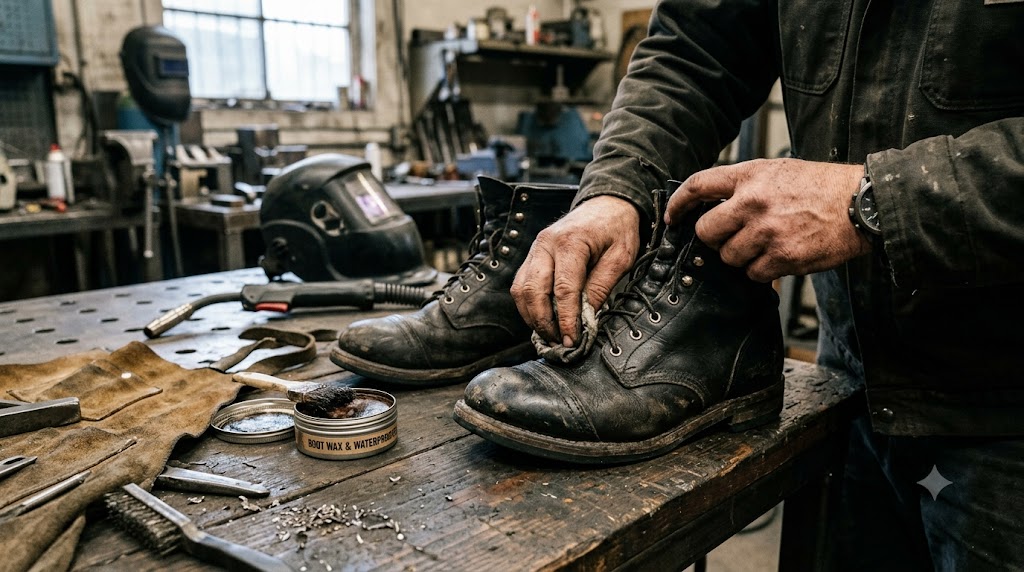
Welding boots earn their keep in wet, grimy environments, and the first sign that they are failing you is not the leather cracking, it is water soaking through instead of beading off. When welding boots lose waterproofing, the fix is not a new pair of boots. It is a thirty-minute maintenance job that restores the water barrier and extends the boot’s life by years. Here is exactly how to do it, what to use, and what to avoid.
Why Boots Lose Waterproofing
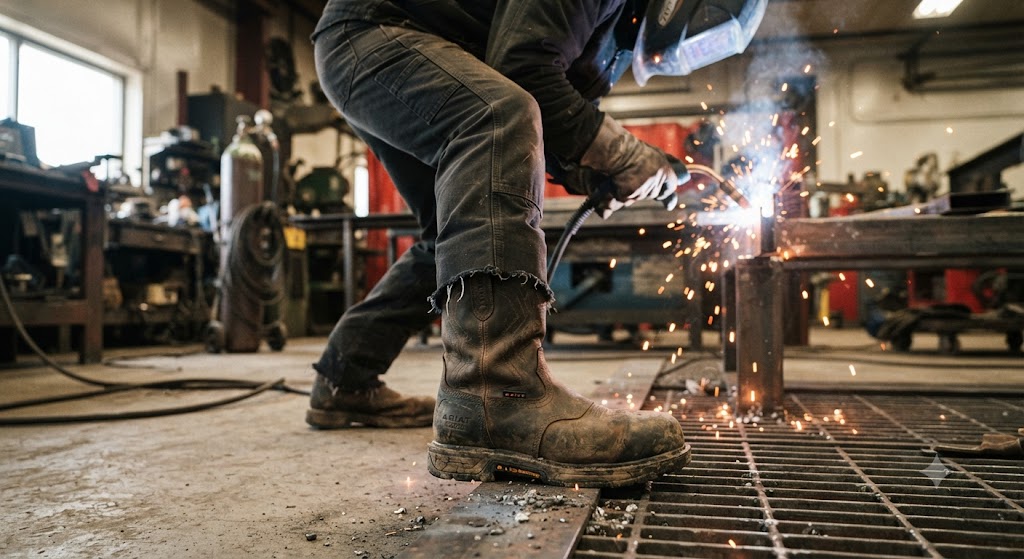
Leather work boots are waterproofed at the factory with wax, oil, or a membrane treatment, and all of those fade with use. Heat from the shop floor, UV from outdoor work, foot sweat from inside, and physical abrasion all degrade the waterproofing layer. This is not a defect. It is the cost of a leather boot doing real work, and it is reversible with the right treatment applied at the right time.
You can usually tell waterproofing has worn off when water stops beading on the surface and soaks straight in, the leather starts to look dry and dull, and you notice wet socks after a day in wet conditions.
Step 1: Clean the Boots First
No waterproofing treatment bonds well to a dirty surface. Brush off mud and debris with a stiff brush, wipe down the leather with a damp cloth, and allow the boots to dry completely. Applying a treatment to wet or dirty leather traps contaminants and reduces how well the wax or oil penetrates.[^https://nikwax.com/en-us/posts/how-to-waterproof-your-leather-boots/]
Remove the laces so you can work the treatment into the tongue and around the eyelets, which are common early-failure points.
Step 2: Choose the Right Treatment
The treatment depends on your boot’s leather type:
- Full-grain smooth leather boots: wax-based treatments such as Sno-Seal beeswax or Nikwax Waterproofing Wax for Leather work by filling the leather pores. They are immediately effective and condition the leather as they protect it.[^https://nikwax.com/en-us/posts/how-to-waterproof-your-leather-boots/][^https://www.rei.com/learn/expert-advice/boots-waterproofing.html]
- Roughout, suede, or nubuck leather boots: use treatments formulated for rough leathers (Nikwax Nubuck and Suede Proof or similar). Wax-based products can change the texture and appearance of these materials.
- Boots with a waterproof membrane (Gore-Tex): the membrane itself does not need treatment. Clean the outer fabric or leather normally, but do not apply wax or oil to the membrane portions.[^https://www.rei.com/learn/expert-advice/boots-waterproofing.html]
Caution about wax if you plan to resole: wax residue left in the leather can impair the ability of a new adhesive to bond with a new sole. If resoling is part of your long-term plan, check the resoler’s recommendation before committing to wax treatments.[^https://www.rei.com/learn/expert-advice/boots-waterproofing.html]
Step 3: Apply and Work It In
For wax treatments, warm the boots slightly first, either by placing them near a heat source briefly or working in a warm room. Warm leather is more receptive and allows the wax to penetrate deeper. Apply the wax with a cloth or soft brush, working it into seams and the welt line (the joint between the sole and the upper), which is often the first place water enters.[^https://nikwax.com/en-us/posts/how-to-waterproof-your-leather-boots/] For thorough re-waterproofing, apply two coats and allow each to absorb for at least an hour before wiping off the excess.
For liquid treatments, apply to clean dry or slightly damp leather depending on the product instructions, work it in with the sponge applicator or a cloth, and allow to air dry.
Step 4: Seal the Seams
Boot seams are stitched, which creates needle-holes that water finds. After the main treatment, run a small bead of seam sealer (Seam Grip or shoe-goo applied with a toothpick) along the welt and any visible seam lines. This extra step makes a large difference in how long the boots stay dry in genuinely wet conditions.[^https://www.instructables.com/Boot-Waterproofing/]
How Often to Retreat
Repeat the treatment whenever water stops beading on the leather, roughly every few months of heavy use or seasonally for lighter use. For shop welders whose boots see mostly dry conditions, once a year is usually enough. For field welders or pipeline work in wet and muddy conditions, two to three times a year.
Who should skip wax treatment: owners of boots with synthetic uppers or rubber compound materials, where wax does not bond and a spray-on waterproofing product is the correct choice.
The Bottom Line
Welding boots losing waterproofing is maintenance, not a failure. Clean them thoroughly, pick the right treatment for your leather type, work it into the seams and welt, and add a seam sealer for wet conditions. Do it on schedule rather than after the first wet sock, and boots that should last years stop letting water in halfway through their useful life. A clean thirty-minute re-waterproofing session costs almost nothing and adds a full season to a good pair of boots.
Frequently Asked Questions
Why are my welding boots no longer waterproof? The factory waterproofing wears off with heat, UV exposure, sweat, and abrasion. It is normal and reversible with the right treatment.
What is the best waterproofing treatment for leather work boots? For full-grain smooth leather, wax-based treatments like Sno-Seal beeswax or Nikwax Waterproofing Wax for Leather work well. For roughout or nubuck leather, use a treatment formulated for that surface.
Do I need to clean my boots before waterproofing? Yes. Treatment does not bond to a dirty surface. Clean and fully dry the boots first for the best penetration.
How do I waterproof boot seams? Apply a seam sealer such as Seam Grip or shoe-goo with a toothpick along the welt and visible seam lines after the main waterproofing treatment.
My boots have Gore-Tex. Do I still need to waterproof them? The Gore-Tex membrane does not need treatment. Clean the outer upper normally. Applying wax or oil to the membrane area is unnecessary and can clog the breathable membrane.
Should I avoid wax if I want to resole my boots? Check with your resoler first. Wax residue can impair the bond of new sole adhesive. Some resolers recommend avoiding wax if resoling is planned.
How often should I re-waterproof my welding boots? Whenever water stops beading on the leather, roughly every few months for heavy field use or once a year for shop welders in mostly dry conditions.
References
- How to Waterproof Your Leather Boots (Nikwax, step-by-step application): https://nikwax.com/en-us/posts/how-to-waterproof-your-leather-boots/
- How to Waterproof Boots for Hiking (REI Expert Advice, leather types and wax-vs-membrane): https://www.rei.com/learn/expert-advice/boots-waterproofing.html
- Boot Waterproofing (Instructables, seam sealing technique): https://www.instructables.com/Boot-Waterproofing/