Welding Gloves Buying Guide
A good pair of welding gloves is the difference between a full shift at the bench and a night spent nursing a blister the size of a nickel. If you have ever felt a bead of spatter find the gap between your cuff and your sleeve, you already know why welders get particular about this one piece of gear. The right welding gloves protect your hands from heat, sparks, and molten metal while still letting you feel the work, and the wrong pair either cooks your fingers or turns them into clumsy sausages.
What welding gloves actually are
Welding gloves are leather hand protection built to shield you from radiant heat, direct flame, sparks, and hot slag while you weld. They are almost always made from animal leather because leather chars instead of melting, and the natural grain resists sparks far better than any synthetic knit. The four common leathers are cowhide, goatskin, pigskin, and elkskin, and each one trades heat protection for dexterity in its own way.
Most welding gloves share a few parts: a palm, a back, a gauntlet cuff that covers the wrist and lower forearm, and stitching that holds it all together. That stitching matters more than beginners expect. Cheap gloves sewn with cotton or nylon thread come apart at the seams the first time a spark lands on the stitch line, which is why serious brands sew with Kevlar thread that resists both heat and abrasion.
Which welding gloves should you buy
Match the glove to the process, not the other way around. For MIG and stick welding, where amperage runs high and spatter flies, you want a thick, insulated cowhide or elkskin glove with a long cuff. The Tillman 1350 top grain cowhide MIG glove is the classic default here, rated for ANSI Level 4 abrasion and puncture resistance and thick enough to shrug off sustained heat. The Black Stallion GM1611 cowhide MIG glove is its main rival, with reinforced palm padding and a DragPatch on the pinky that outlasts a plain seam.
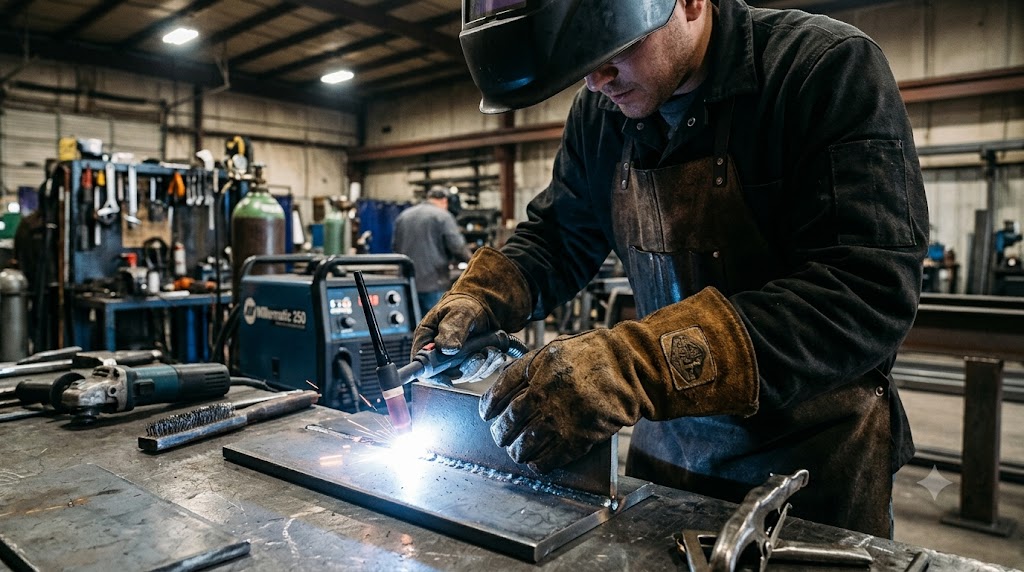
For TIG, throw the thick gloves out. TIG welders feed filler by hand and ride a foot pedal, so you need a thin goatskin glove that lets you feel the rod. For all around general purpose work, a heavy MIG/stick glove like the Miller 263340 Arc Armor heavy duty glove with a pigskin palm handles almost everything a hobbyist throws at it. If you want a single do-everything pair and mostly run a wire feeder, start there and add a dedicated TIG glove later.
Budget shoppers should not panic. Even the entry level Lincoln Electric K2979-ALL MIG/stick glove uses split cowhide and Kevlar stitching, and it costs about the same as lunch. It runs one size fits most, though, so it is a poor pick if your hands are small.
Leather types compared
Here is the short version of a debate welders have been having for decades.
| Leather | Best for | Trade-off |
| Cowhide | MIG, stick, general work | Stiffer, less feel |
| Goatskin | TIG, fine work | Thin, less heat protection |
| Pigskin | Wet or oily conditions | Coarse texture |
| Elkskin | Stick, high heat | Premium price, bulky |
Cowhide is the workhorse: durable, cheap, and heat resistant, but it stiffens up when it gets wet and dries hard. Goatskin has natural lanolin that keeps it soft and gives it the best dexterity, which is why nearly every TIG glove is goatskin. Pigskin breathes well and stays flexible after getting wet, so it suits sweaty summer work. Elkskin resists heat shrinkage better than anything, so premium stick gloves lean on it.
How to size and care for them
Measure around your palm just above the thumb to get your circumference in inches, then check the brand chart, because a Tillman large is not always a Miller large. A glove that is too big steals your dexterity and a glove that is too tight tears at the seams. Keep leather gloves dry, let them air dry if they get wet, and never machine wash them, since heat and detergent strip the oils and leave the leather stiff and cracked.
Frequently asked questions
What do welders recommend for gloves? Most welders keep two pairs: a thin goatskin glove for TIG and a thick cowhide or elkskin glove for MIG and stick. Tillman, Black Stallion, and Caiman are the names that come up most in shops.
Who makes the best welding gloves? There is no single winner, but Tillman and Black Stallion dominate professional use for their Kevlar stitching and consistent sizing. Caiman leads for premium deerskin comfort, and Miller and Lincoln make solid brand-name options.
What are the best gloves for TIG welding? Thin goatskin gloves like the Tillman 1328 or 1338. TIG is a low heat process, so you trade thickness for the finger feel you need to feed filler rod.
Are cheap welding gloves safe? Many budget gloves are genuinely fine for light MIG and stick work if they use real leather and Kevlar stitching. The risk with the cheapest gloves is thin leather and cotton thread that fails at the seams.
How long should welding gloves last? A daily-use MIG or stick glove typically lasts a few months of heavy shop use. TIG gloves wear faster because the thin leather takes more abuse for less protection.
Do I need a different glove for MIG and stick? Not strictly. A heavy MIG/stick glove covers both, since stick and MIG both produce high heat and spatter. Only TIG demands its own thin glove.
References
- John Tillman & Co. product specifications, jtillman.com
- Black Stallion (Revco Industries) product data, blackstallion.com
- OSHA hand protection guidance, osha.gov