Welding Gloves for Blacksmithing Guide
Blacksmithing and welding both live around fire and hot metal, so it is natural to assume the gloves are interchangeable. I made that assumption early on, and it took exactly one session at a forge to understand where welding gloves succeed and where blacksmithing puts demands on a glove that welding never does. If you are moving into forge work and wondering whether your welding gloves are enough, this guide covers the real differences.
Are Standard Welding Gloves Hot Enough for Blacksmithing?
The honest answer is: for many blacksmithing tasks, yes, but with important caveats about which glove and which hand.
Welding gloves and blacksmithing gloves both protect against high heat, but the heat profile is different. Welding exposes the glove to intense radiant heat and sparks for relatively brief, intermittent periods. Blacksmithing involves handling hot stock, tongs that conduct heat, and sustained proximity to a forge that radiates continuous heat. The difference is duration and conductive contact.
A quality leather welding glove, particularly a heavier MIG or stick welding glove made from thick cowhide, handles a great deal of forge work adequately. The thick leather resists the radiant heat of the forge and protects against incidental contact with warm stock and tools. Lighter TIG gloves, made from thin goatskin for dexterity, are not suitable for blacksmithing. They lack the thermal mass to protect against forge heat.
The One-Glove Tradition in Blacksmithing
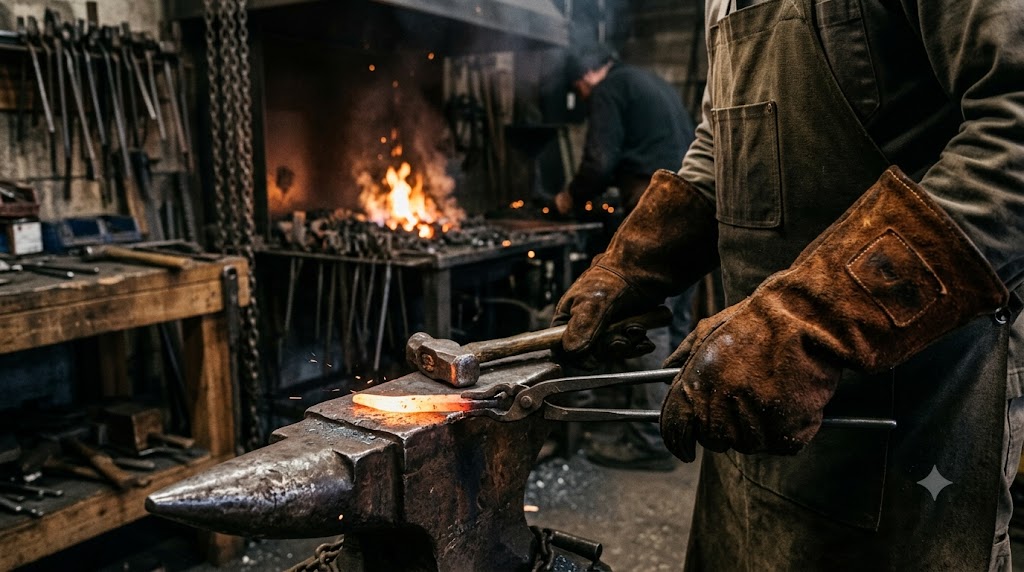
Something many newcomers do not know: a lot of experienced blacksmiths wear a glove on only one hand, or no gloves at all for certain work. The tong hand, the hand holding the metal via tongs, is often gloved for protection against conducted heat and accidental contact. The hammer hand is frequently left bare, because a glove reduces grip feel and control on the hammer, and a sweaty glove can actually make a hammer more likely to slip.
This matters for your buying decision. You may not need two heavy gloves. You may want one heavy protective glove for the tong hand and either a lighter glove or no glove for the hammer hand, based on your comfort and the specific work.
What Cuff Length Is Recommended for Forge Work?
An extended cuff is more important in blacksmithing than in most welding. When you reach toward a forge or handle long stock coming out of the fire, the forearm is exposed to significant radiant heat. A long gauntlet cuff protecting the forearm is genuinely valuable. Look for gloves with cuffs extending well up the forearm, similar to or longer than a standard stick welding glove gauntlet.
Do Blacksmiths Prefer a Different Leather Than Welders?
Blacksmiths and welders both favor cowhide for heavy heat protection, so there is real overlap. The distinction is in weight and treatment. Blacksmithing rewards heavier, thicker leather for the tong hand because of the sustained and conductive heat exposure. Some blacksmiths prefer elk or heavy cowhide for its combination of heat resistance and durability against the abrasion of handling rough stock and tools.
One consideration specific to forge work: a glove should be easy to shed quickly. If a hot scale or ember gets inside a glove, or if the glove itself gets too hot, you need to be able to fling it off your hand instantly. Blacksmiths often favor gloves that are snug enough to work in but loose enough at the cuff to remove in a fraction of a second. A glove that is difficult to remove is a hazard in a forge environment.
Recommendations for Forge Work
- Heavy cowhide leather for the tong hand, with substantial thickness for conductive heat protection.
- Extended gauntlet cuff to protect the forearm from forge radiant heat.
- Easy to remove in case a hot ember gets inside; avoid gloves that are difficult to shed quickly.
- Reserve lightweight TIG gloves for welding only; they are not suitable for forge heat.
A heavier stick or MIG welding glove is a reasonable and economical choice for blacksmithing tong-hand protection. Many blacksmiths use exactly this.
Browse heavy leather welding gloves on Amazon
The Bottom Line
Heavy leather welding gloves work well for blacksmithing, especially for the tong hand, where thick cowhide and a long cuff protect against forge radiant heat and conducted heat through tongs. Skip the lightweight TIG gloves for forge work. Consider the traditional one-glove approach, gloving the tong hand while keeping the hammer hand bare for control, and always choose a glove you can shed instantly if an ember gets inside.
Frequently Asked Questions
Are standard welding gloves hot enough for blacksmithing? Heavy cowhide MIG or stick welding gloves handle most forge work well, particularly for the tong hand. Lightweight TIG goatskin gloves are not suitable, as they lack the thermal mass for sustained forge heat.
What cuff length is recommended for forge work? An extended gauntlet cuff that protects well up the forearm is important, because reaching toward a forge exposes the forearm to significant radiant heat. Longer is better for blacksmithing.
Do blacksmiths prefer a different leather than welders? There is significant overlap; both favor cowhide. Blacksmiths tend to prefer heavier, thicker leather for the tong hand due to sustained and conductive heat, and some prefer elk or heavy cowhide for durability.
Why do some blacksmiths wear only one glove? The tong hand is gloved for heat protection, while the hammer hand is often left bare for better grip feel and hammer control. A glove can reduce control and, when sweaty, make a hammer more likely to slip.
Is it safe to reuse welding gloves for forge work? Yes, provided they are heavy leather in good condition. Ensure they are easy to remove quickly in case an ember gets inside, which is a real hazard in forge environments.
References
https://www.osha.gov https://www.tillman.com https://www.abana.org
SEO Title: Welding Gloves for Blacksmithing Guide