welding gloves size chart
You pull on a “large” welding glove, flex your hand around a MIG gun, and something feels off. The fingers are a half inch too long, the cuff swims on your forearm, and your trigger control turns mushy. A good welding gloves size chart is the difference between a glove that becomes an extension of your hand and one that fights you on every bead. The frustrating part is that sizing is not standard across the industry, so a large from one maker can fit like a medium from another. This guide shows you how to measure your hand correctly, how to read a chart without guessing, and how fit ties directly into both safety and dexterity at the arc.
What a welding gloves size chart actually tells you
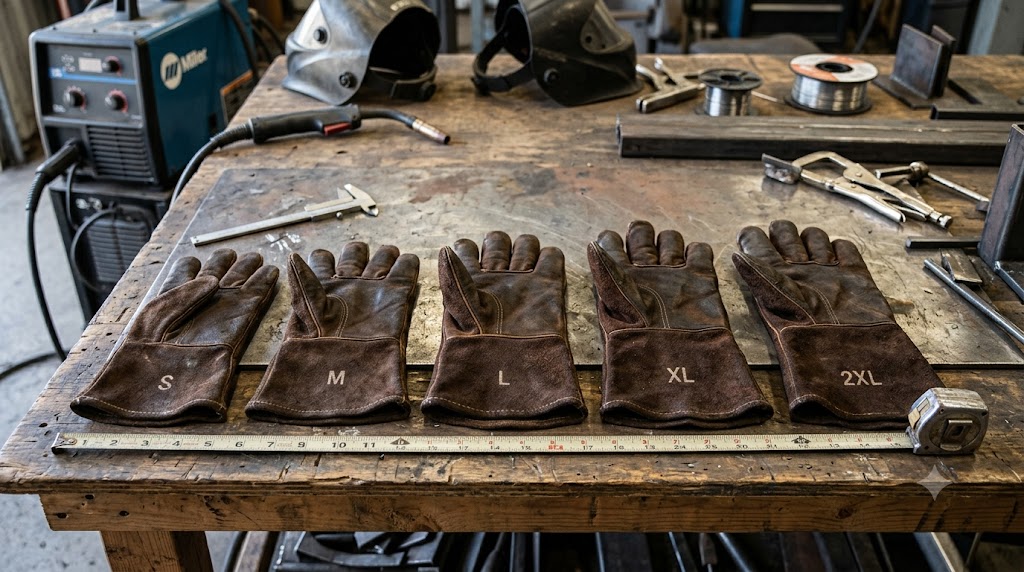
A welding gloves size chart maps two physical measurements, hand circumference and hand length, to a letter size (usually small through 2XL). Circumference is measured around the widest part of your palm, just below the knuckles, with your thumb relaxed out of the way. Length is measured from the tip of your middle finger down to the base of your palm where it meets your wrist. Most manufacturers list a range for each size, so a hand that measures 9 inches around and 7.5 inches long might land in medium on one chart and large on another.
The chart also hints at cut and pattern. A “gunn cut” glove seats the seams away from your gripping surface, while a “clute cut” runs a single piece across the palm. Two gloves can share the same numeric range yet feel different because of leather thickness, lining, and how the fingers are curved. Treat the chart as a starting point, not a promise, and always confirm against the maker of the specific glove you want.
How to measure your hand for welding gloves
Grab a soft tailor’s tape or a length of string and a ruler. Measure your dominant hand, since it is usually slightly larger, and round up if you land between two numbers.
- Circumference: Wrap the tape around your palm at the knuckles, excluding the thumb. Keep the tape snug but not tight. Record the number in inches.
- Length: Lay your hand flat and measure from the crease at your wrist to the tip of your middle finger.
- Compare: Match both numbers to the specific brand chart. If circumference says large but length says medium, prioritize the measurement tied to your grip comfort, which for most welders is circumference.
Welders who wear glove liners for cold shops or extra sweat control should measure over the liner, or simply size up one step.
Direct recommendation: start with your grip, then confirm the brand chart
If you want a fast answer, buy the glove whose chart is published by the actual manufacturer and whose sizing reputation is consistent. Below, the Tillman 1350 is my pick when a brand’s chart runs true, and the Black Stallion GM1611 is the example I use to prove that you cannot copy your size from one brand to the next. Read both, measure once, and order to the chart that belongs to the glove in your cart.
Tillman 1350 top grain cowhide MIG glove
The Tillman 1350 top grain cowhide MIG glove is my reference point for sizing that behaves. When you measure your hand and follow Tillman’s own chart, the glove lands where you expect it to, which is rarer than it should be. The top grain cowhide gives you a smooth, consistent surface, the seams sit off the palm, and the fit through the fingers stays honest across the size run. For general MIG work where you want predictable length and a cuff that actually matches the stated size, this is the one I reach for first.
Named flaw: The top grain leather runs stiff out of the box and needs a real break-in period before the fingers move freely, so early dexterity suffers.
Who should skip it: TIG welders who need fingertip sensitivity from day one, and anyone who hates breaking in leather, should look at a thinner glove instead.
Black Stallion GM1611 cowhide MIG glove
The Black Stallion GM1611 cowhide MIG glove is here to make one point loud and clear: brand charts differ. Order this in the same letter size you wear in a Tillman and you may find the length or the cuff opening does not match your expectation. That is not a defect, it is a different pattern built to a different chart. When you measure your hand and follow Black Stallion’s own numbers, it fits well, with a comfortable palm and a cuff that flares nicely for quick on and off. The lesson is simple. Never assume your Tillman large equals a Black Stallion large.
Named flaw: The sizing runs to its own pattern, so a straight letter for letter swap from another brand often misses, forcing a return if you skipped the chart.
Who should skip it: Buyers who refuse to re-measure and just want to reorder the same letter they already own should not pick this without checking the chart first.
Why a Tillman large is not a Miller large
Here is the trap that costs welders time and shipping labels. There is no single enforced dimensional standard that forces every “large” to share the same inches. General hand protection standards such as EN 388 and the ANSI/ISEA 105 classification system rate performance properties like abrasion and cut resistance, not a universal size grid. That means each manufacturer builds its own last and its own chart. Tillman, Miller, Black Stallion, and Lincoln can all print “large” on a tag and deliver three different internal volumes. The only reliable move is to measure your hand and match the chart that belongs to the exact glove you are buying.
How fit affects safety and dexterity
Fit is not a comfort luxury, it is a safety control. A glove that is too large leaves slack leather at the fingertips, which snags on fixtures, dulls your feel for the wire, and slows your reaction if you need to drop a hot part. A glove that is too small pulls the cuff up your wrist and exposes skin to spatter and radiant heat, and it fatigues your grip because you are fighting the leather all shift. The correct size lets the glove flex where your hand flexes, keeps the cuff overlapping your sleeve, and preserves the dexterity you need for consistent torch or gun control. OSHA’s general requirement for appropriate hand protection assumes the glove actually fits the worker, and a chart-matched fit is how you satisfy that in practice.
Reading a chart without getting burned
- Confirm the chart is published by the glove’s own manufacturer, not a generic reseller table.
- Check whether the chart measures in inches or centimeters and convert cleanly.
- Note whether the range is for circumference, length, or both, and match both.
- When you fall between sizes, size up for MIG and stick and size down for TIG.
- Re-measure every time you switch brands.
Brand sizing comparison at a glance
| Feature | Tillman 1350 | Black Stallion GM1611 |
| Leather | Top grain cowhide | Cowhide |
| Primary use | MIG | MIG |
| Sizing behavior | Runs true to Tillman's own chart | Runs to its own pattern, differs from other brands |
| Best for | Predictable fit across the size run | Welders who re-measure per brand |
| Named flaw | Stiff until broken in | Not a letter for letter swap from other brands |
| Skip it if | You need instant fingertip feel | You refuse to check the chart |
Getting your size right the first time
Fit comes down to two honest measurements and the discipline to match them against the correct chart every single time you change brands. Measure your circumference and length, size up for heavier MIG and stick work, size down for fine TIG control, and never carry a letter size from one maker to another as if it were universal. Do that, and the glove disappears into the work, which is exactly what you want when the arc is lit.
FAQ
How do I measure my hand for welding gloves? Wrap a tape around your palm at the knuckles for circumference, then measure from your wrist crease to the tip of your middle finger for length. Match both numbers to the brand’s chart.
Why does a large in one brand fit differently than a large in another? Because there is no enforced universal size grid. Standards like EN 388 and ANSI/ISEA 105 rate protection performance, not fit dimensions, so each maker builds its own chart.
Should I size up or size down for welding gloves? Size up for MIG and stick work where you may wear liners and want extra room, and size down for TIG where fingertip sensitivity matters most.
What happens if my welding gloves are too big? Excess leather at the fingertips snags on fixtures, reduces your feel for the gun or torch, and slows your reaction if you need to release a hot part.
What happens if my welding gloves are too small? The cuff rides up and exposes your wrist to spatter and heat, and your grip fatigues faster because you fight the leather all shift.
Do I need to re-measure when I switch glove brands? Yes. Sizing is brand specific, so re-measure and check the new brand’s chart rather than reordering the same letter size.
Can I use one size chart for every welding process? No. The same hand may fit differently depending on whether the glove is cut for MIG, stick, or TIG, so confirm the chart for that specific glove.
References
- Tillman (John Tillman Co.), manufacturer product and sizing information
- Black Stallion (Revco Industries), manufacturer product and sizing information
- Occupational Safety and Health Administration (OSHA), hand protection requirements, 29 CFR 1910.138
- American Welding Society (AWS), guidance on personal protective equipment for welding
- ANSI/ISEA 105, American National Standard for hand protection classification