Welding Half Chaps Guide: When They Work and When They Don't
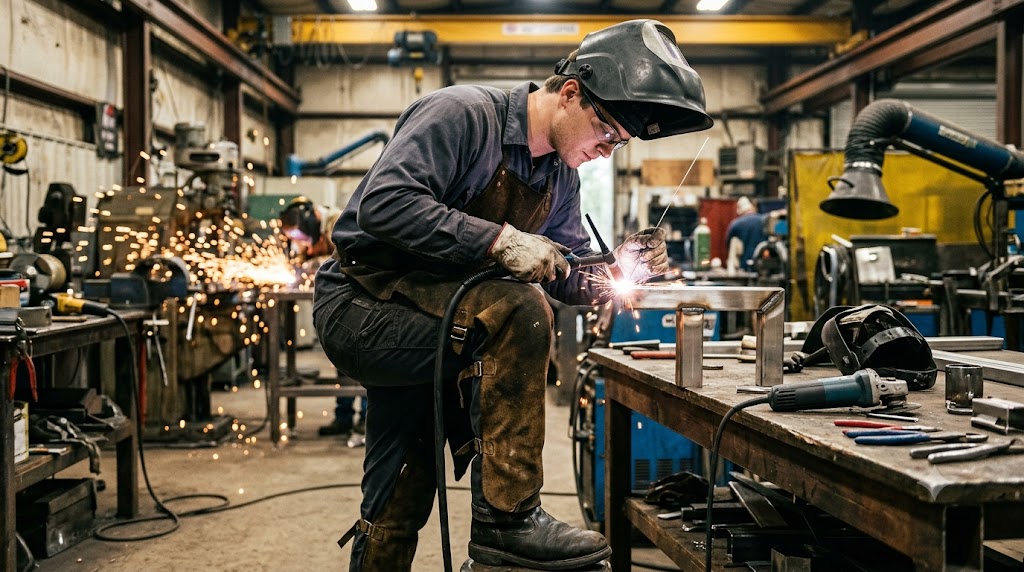
You are running a MIG bead on a flat table, sparks going mostly forward and down, and you think: do I really need to strap on a full set of leg chaps for this? Sometimes the honest answer is no. Half chaps, which cover from the knee to the ankle, exist for exactly that scenario. They are lighter, faster to put on, and more than sufficient for specific welding tasks. The problem is that people use them in situations they are not designed for, and that is where things go wrong.
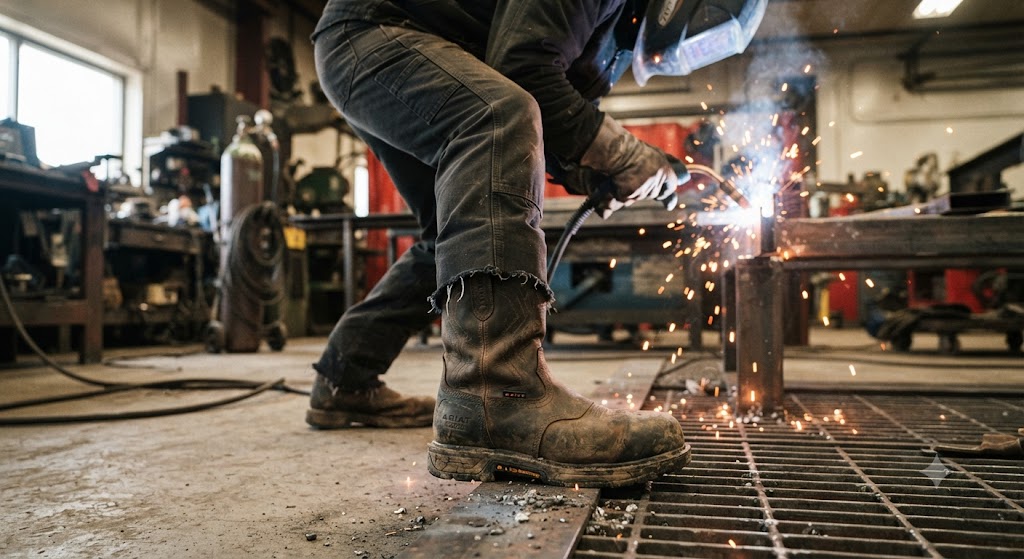
Welding half chaps are shortened leather leg coverings designed to protect the lower leg, specifically from the knee to approximately the ankle, during welding operations. They use the same split cowhide leather and Kevlar-stitched construction as full-length chaps, but cover only the lower leg rather than the full length from waist to ankle. They are sometimes called short welding chaps, lower leg chaps, or shin guards.
The direct answer: half chaps are a legitimate tool for bench MIG and TIG work, tacking, and light fabrication where spatter falls primarily forward and down, and you are working in a fixed position. They are not adequate for overhead welding, stick welding, or any task where spatter reaches the upper leg or approaches from the side.
What Half Chaps Are Built For
The lower leg is the most common spatter target in bench welding. When you are running a bead on a flat or horizontal joint at waist height, the spatter cone mostly forward and downward. The upper leg, from the knee to the hip, is often outside the main hazard zone if you are properly positioned relative to the work. Half chaps close that gap between boot and work pants without the weight or the on-time of full leg chaps.
For TIG welding specifically, where spatter is minimal and the arc runs relatively clean, half chaps provide more than enough protection against the occasional hot tungsten chip or accidental contact with the torch body. TIG welders who work at a bench all day often prefer half chaps precisely because they do not want the heat retention of a full leather leg wrap for a low-spatter process.
For light MIG tacking, where you are placing a series of short arc starts to position parts before full welding, half chaps keep your lower legs covered during the most hazard-concentrated moments without requiring you to suit up in full chaps for a ten-second task.
What Half Chaps Are Not Built For
Overhead welding. Full stop. When you weld overhead, spatter falls directly downward. It does not care where your knee is. Gravity sends every hot particle toward your legs, and if your upper leg is uncovered, half chaps solve nothing. For overhead welding, full-length chaps that cover from the waist to the ankle are required. Using half chaps for overhead work is not a compromise, it is a gap in protection that will find you eventually.
Heavy stick welding produces spatter volume and particle size that exceeds what half chaps are designed to handle. A heavy stick bead generates large, high-energy spatter that travels further and carries more thermal mass than MIG spatter. At those energy levels, you want full-length coverage and you want the upper leg included.
For any structural, pipe, or field welding where your body position varies, full-length chaps are the correct gear. If you are kneeling in a pipe trench, the top of your thigh is the area closest to the work and the most exposed. Half chaps do not reach it.
What Is on Amazon in This Category
Dedicated half-length welding chaps from established welding PPE brands like Tillman and Black Stallion are primarily sold through welding supply distributors rather than through Amazon’s main catalog. Amazon search results for “welding half chaps” return a mix of general-purpose split leather leg covers and apron-style short chaps from smaller brands.
One verified Amazon listing for a split leather welding chap with lower-leg coverage is the CHEOTIME welding safety chaps, which is an apron-style split leather leg cover made from top-grain split leather with adjustable straps. It is designed for workshop and welding use and covers the lower leg zone.
Named flaw: the CHEOTIME is a newer listing from a smaller brand without the welding-industry track record of Tillman or Black Stallion. The leather weight and construction quality have not been independently reviewed over multiple years of professional shop use. If you need a verified professional-grade half-chap option, purchasing from a welding supply distributor that stocks Tillman’s short leg protection offerings is a more reliable route.
For the most reliable half-chap equivalent on Amazon at this time, the Black Stallion 40WS full-length chap remains the better-documented product, and the Tillman 3840 supplies similar coverage. If your specific need is lower-leg-only protection, check with a local welding supply house for Tillman’s current short-format offerings or look at the Tillman 3114 leather bib, which is a 14-inch short bib designed for specific lower-coverage applications.
Half Chaps vs Full Chaps: A Direct Comparison
| Feature | Half Chaps | Full-Length Chaps |
|---|---|---|
| Coverage | Knee to ankle | Waist to ankle |
| Weight on body | Lower | Higher |
| On/off speed | Faster | Slower |
| Overhead welding | Not sufficient | Required |
| Stick welding | Not sufficient | Required |
| Bench MIG/TIG | Suitable | Suitable (heavier) |
| Upper leg protection | None | Full |
| Field/structural work | Not suitable | Required |
Honest Framing: When Half Chaps Are the Wrong Tool
The welding industry does not broadly promote half chaps as a first PPE choice, and for good reason. The hazard zones in welding are not always predictable. A weld that starts flat can require repositioning. A tack session can turn into a full pass. Upper-leg protection that you skipped because you thought you were running a clean bench session suddenly matters when your angle changes.
Full-length chaps from Black Stallion or Tillman add meaningful protection without a significant performance cost compared to half chaps. If you are equipping a shop from scratch, start with full-length chaps. If you are a TIG bench welder who has assessed your specific workflow and determined that lower-leg coverage is sufficient for your task, half chaps are a legitimate choice. The key word is “assessed.” The gear has to match the actual work, not the optimistic version of it.
Verdict
Half chaps have a real role in bench TIG, light tacking, and low-spatter-volume welding where you are working in a fixed forward position. They are not a shortcut to full protection and they are not appropriate for overhead, stick, or structural work. If you are buying your first set of leg protection for a general welding shop, buy full-length chaps. If you already own full chaps and want a lighter option for specific bench tasks, half chaps add convenience without removing your ability to make a safe choice for each session.
FAQ
What is the difference between full chaps and half chaps? Full-length welding chaps cover from the waist to the ankle, providing complete leg protection including the upper thigh. Half chaps cover from approximately the knee to the ankle. Half chaps are lighter and faster to put on; full chaps are required for overhead welding, stick, and any task where upper-leg exposure is a risk.
When should a welder choose half chaps over full leg protection? Half chaps are appropriate for bench MIG or TIG welding in a fixed front-facing position where spatter falls primarily forward and down, and the upper leg is outside the main hazard zone. They suit light tacking tasks and low-spatter-volume processes. They are not appropriate when work position varies, when overhead welding is involved, or when running high-spatter processes like stick or heavy MIG.
Are half chaps enough for overhead welding? No. Overhead welding creates a downward spatter pattern that lands on the upper leg and thigh, which half chaps do not cover. For overhead welding, full-length chaps from the waist to the ankle are required. Using half chaps for overhead work leaves the upper leg unprotected against falling spatter and hot metal.
What leather is used in welding half chaps? The same materials used in full-length chaps apply to half chaps: split cowhide is the standard, with Kevlar stitching at seams. The leather weight should be at least 2mm to provide meaningful spatter resistance. Thin or lightweight leather marketed as welding PPE without brand verification from established welding suppliers should be treated with caution.
Can welding half chaps be used for plasma cutting? For bench plasma cutting with a fixed torch position and forward spatter pattern, half chaps provide reasonable lower-leg coverage. For any plasma cutting work where the cut angle changes or overhead cuts are involved, full-length chaps are more appropriate for the same reasons that apply to welding.
Do half chaps work for MIG welding? For bench MIG in a fixed forward position, yes. Half chaps cover the lower leg adequately for that use case. For vertical, horizontal, or overhead MIG work, where spatter reaches the upper leg and approaches from multiple directions, full-length chaps are required.
What brands make welding-specific half chaps? Tillman and Black Stallion both make shorter-format leather leg protection products available through welding supply distributors. On Amazon, dedicated welding half chaps from these established brands are limited; the CHEOTIMEis one available option but has not been independently reviewed over extended professional use. For professional-grade half-chap options, a welding supply distributor is the more reliable source.
References
- https://www.osha.gov/laws-regs/regulations/standardnumber/1910/1910.252 (OSHA 29 CFR 1910.252, Welding General Requirements)
- https://www.osha.gov/etools/shipyard/shipbreaking/ppe/ppe-selection/hot-work (OSHA Hot Work PPE eTool)
- https://jtillman.com/products/clothing/leather-clothing/leather-pants-chaps/ (Tillman leather chaps and aprons product line)