What Causes Welding Distortion (Warping)? Explained
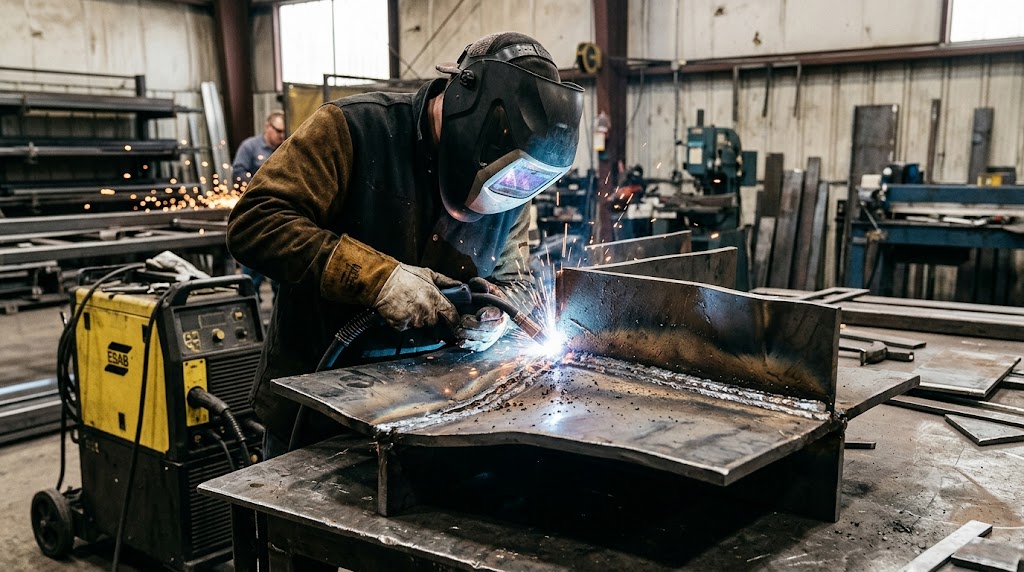
You weld up a perfectly square frame, step back to admire it, and watch it pull itself out of shape as it cools. Panels bow, corners tilt, holes stop lining up. That is welding distortion, and it is one of the most common headaches in fabrication. The metal is not defective and your welds may be fine; the shape changed because of heat. The good news is that distortion follows predictable rules, so once you understand it, you can control it. This explainer covers what causes welding distortion and how to prevent warping.
Welding distortion is a permanent change in the shape or dimensions of a part caused by the uneven heating and cooling of welding. The heated metal expands, then shrinks as it cools, and that shrinkage pulls the part out of shape. Here is why it happens and how to stop it.
What distortion looks like
Distortion shows up as several kinds of movement:
- Angular distortion, where a joint tilts or a fillet pulls closed.
- Bowing or bending, where a long piece curves along its length.
- Shrinkage, where the part gets shorter or narrower across the weld.
- Buckling, where thin sheet ripples or waves.
Different parts distort in different ways, but all of them trace back to the same root cause.
Direct answer: what causes distortion?
Distortion comes from uneven expansion and contraction. The main drivers are:
- Uneven heating, since only the weld area gets hot while the rest stays cool.
- Shrinkage on cooling, as the heated metal contracts and pulls the part.
- Residual stress, locked into the part by the surrounding cool metal resisting that movement.
- Too much heat input, which increases the expansion and shrinkage.
- Weak restraint or poor sequence, which lets the part move freely.
The core cause is simple: metal expands when heated and shrinks when cooled, and when that happens unevenly, the part changes shape.
Why distortion happens
The physics is straightforward once you picture it. When you weld, you heat a small area intensely while the rest of the part stays cool. That hot metal wants to expand, but the surrounding cool metal holds it in place, so the heated area gets squeezed. Then, as the weld and the area around it cool, the metal shrinks. The surrounding metal resists that shrinkage too, and the result is internal, or residual, stress locked into the part. If those stresses are strong enough to overcome the metal’s stiffness, they pull the part out of shape, and once you unclamp it, the movement shows. This is why the amount of distortion is tied to how much heat went in and how much the part was allowed to move: more heat means more expansion and shrinkage, and less restraint means more freedom to warp.
How to prevent welding distortion
You cannot eliminate the heating and cooling, but you can manage it, and several proven techniques keep distortion under control. Start by limiting heat input: do not over-weld (a weld larger than needed just adds heat and shrinkage), and use settings and techniques that put in only the heat the joint requires. Use tack welds to hold parts in position before welding, and use fixtures or clamps to restrain the work so it cannot move as it cools. Plan your welding sequence: back-step welding (welding short segments in the opposite direction of overall travel) and skip or staggered welding spread the heat out instead of dumping it all in one place, and balancing welds on opposite sides of a joint lets their shrinkage forces cancel out. Presetting parts slightly out of position so they pull into alignment as they cool is another classic trick. For thin sheet, keeping heat low and welds short helps prevent buckling. Combine less heat, good restraint, and a smart sequence, and warping drops dramatically.
Can you fix distortion after welding?
A fair question is what to do when a part has already warped, and there are options, though prevention is easier. Distortion can sometimes be corrected after the fact by mechanical means, such as pressing or straightening the part, or by controlled heating techniques like flame straightening, where carefully applied heat is used to shrink specific areas and pull the part back into shape. Thermal stress relief, heating the whole weldment to a set temperature and cooling it in a controlled way, can also relax residual stresses. These corrections take skill and can be time-consuming, and heat straightening in particular must be done carefully to avoid making things worse. That is why controlling distortion during welding, through heat control, restraint, and sequence, is almost always better than trying to straighten a warped part afterward.
The bottom line
Welding distortion is a permanent shape change caused by the uneven heating and cooling of welding: the heated metal expands, then shrinks as it cools, and because the surrounding cool metal resists that movement, residual stress builds up and pulls the part out of shape. It shows up as angular tilt, bowing, shrinkage, and buckling, and the amount depends on how much heat went in and how freely the part could move. You control it by limiting heat input, tacking and clamping the work, and using a smart sequence like back-step, skip, and balanced welding, plus presetting parts when it helps. Warped parts can sometimes be straightened with pressure or careful heating, but preventing distortion during welding is far easier than fixing it after.
FAQ
What causes welding distortion? Welding distortion is caused by uneven heating and cooling. Welding heats a small area intensely while the rest stays cool, so the hot metal expands and then shrinks as it cools. The surrounding cool metal resists this, locking in residual stress that pulls the part out of shape. More heat input and less restraint both increase distortion.
How do you prevent warping when welding? Limit heat input by not over-welding and using appropriate settings; tack weld and clamp parts in fixtures so they cannot move as they cool; and plan the sequence using back-step welding, skip welding, and balancing welds on opposite sides so shrinkage forces cancel. Presetting parts slightly out of position and keeping welds short on thin sheet also help control warping.
Why does thin metal warp more than thick metal? Thin metal has less stiffness to resist the shrinkage forces from welding, so the same residual stress pulls it out of shape more easily, often as buckling or rippling. Thin sheet also heats up quickly across a larger area. That is why thin material needs extra care: lower heat, shorter welds, good clamping, and a spread-out sequence to keep it flat.
Can welding distortion be fixed after the fact? Sometimes. A warped part can be corrected mechanically by pressing or straightening, or by controlled heating methods like flame straightening, which shrinks specific areas to pull the part back into shape. Thermal stress relief can also relax residual stresses. These fixes take skill and time, so controlling distortion during welding is usually easier than straightening a part afterward.
Does welding sequence really affect distortion? Yes, significantly. The order in which you weld changes how heat and shrinkage are distributed. Dumping all the heat into one continuous weld concentrates shrinkage, while techniques like back-step welding, skip welding, and alternating sides spread the heat out and let shrinkage forces balance. A good sequence can be the difference between a flat part and a badly warped one.
What is back-step welding? Back-step welding is a technique where the overall weld progresses in one direction, but each short segment is welded in the opposite direction. This spreads the heat along the joint rather than concentrating it, and it helps balance the shrinkage so the part distorts less. It is one of several sequencing methods used to control warping on longer joints.
References
- Lincoln Electric, weld distortion causes and control (manufacturer), lincolnelectric.com.
- TWI, distortion control and prevention by fabrication techniques (industry), twi-global.com.
- ESAB, key steps to minimize distortion in welding (manufacturer), esab.com.