What Is Arc Welding? Full Explainer
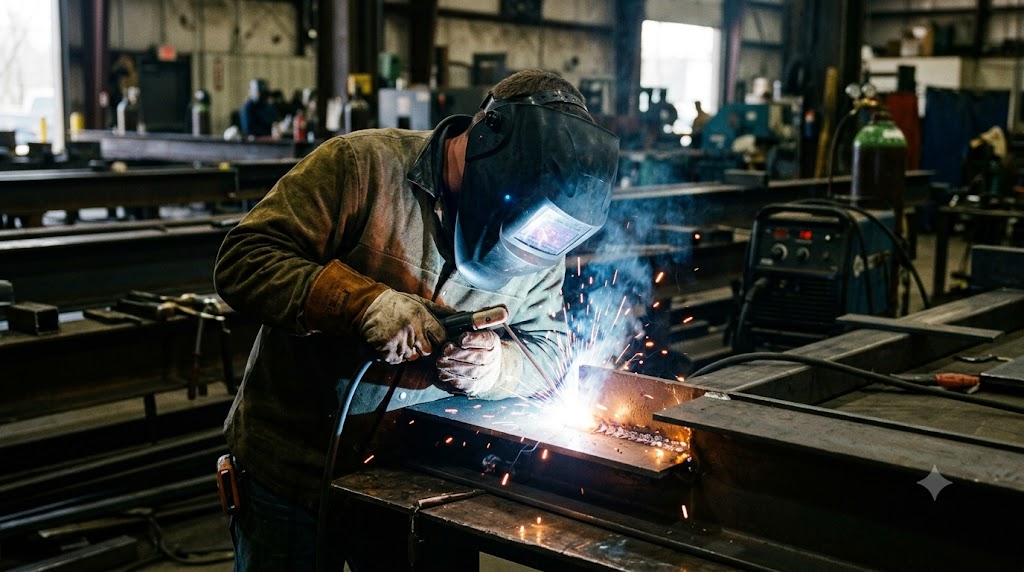
Most of the welding you have ever seen, the blue-white flash from a construction site, the sparks in an auto shop, the steady glow on a pipeline, is arc welding. It is the family that includes MIG, TIG, and stick, and it is the backbone of how the modern world gets built and repaired. Underneath all those variations sits one simple idea: use an electric arc as a heat source to melt and join metal. This explainer covers what arc welding is, how it works, and what it is used for.
Arc welding is a group of welding processes that use an electric arc to generate the heat needed to melt and fuse metal. The arc forms between an electrode and the base metal, powered by a welding power source. Here is the full picture.
The core idea
Every arc welding process shares the same basic ingredients:
- A power source that supplies welding current, AC or DC.
- An electrode that carries the current to form the arc.
- The base metal, the workpiece being joined.
- An electric arc between electrode and metal, the heat source.
- Some form of shielding to protect the molten metal from the air.
Get an arc going between an electrode and the work, and you have the heart of arc welding.
Direct answer: how arc welding works
Here is the basic sequence:
- The power source sends current to the electrode and the workpiece.
- You bring the electrode close to the base metal to start an arc.
- An arc forms, a sustained electrical discharge across the small gap.
- The arc’s intense heat melts the base metal and usually the electrode.
- The molten metal fuses, then cools into a solid joint.
- Shielding protects the pool from the air during all of this.
The arc is the star: it produces the concentrated heat that makes fusion possible.
What the electric arc actually is
At the center of it all is the electric arc, so it helps to understand what that is. When two points in an electrical circuit are close but not touching, and the voltage is high enough, current can leap across the gap as a sustained discharge. That discharge is the arc, and it is extremely hot, reaching thousands of degrees, hot enough to melt steel almost instantly. In arc welding, one point is the electrode and the other is the workpiece, connected through the power source and ground clamp. Bring them close and the current jumps, forming an arc whose heat melts the metal at the joint. The welder’s craft is controlling that arc: its length, its heat, and its travel, so the metal melts and fuses just right.
The role of shielding
Molten metal has a problem: it eagerly reacts with oxygen, nitrogen, and hydrogen in the air, and those reactions create weak, porous welds. So every arc welding process includes some way to shield the molten pool from the air. The method varies by process, and it is one of the main ways the processes differ. Some use an external shielding gas from a bottle, as MIG and TIG do. Others use a flux that burns to make its own shielding gas and slag, as stick and flux core do. Still others bury the arc under a blanket of granular flux, as submerged arc welding does. Whatever the method, the goal is the same: keep the air away from the molten metal until it solidifies, so the weld comes out sound and strong.
The arc welding family
Arc welding is an umbrella term, and under it sit the specific processes you have probably heard of. The most common include shielded metal arc welding (SMAW, or stick), gas metal arc welding (GMAW, or MIG), gas tungsten arc welding (GTAW, or TIG), flux-cored arc welding (FCAW, or flux core), and submerged arc welding (SAW). They all share the electric arc as the heat source, but they differ in the electrode, the shielding method, and how filler is added. That shared foundation is why learning one arc process makes the next easier: the arc physics are the same, and mainly the delivery of electrode and shielding changes. Arc welding is used across nearly every industry that works with metal, from construction, shipbuilding, pipelines, and automotive to manufacturing and repair, precisely because it is versatile, strong, and adaptable to so many jobs.
The bottom line
Arc welding is the family of processes that use an electric arc as the heat source to melt and fuse metal. A power source drives current through an electrode and the workpiece, an arc forms across the gap and reaches thousands of degrees, and that heat melts the metal into a joint while shielding keeps the reactive air away. The individual processes, stick, MIG, TIG, flux core, and submerged arc, all share this same arc foundation and differ mainly in their electrode and shielding method. That combination of intense, controllable heat and reliable, strong joints is why arc welding is used to build and repair almost everything metal around us.
FAQ
What is arc welding used for? Arc welding is used to join and repair metal across nearly every industry, including construction, shipbuilding, pipelines, automotive, manufacturing, and general repair. Because the electric arc provides intense, controllable heat and produces strong joints, arc welding is the main way structural steel, vehicles, pipe, and countless metal products are built and fixed.
What is the difference between arc welding and MIG welding? Arc welding is the whole family of processes that use an electric arc, and MIG welding is one member of that family. MIG, formally gas metal arc welding, is a specific arc process that feeds a continuous wire with shielding gas. So all MIG welding is arc welding, but arc welding also includes stick, TIG, flux core, and more.
What is an arc welder? An arc welder is the machine, a welding power source, that supplies the electrical current needed to create and sustain the arc. It connects to an electrode and to the workpiece and delivers AC or DC current so the arc can form and melt the metal. Different arc welders are set up for processes like stick, MIG, or TIG.
What is the electric arc in welding? The electric arc is a sustained electrical discharge that jumps the small gap between the electrode and the workpiece when the voltage is high enough. It reaches thousands of degrees, hot enough to melt steel, and that concentrated heat is what melts and fuses the metal. Controlling the arc is the core skill of arc welding.
Why does arc welding need shielding? Because molten metal reacts readily with oxygen, nitrogen, and hydrogen in the air, forming weak, porous welds. Shielding keeps that air away from the pool until it solidifies. Depending on the process, shielding comes from a bottled gas, a burning flux that makes its own gas and slag, or a blanket of granular flux over the arc.
What are the main types of arc welding? The main types are shielded metal arc welding (SMAW, stick), gas metal arc welding (GMAW, MIG), gas tungsten arc welding (GTAW, TIG), flux-cored arc welding (FCAW, flux core), and submerged arc welding (SAW). They all use an electric arc as the heat source but differ in the electrode used, the shielding method, and how filler metal is added.
References
- The Welding Institute (TWI) definition of arc welding and its process types (industry), twi-global.com.
- Miller Electric and Lincoln Electric arc welding resources (manufacturers), millerwelds.com, lincolnelectric.com.
- American Welding Society references on arc welding processes (industry), aws.org.