What Is Slag in Welding? Why It Forms and What It Does
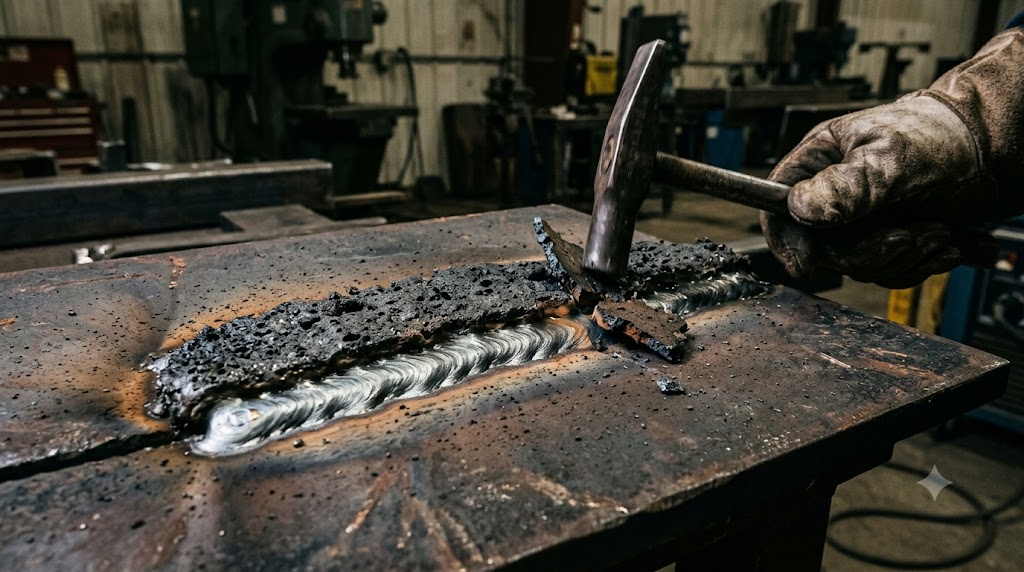
Finish a stick weld and you will see the bead hidden under a hard, glassy crust. Chip it off and the shiny weld appears underneath. That crust is slag, and new welders often mistake it for a mistake. It is not: slag is doing an important job. But leave it in the wrong place and it becomes a defect. This explainer covers what slag is, why it forms, what it does, how it differs from spatter, and why some processes make it while others do not.
Slag in welding is a hardened layer of nonmetallic material that forms on top of a weld, created from the flux used in certain processes. It protects the weld as it cools and must then be chipped off. Here is why it forms and what it does.
Where slag comes from
Slag is a byproduct of flux-based welding processes:
- It forms from melted flux, not from the metal itself.
- It appears with stick welding (SMAW), which uses a flux-coated electrode.
- It appears with flux-cored welding (FCAW), which uses flux-filled wire.
- It appears with submerged arc welding (SAW), which uses granular flux.
Any process that uses flux leaves slag; processes that shield with gas instead do not.
Direct answer: what slag does
Slag serves real purposes while the weld cools:
- It shields the weld from oxygen and contamination in the air.
- It slows cooling and helps the weld cool more evenly.
- It shapes the bead, helping hold the molten metal in place, useful out of position.
- It must be removed after welding so it does not become a defect or hide flaws.
So slag is helpful during and just after welding, then it needs to come off.
Why slag forms
Slag forms because of the flux used in certain welding processes. Flux is a material designed to protect the weld, and when the arc’s heat melts it, it does its work as a liquid and then hardens into slag as the weld cools. Here is the chemistry in plain terms: as the flux and metal melt, nonmetallic elements and impurities are pushed out of the molten weld pool and rise to the surface, where they combine and solidify into the slag layer. In doing so, the slag can carry impurities like oxides out of the weld with it. This is why slag sits on top of the bead as a distinct crust rather than mixing into the weld metal. It is essentially the spent flux plus the impurities it collected, hardened into a shell over the finished weld.
What slag does for the weld
Slag is not waste, it is protection. Its main job is to shield the molten and cooling weld from the atmosphere, keeping oxygen and nitrogen from reaching the hot metal and causing porosity or other problems, much as shielding gas does in gas-based processes. It also blankets the weld as it cools, slowing and evening out the cooling, which helps produce a sounder weld. And it physically supports the molten pool, helping hold it in the joint, which is especially valuable when welding out of position (vertical or overhead), where gravity would otherwise pull the pool down. This is a big reason flux-based processes like stick and flux-cored are so useful in the field and in awkward positions. The catch is that slag must be removed after welding, because trapped slag left between passes or in the finished weld becomes a defect (a slag inclusion) and can hide flaws underneath.
Slag versus spatter, and processes without slag
Two common points of confusion are worth clearing up. First, slag is not the same as spatter. Slag is the hardened flux layer that forms over the weld and serves a protective purpose; spatter is the little balls of molten metal thrown out of the arc that stick to the surrounding surface and serve no purpose. You chip and brush slag off the weld itself, while you scrape or grind spatter off the nearby metal. Second, not every process makes slag. Solid-wire MIG (GMAW) and TIG (GTAW) shield the weld with an inert or shielding gas instead of flux, so they leave little to no slag, which is one reason MIG welds need less cleanup between passes. The processes that make slag, stick, flux-cored, and submerged arc, are the ones that rely on flux for shielding. So whether you get slag depends entirely on whether the process uses flux or gas to protect the weld.
The bottom line
Slag is a hardened layer of nonmetallic material that forms over a weld from the flux used in processes like stick, flux-cored, and submerged arc welding. It is not a mistake: while the weld is hot, slag shields it from the air, slows and evens the cooling, and supports the molten pool, which is why flux-based processes work so well outdoors and out of position. It is different from spatter (loose balls of metal that serve no purpose), and processes that shield with gas instead of flux, like solid-wire MIG and TIG, leave little to no slag. The one rule is that slag must be chipped and brushed off after welding, because slag left in the weld becomes a defect. Understand slag and you will see it as a tool doing its job, not a problem.
FAQ
What is slag in welding? Slag is a hardened layer of nonmetallic material that forms on top of a weld, created from the flux used in processes like stick (SMAW), flux-cored (FCAW), and submerged arc (SAW) welding. It forms as the melted flux and impurities rise to the surface and solidify. Slag protects the weld as it cools and must then be chipped off.
Why does slag form on a weld? Slag forms from the flux used in certain welding processes. When the arc melts the flux, it protects the weld as a liquid, and as the weld cools it hardens into slag. Nonmetallic elements and impurities are pushed out of the weld pool to the surface, where they combine and solidify into the slag layer, carrying some impurities out of the weld.
Is slag the same as spatter? No. Slag is the hardened flux layer that forms over the weld and serves a protective purpose while the weld cools. Spatter is the small balls of molten metal thrown out of the arc that stick to the surrounding surface and serve no purpose. You chip and brush slag off the weld, while you scrape or grind spatter off the nearby metal.
Why does MIG welding not leave slag? Solid-wire MIG (GMAW) shields the weld with a gas rather than flux, so there is no flux to turn into slag. That is why MIG leaves little to no slag and needs less cleanup between passes. Processes that make slag, like stick and flux-cored, rely on flux for shielding, and it is the flux that becomes slag as the weld cools.
Do you have to remove slag? Yes. Slag must be removed after welding and between passes, usually with a chipping hammer and wire brush. If slag is left in the finished weld or trapped between passes, it becomes a defect called a slag inclusion, which weakens the weld and can hide flaws underneath. Removing slag also lets you properly inspect the finished bead.
What is a slag inclusion? A slag inclusion is a defect where slag gets trapped inside the weld instead of being removed, often because it was not cleaned off between passes or the weld pool trapped it. The trapped slag is a nonmetallic pocket that weakens the weld and can act as a starting point for cracks. Cleaning slag thoroughly between passes prevents inclusions.
References
- TWI, what is slag in welding, a complete guide (industry), twi-global.com.
- Hobart Brothers, everything you should know about weld slag, definition and purpose (manufacturer), hobartbrothers.com.
- Fractory and STI Group references on SMAW slag formation and removal (industry), fractory.com.