What Is Spot Welding? How It Works and Where It's Used
Look closely at a car body and you will spot them: rows of little dimpled marks along the seams and flanges. Those are spot welds, and a typical vehicle has thousands of them. Spot welding is a completely different animal from the arc processes like MIG and stick, no filler rod, no shielding gas, no long bead. Instead it fuses metal in an instant with pressure and electricity. This explainer covers what spot welding is, how it works, and where it shows up in the world around you.
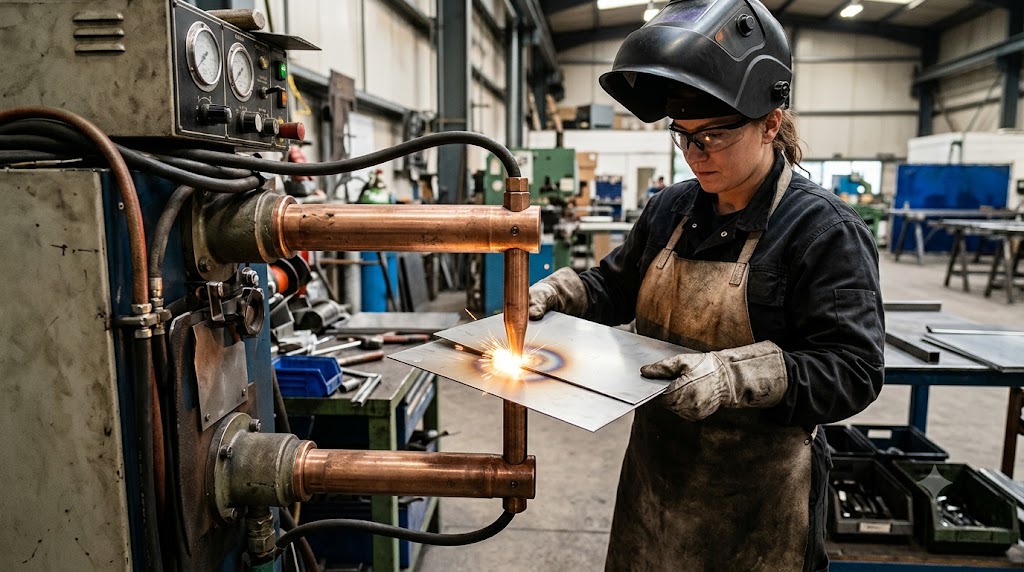
Spot welding is a resistance welding process that joins overlapping sheets of metal by pressing them between two electrodes and passing an electric current through them. The metal’s resistance to the current creates heat that melts a small “nugget” fusing the sheets. Here is how it works.
The main parts
A spot welder is built around a simple idea:
- Two electrodes that clamp the metal from both sides.
- A clamping force that presses the sheets tightly together.
- A power source that sends a strong current for a short time.
- The overlapping workpieces, usually thin sheet metal.
No filler, no gas, no long torch, just pressure, current, and the metal itself.
Direct answer: how spot welding works
Here is the sequence for a single spot weld:
- Two electrodes clamp the overlapping sheets together with force.
- Current flows from one electrode, through the metal, to the other.
- The metal resists the current, and that resistance creates heat.
- The heat melts a small pool right at the interface between the sheets.
- The current stops and the molten spot solidifies under pressure.
- A weld nugget forms, fusing the two sheets at that point.
Each cycle makes one spot, and the whole thing happens in a fraction of a second.
Resistance welding and the weld nugget
Spot welding belongs to the family called resistance welding, and the name explains the science. Instead of an arc, the heat comes from the metal’s own electrical resistance. When a strong current is forced through the clamped sheets, the point of highest resistance is the interface where the two sheets meet, so that is where the most heat builds up. The metal there quickly reaches melting temperature and forms a small molten pool. Because the electrodes are squeezing the sheets together the whole time, that pool solidifies under pressure into a solid button of fused metal called a weld nugget. That nugget, hidden between the sheets, is the actual joint. Its size and quality depend on getting the current, the time, and the clamping force right, which is why spot welding machines control all three carefully.
Where spot welding is used
Spot welding’s speed and simplicity make it a manufacturing staple, especially where thin sheet metal is joined in high volume. The automotive industry is the classic example: car bodies are assembled from stamped sheet-metal panels, and robots spot-weld them together with thousands of welds per vehicle, fast and consistently. Beyond cars, spot welding shows up in appliances, metal furniture, electrical enclosures, battery packs, and many other sheet-metal products. What makes it so suited to these jobs is that it is quick, easy to automate, needs no filler or gas, and leaves a relatively clean joint. Its main limits are that it works best on thinner materials (roughly up to a few millimeters), it joins overlapping sheets rather than butted edges, and each weld is a discrete point rather than a continuous seam.
How spot welding differs from arc welding
It helps to contrast spot welding with the arc processes most people picture when they hear “welding.” Arc welding (MIG, TIG, stick) uses an electric arc as the heat source, usually adds filler metal, and lays a continuous bead, often with shielding gas or flux. Spot welding uses no arc and no filler at all: the heat comes from the metal’s resistance to a current, and the sheets themselves fuse under pressure into a nugget. Arc welding is versatile across thick and thin metal, joint types, and positions, while spot welding is specialized for joining overlapping sheets quickly at discrete points. One other practical difference: an arc weld bead can be visually inspected, but a spot weld nugget is hidden between the sheets, so a spot weld can look fine on the surface yet lack proper fusion inside, which is why controlling the machine settings matters so much.
The bottom line
Spot welding is a resistance welding process that fuses overlapping sheet metal by clamping it between two electrodes and passing a current through it. The metal’s resistance creates heat right at the interface, melting a small pool that solidifies under pressure into a weld nugget, all in a fraction of a second, with no filler rod or shielding gas. That speed and simplicity make it a manufacturing workhorse, especially in automotive body assembly and other high-volume sheet-metal products. It differs from arc welding by using resistance instead of an arc and joining discrete points instead of continuous beads, which makes it a specialist tool that is unbeatable for the jobs it is built for.
FAQ
What is spot welding used for? Spot welding is used to join overlapping sheet metal quickly in high volume. The biggest example is automotive body assembly, where robots make thousands of spot welds per vehicle. It is also used in appliances, metal furniture, electrical enclosures, and battery packs, anywhere thin sheet metal needs fast, consistent, automated joining without filler or shielding gas.
What is a weld nugget? A weld nugget is the small button of fused metal that forms between two sheets in a spot weld. When current passes through the clamped sheets, resistance heats the interface until it melts, and that molten spot solidifies under the electrodes’ pressure into a solid nugget. The nugget, hidden between the sheets, is the actual joint holding them together.
Is a spot welder the same as a MIG welder? No. A MIG welder is an arc process that feeds filler wire and uses shielding gas to lay a continuous bead. A spot welder is a resistance process that uses no arc, no filler, and no gas; it clamps sheets between electrodes and passes current so the metal’s own resistance melts and fuses a nugget. They work on completely different principles.
How is spot welding different from arc welding? Arc welding uses an electric arc as the heat source, usually adds filler metal, and lays a continuous bead. Spot welding uses the metal’s resistance to a current for heat, adds no filler, and fuses overlapping sheets at discrete points into nuggets. Arc welding is versatile across many metals and joints, while spot welding specializes in fast sheet-metal joining.
What thickness can spot welding handle? Spot welding works best on thinner materials, generally up to a few millimeters, which is why it suits sheet-metal work like car bodies and appliances. It joins overlapping sheets rather than thick butted sections, and heavier plate is usually welded with arc processes instead. The exact limit depends on the machine’s current and force capacity.
Why can a spot weld look fine but be weak? Because the weld nugget forms hidden between the sheets, the surface can look normal even if the nugget inside did not fuse properly. This can happen if the machine is too small for the material or set incorrectly on current, time, or force. That is why spot welding relies on careful control of settings and sometimes destructive or nondestructive testing.
References
- AMADA Weld Tech, Fundamentals of Resistance Welding (industry white paper), amadaweldtech.eu.
- The Fabricator references on resistance spot welding technology (industry), thefabricator.com.
- MetalForming Magazine references on spot welding electrodes and weld nuggets (industry), metalformingmagazine.com.