What Is Weld Penetration? Full vs Partial Penetration Explained
A weld is only as strong as how deeply it fuses into the metal, and that depth has a name: penetration. Two welds can look identical on the surface while one bites deep into the joint and the other barely skims it. Knowing the difference between full and partial penetration, and when each is required, separates welders who make pretty beads from welders who make sound joints. This explainer covers what weld penetration is, the difference between full and partial penetration, what causes a lack of it, and how to check.
Weld penetration, properly called depth of fusion, is how far the weld fuses into the base metal from the surface. Full penetration means the weld fuses through the entire joint thickness; partial penetration means it fuses only part way. Here is what that means in practice.
What penetration means
Penetration is about depth of fusion into the joint:
- It measures how deep the weld fuses into the base metal.
- Full penetration fuses completely through the joint thickness.
- Partial penetration fuses only part of the way through.
- It is different from bead width, which is only the surface size.
Because it is mostly below the surface, penetration cannot be judged by the face of the bead alone.
Direct answer: full vs partial penetration
Here is the core distinction:
- Full penetration (complete joint penetration): the weld fuses through the entire thickness of the joint, joining it solidly all the way.
- Partial penetration (partial joint penetration): the weld fuses only part way through, by design, leaving some of the joint unfused.
- Full penetration is stronger and is required where the joint must carry full load or be leak-tight.
- Partial penetration is sufficient where the design does not need the full thickness fused.
Which one you need is set by the design and the code, not chosen at random.
Full penetration versus partial penetration
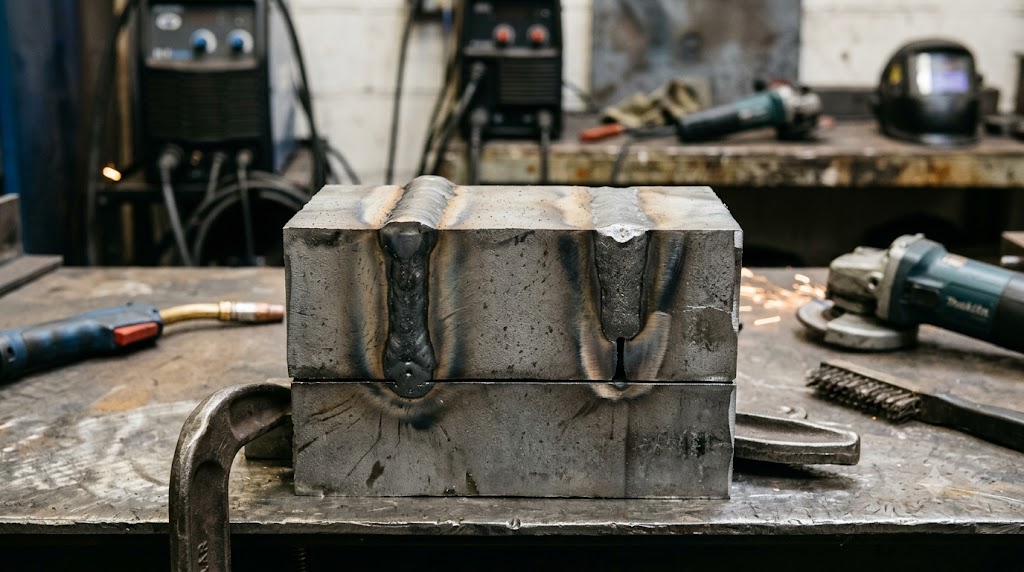
The choice between full and partial penetration is a design decision based on strength. A full penetration weld, also called a complete joint penetration (CJP) weld, fuses through the entire joint thickness, so the joined section is as strong as the base metal and can handle full load, fatigue, and pressure. That is why codes call for full penetration on critical joints, such as pressure vessels, primary structural connections, and anything cyclically loaded. A partial penetration weld, or partial joint penetration (PJP) weld, only fuses part way through on purpose, and its allowable strength is reduced accordingly, closer to that of a fillet weld of similar size. Partial penetration is perfectly appropriate where the design does not require the full thickness to be fused, and it uses less weld metal and time. The important thing is to match the penetration to what the joint actually needs, which the drawing and specification define.
What causes lack of penetration
Lack of penetration is when a weld that was supposed to reach through the joint does not, and it usually comes from too little heat reaching the root. Common causes include amperage set too low for the thickness, travel speed too fast so the arc does not dwell long enough to melt the root, a joint design with too tight a root gap or too small a bevel, and poor torch positioning that keeps the arc from driving into the root. On thick material welded from one side, not preparing the joint properly (with the right gap and bevel) is a frequent culprit. The fix follows the cause: use enough current, slow down to let the arc reach the root, prepare the joint with an adequate gap and bevel, and aim the arc into the root. Getting heat to the root is the whole game.
How to test weld penetration
Because penetration is mostly hidden, checking it takes more than a glance at the bead. On joints with backside access, the simplest visual check is the root: a consistent, uniform bead showing on the underside of a full penetration weld confirms the weld reached through, while gaps mean it did not. For hidden joints, nondestructive testing is used, such as ultrasonic testing (UT) or radiography (RT), which reveal whether fusion extends through the joint without cutting it apart. For qualifying procedures or welders, a destructive method like sectioning and etching a sample shows the penetration profile directly under magnification. The right method depends on the job: a fabricator might rely on root reinforcement and UT on production welds, while a lab uses etched cross sections to prove out a procedure. Whatever the method, the point is that penetration must be verified, not assumed from the surface.
The bottom line
Weld penetration, or depth of fusion, is how far the weld fuses into the joint, and it is what really determines a weld’s strength below the surface. Full penetration fuses through the entire joint thickness and is required on critical, fully loaded, or leak-tight joints, while partial penetration fuses only part way by design and suits joints that do not need the full thickness fused. Lack of penetration comes from too little heat at the root, from low amperage, fast travel, tight joint prep, or poor arc placement, and it is fixed by getting more heat to the root. Since penetration is hidden, it is verified with root inspection, UT, RT, or etched sections. Match the penetration to what the joint needs and confirm you achieved it, and your welds will be as strong below the surface as they look on top.
FAQ
What is the difference between full and partial penetration welds? A full penetration weld fuses through the entire thickness of the joint, making the connection as strong as the base metal, which is why it is required on critical and fully loaded joints. A partial penetration weld fuses only part way through on purpose, giving reduced strength suited to joints that do not need the full thickness fused. The design and code decide which is required.
What causes lack of penetration? Lack of penetration is usually caused by too little heat reaching the root: amperage set too low for the thickness, travel speed too fast, a joint with too tight a root gap or too small a bevel, or poor arc positioning that fails to drive into the root. The fix is more current, slower travel, proper joint preparation, and aiming the arc into the root.
How do you test weld penetration? On joints with backside access, check the root visually for a consistent, uniform bead, which confirms full penetration. For hidden joints, use nondestructive testing like ultrasonic testing (UT) or radiography (RT). To qualify a procedure, a destructive method like sectioning and etching a sample shows the penetration profile directly. The method depends on the job and code.
Is more penetration always better? No. The right amount of penetration is what the joint’s design requires. Full penetration is needed on critical, fully loaded, or leak-tight joints, but many joints only need partial penetration, and forcing excessive penetration can waste metal, add heat and distortion, or even burn through thin material. Match the penetration to the design rather than always chasing maximum depth.
Is penetration the same as fusion? Not exactly. Fusion is the weld metal properly melting together with the base metal, which every sound weld needs. Penetration, or depth of fusion, is how far that fusion extends into the base metal. You can have complete fusion without deep penetration, and both matter: fusion must occur for the joint to hold, and penetration depth must meet what the design requires.
Why do critical joints require full penetration? Because full penetration fuses through the entire joint thickness, giving the connection the full strength of the base metal and making it able to carry full load, resist fatigue, and stay leak-tight. Partial penetration leaves part of the joint unfused, which creates a built-in stress point and reduced strength, so codes require full penetration on pressure vessels, primary structure, and cyclically loaded joints.
References
- Lincoln Electric, Weld Fusion vs Weld Penetration and AWS depth-of-fusion definitions (manufacturer), lincolnelectric.com.
- American Welding Society D1.1 references on complete and partial joint penetration (industry), aws.org.
- ESAB welding defects guide on lack of penetration (manufacturer), esab.com.