Wolverine Welding Boots Review: Are They Built for the Arc?
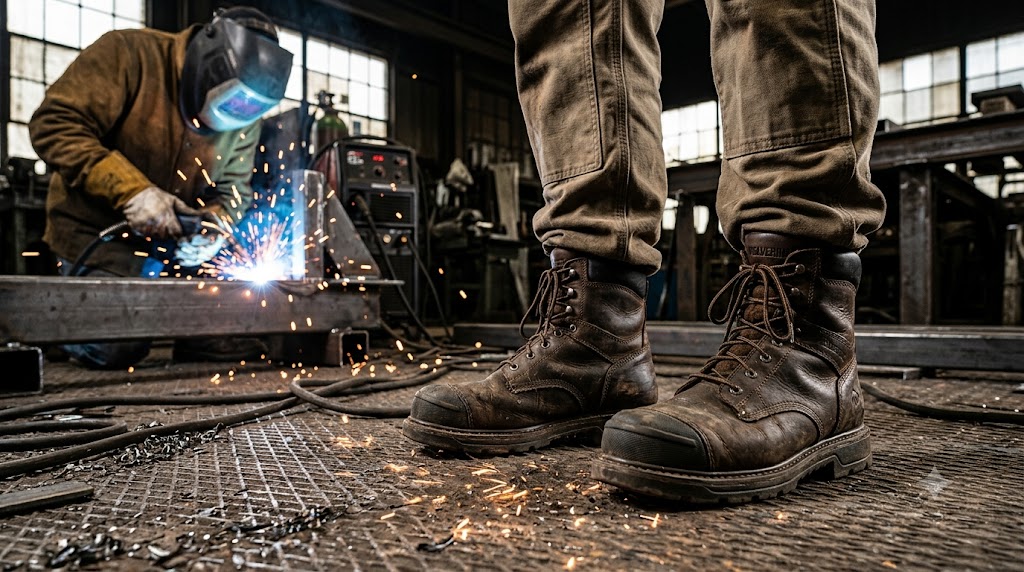
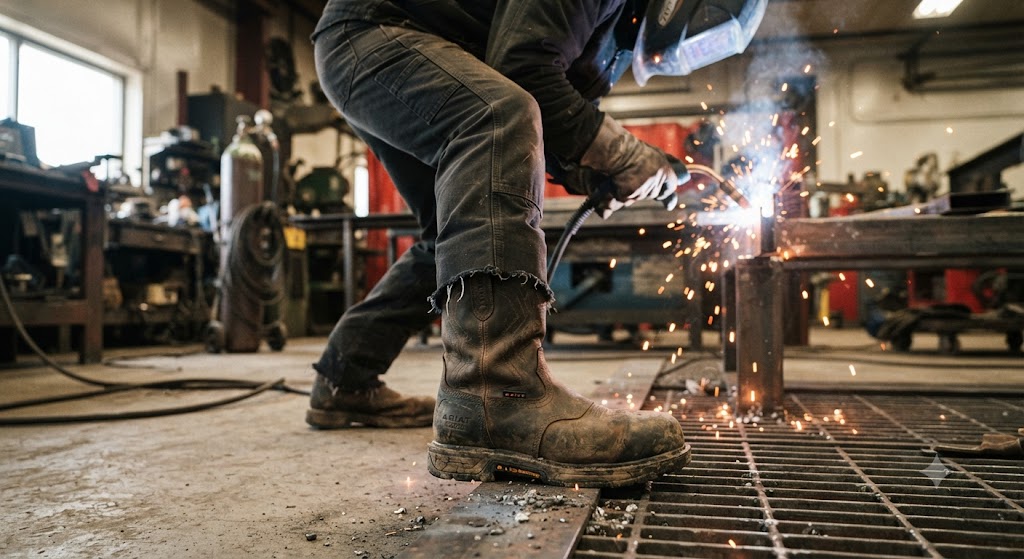
You pull on a boot for a 10-hour shift, run a bead overhead, and a glob of spatter lands square on the toe cap. If the leather buckles or the welt separates by noon, you learn fast that not every steel-toe work boot is a welding boot. The Wolverine Floorhand 6” Waterproof Steel-Toe is the model most welders actually end up buying from the Wolverine lineup, and it handles that spatter test better than most boots in its range. Here is what you need to know before you order a pair.
What Are Wolverine Welding Boots?
Wolverine welding boots are steel-toe work boots from Wolverine, an American brand founded in Rockford, Michigan in 1883. Their work boot lineup is built on full-grain leather, Goodyear welt or cement construction depending on the model, and rubber outsoles rated for oil and slip resistance. The Floorhand series, their most widely available steel-toe boot on Amazon, meets ASTM F2413 standards for impact and compression resistance and carries an electrical hazard (EH) rating, which matters in shops where welding equipment, conduit, and live circuits share the same floor. The leather upper is waterproof, which doubles as a buffer against mill scale and light weld spatter that a quick boot-knock will shed before it burns through. These are not dedicated welding boots in the sense of a metatarsal guard or a full-length leather upper, but they cover the ground a welder actually stands on for most of a workday.
Do Wolverine Boots Work for Welding?
For structural welding, fabrication, pipe fitting, and light shop work, yes. The Floorhand 6” Steel-Toe carries the critical specs: ASTM F2413-11 I/75 C/75 EH, meaning it passes the impact (75 foot-pounds), compression (2,500 pounds), and electrical hazard tests that OSHA references in 29 CFR 1910.136 when mandating protective footwear in areas with falling or rolling object hazards. The full-grain leather upper resists weld spatter well enough for a standard shift. The slip-resistant rubber outsole grips grating, concrete, and painted steel floors without leaving marks.
Where they fall short of a dedicated welding boot is metatarsal protection. The Floorhand does not include an external or internal metatarsal guard. If you are grinding overhead, working under suspended loads, or in a heavy structural shop where OSHA would mandate met-guard coverage, you need a separate metatarsal guard strap or a different boot entirely. That gap is real and worth naming before you add to cart.
Compared to a Timberland PRO Pit Boss, the Floorhand sits in a lighter-weight, more affordable category. The Pit Boss uses a thicker rubber outsole and is better suited to 12-hour shifts on concrete. Compared to Ariat’s WorkHog, the Wolverine Floorhand has a lower heel and a flatter profile, which most stand-up welders and fitters prefer over a cowboy-cut heel that can rock on flat concrete.
Check the Wolverine Floorhand Steel-Toe on Amazon
Wolverine Floorhand 6” Steel-Toe: What You Get
The Floorhand’s waterproof membrane uses a moisture-wicking mesh lining against your foot, which reduces sweat buildup during long shifts. The removable EVA footbed is soft enough at the start but compresses noticeably by the third or fourth month of daily use. That is the honest flaw here: the stock insole does not hold its cushioning under full-day wear. Most long-term owners swap it for a Superfeet or a Wolverine RC350 insole after six to eight weeks. Budget that into your plan.
The cement construction (on most Floorhand SKUs) is lighter than a Goodyear welt, but it also means the boot cannot be resoled. When the outsole is done, the boot is done. For a welder who goes through boots hard, welt construction like Timberland PRO’s Pit Boss or Ariat’s WorkHog is a stronger long-term investment. If you rotate pairs, cement construction is fine.
The leather upper is durable on the toe box and heel, but the lace eyelets are metal grommets rather than speed hooks, so lacing takes a moment longer in the morning. Minor complaint, but noted.
How Do Wolverine Boots Compare to Timberland PRO?
Timberland PRO Pit Boss uses a thicker outsole platform, a wider toe box, and a heavier overall build. That pays off on concrete after hour eight. The Wolverine Floorhand is lighter, less stiff out of the box, and breaks in faster. If your welding shifts run 8 hours on varied surfaces, the Floorhand is the easier daily driver. If you are pouring full 12-hour shifts on flat concrete, step up to the Pit Boss or a boot with a PU midsole.
On metatarsal protection, neither boot includes one by default. Timberland PRO offers met-guard models (the 6” Met Guard boot) that Wolverine’s Floorhand line does not match.
Do Wolverine Boots Have Metatarsal Protection?
The Floorhand does not. Wolverine does offer metatarsal guard models in other lines, but the Floorhand, which is the primary Wolverine boot listed on Amazon, is a standard steel-toe with no met coverage. If your job site or facility requires metatarsal protection (common in foundries, structural shops, and any site running OSHA 1910.136 with an internal hazard assessment that flags met risk), look at the Timberland PRO 6” Met Guard or a purpose-built welding boot with an external met strap.
Comparison: Wolverine Floorhand vs. Key Alternatives
| Feature | Wolverine Floorhand 6” ST | Timberland PRO Pit Boss | KEEN Utility Atlanta Cool 2 |
|---|---|---|---|
| Toe protection | Steel, ASTM F2413 | Steel, ASTM F2413 | Steel, ASTM F2413 |
| Metatarsal guard | No | No (met-guard model available) | No |
| Waterproof | Yes | Yes (select models) | Water-resistant |
| Construction | Cement | Rubber outsole direct attach | Cement |
| Outsole | Rubber lug, slip-resistant | Rubber, slip-resistant | Oil/slip-resistant rubber |
| EH rated | Yes | Yes | Yes |
| Stock insole durability | Compresses by 2-3 months | Better long-term cushion | Good for daily wear |
| Best for | Light to medium shop, shorter shifts | Long-shift concrete work | Hot shops, warmer climates |
Who Should Buy Wolverine Welding Boots?
Buy the Floorhand if you want a light, affordable, ASTM-certified steel-toe that breaks in fast and handles regular shop welding without a major upfront commitment. It is a solid everyday boot for hobby welders, beginning fabricators, and tradespeople doing occasional welding on a general construction site.
Skip it if your work requires metatarsal protection, if you’re running 12-hour pours on concrete, or if you need a resole-ready boot that outlasts the stock outsole. In those cases, spend more on the Pit Boss or step into a dedicated met-guard boot.
FAQ
Are Wolverine boots suitable for welding? Yes, with the caveat that the Floorhand is a steel-toe work boot with a waterproof leather upper and EH rating rather than a purpose-built welding boot. It passes ASTM F2413 for impact and compression and handles typical weld spatter well. It does not include metatarsal protection, so assess your specific hazard environment before relying on it for overhead or heavy structural work.
Do Wolverine boots have metatarsal protection? The Floorhand series does not. Wolverine offers metatarsal guard options in other lines, but those are not consistently available on Amazon. If met protection is required at your facility, check Timberland PRO’s met-guard boot or a purpose-built foundry or welding boot.
How do Wolverine welding boots compare to Timberland PRO? The Floorhand is lighter, breaks in faster, and is generally more affordable. The Timberland PRO Pit Boss offers a thicker outsole, better cushion longevity, and a heavier-duty build for longer shifts. Both meet ASTM F2413. For light to medium shop use, Wolverine holds up. For 10 to 12-hour pours on flat concrete, Timberland PRO edges ahead.
Does the Wolverine Floorhand meet OSHA foot protection standards? OSHA 29 CFR 1910.136 requires protective footwear where employees are at risk of foot injuries from falling or rolling objects, or from electrical hazards. The Floorhand meets ASTM F2413 impact, compression, and EH requirements that satisfy those OSHA standards in most shop environments. Whether a specific site requires additional protection (met guards, puncture resistance) depends on the facility’s own hazard assessment.
How long does the Wolverine Floorhand last? With daily shop use, most owners report 12 to 18 months before the outsole wears through. The cement construction means resoling is not an option, so the boot’s life ends with the outsole. Rotating two pairs extends each pair significantly.
Is the Wolverine Floorhand true to size? Generally yes. Wide-footed wearers and those with higher volume feet often go up a half size. The waterproof lining adds a small amount of internal stiffness early on, so they benefit from a break-in period of 3 to 5 days.
Can I wear Wolverine boots for MIG, TIG, and stick welding? Yes. The leather upper handles spatter from all three processes. TIG produces less spatter by nature, so it is the easiest on leather. Stick welding produces more spatter; the lace area takes the most wear there. Keep an eye on your laces and replace them before a frayed lace becomes a trip hazard.
References
- https://www.osha.gov/laws-regs/regulations/standardnumber/1910/1910.136
- https://www.astm.org/f2413-18.html
- https://www.wolverine.com/us/en/floorhand-collection
URL slug: wolverine-welding-boots-review Excerpt: The Wolverine Floorhand 6” Steel-Toe is a solid waterproof work boot for light to medium shop welding. It passes ASTM F2413 and carries an EH rating, but the stock insole compresses fast and there is no metatarsal guard. Here is how it holds up against the Timberland PRO Pit Boss and what kind of welder it suits best.