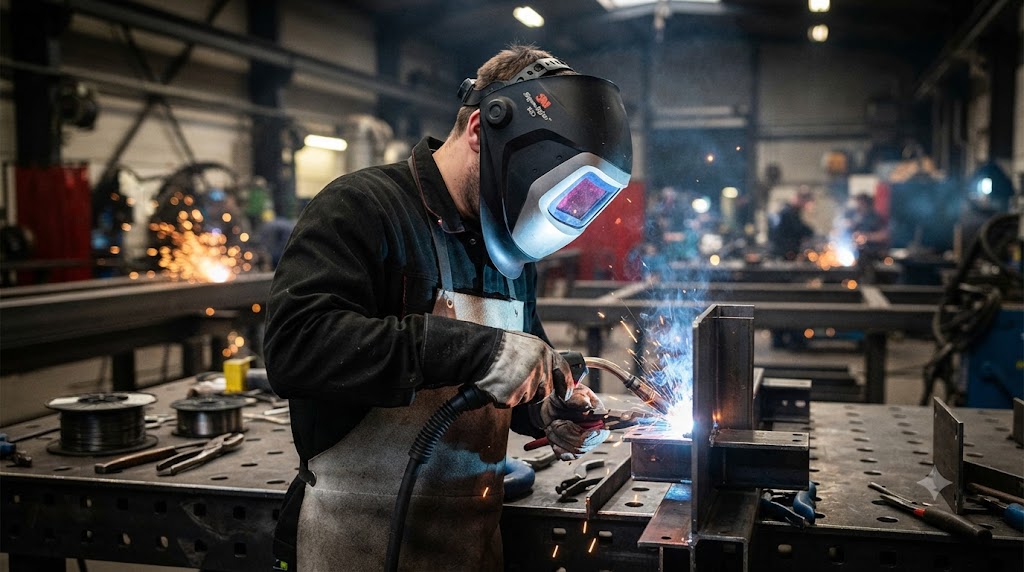
Welding Helmet and Gear Guide for Aluminum Welding
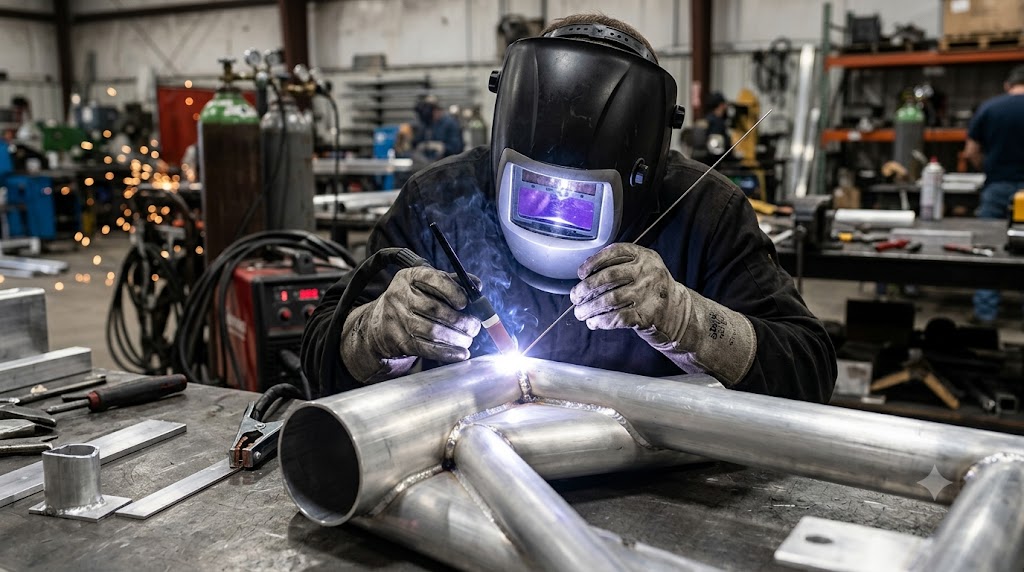
You strike an arc on 3/16” aluminum at 120 amps and your first thought isn’t about the bead — it’s that you can barely see the tungsten through a murky green fog. Standard auto-darkening lenses show aluminum TIG as a low-contrast smear. You end up guessing where the puddle edge is, and contamination follows. The fix isn’t technique. It’s the lens in front of your eyes.
Aluminum TIG welding places specific demands on your helmet that steel work simply doesn’t. The AC arc used for aluminum is more diffuse and visually intense for its amperage than DC TIG. Seeing the tungsten gap, puddle flow, and oxide layer break-up requires a lens that passes natural color tones rather than filtering everything into a single green cast. That distinction — true-color lens versus standard green-tint ADF — is the central gear question for anyone doing precision aluminum work.
A welding helmet for aluminum TIG should have a true-color or high-clarity auto-darkening filter (ADF), a shade range of at least 9 to 13, four arc sensors for reliable triggering at lower amperages, and an optical clarity rating of 1/1/1/1 per ANSI Z87.1. Those four numbers (light diffusion, angle dependence, uniformity of luminous transmittance, and variations in luminous transmittance) tell you whether the lens shows the world as it is or as a distorted approximation.
Why Aluminum TIG Demands a True-Color Lens
Steel MIG welders can get away with a basic green-tint ADF because the arc is short-lived and the puddle behavior is relatively coarse. Aluminum TIG is different. You’re running AC current to break the oxide layer, the arc is wider and more visible, and the puddle moves fast. Reading the puddle color — that bright orange-white at the leading edge versus the flatter tone of solidified aluminum — tells you whether you’re running hot enough to fuse without burning through. A green-tint lens collapses that color distinction into shades of grey-green. A true-color lens preserves it.
Manufacturers achieve true-color transmission through different proprietary technologies: ESAB calls theirs True Color ADF, Miller uses ClearLight, and Lincoln Electric uses 4C lens technology. The mechanism varies, but the output is the same: more of the visible spectrum passes through the filter in both light and dark states. In practice, welders describe it as “the difference between watching in black-and-white versus color.”
What Shade Do You Need for Aluminum TIG?
OSHA 1915.153 Table I-1 sets minimum protective shade numbers for welding processes. For gas tungsten arc welding (TIG), OSHA specifies a minimum shade of 8 for currents under 150 amps and a minimum of 10 for 150 to 500 amps. Those are minimums — the floor, not the comfort setting.
The AWS lens shade chart and industry practice place the comfortable working range for aluminum TIG at shade 9 to 13, depending on amperage:
| Amperage Range | Minimum Shade (OSHA 1915.153) | Practical/Comfort Range |
|---|---|---|
| Under 50A | 8 | 9-10 |
| 50-150A | 8 | 10-11 |
| 150-500A | 10 | 12-13 |
For most shop aluminum TIG — body panels, tube frames, fabrication work — you’ll land between shade 9 and 11. Going darker than necessary on low-amperage aluminum is one of the most common reasons welders contaminate tungsten: they can’t see the arc gap tighten before contact.
The Two Helmets Worth Buying for Aluminum TIG
ESAB Sentinel A50
The Sentinel A50 is the first choice for aluminum TIG in most professional shops, and the reason is simple: the True Color ADF is genuinely better for reading a puddle than nearly anything else at this level. The lens passes more of the warm color range, so the aluminum puddle looks bronze-orange instead of muddy green. You can actually see the moment the oxide layer clears and the puddle goes fluid.
Specs: 3.93” x 2.36” viewing area, 1/1/1/2 optical clarity (the “2” in the last position reflects lens uniformity, which is still commercial-grade), shade range 5-13, four arc sensors, low-amperage TIG rating down to 2 amps. The shell is high-impact nylon with a low-profile design that keeps the center of gravity close to your head — meaningful on full production days.
The flaw: the Sentinel A50 gets the “2” in the fourth position of its optical clarity rating instead of a perfect “1/1/1/1.” For most welders this is invisible in practice, but if you’re comparing spec sheets against a Miller Digital Infinity, it shows up. The headgear’s infinite-adjust ratchet is well-built but the adjustment knob sits low enough that gloved hands sometimes miss it on the first grab.
A verified live listing: ESAB Sentinel A50
Miller Digital Infinity with ClearLight 2.0
If you want the full 1/1/1/1 optical clarity rating with a large viewing area, the Miller Digital Infinity is the other answer for aluminum TIG. The 13.4 square-inch lens is the largest standard ADF viewing area on the market, which matters when you’re working overhead or in a tight corner and need to see the joint without repositioning your head.
ClearLight 2.0 builds on Miller’s original color transmission technology by extending the warm end of the spectrum further. Welders who’ve run both back-to-back describe the Infinity as slightly warmer in color tone than the Sentinel A50, with less of a blue shift in the light state. The X-Mode feature is also worth calling out for aluminum: it allows the helmet to trigger off the UV/IR signature of the arc rather than visible light, which helps when you’re welding in bright outdoor conditions or with a restricted view of the arc.
Specs: 13.4 sq. in. viewing area, 1/1/1/1 optical clarity, shade range 5-13, four arc sensors, InfoTrack arc time monitoring. The helmet ships with five outer cover lenses and two inner lenses.
The flaw: the Digital Infinity is the heaviest option in its class. That 13.4-inch lens comes at a weight cost that some welders feel in their neck after a full shift. If you’re doing interrupted TIG passes — a few inches, look up, reposition, weld again — the weight compounds faster than it does in production seam welding.
A verified live listing: Miller Digital Infinity ClearLight 2.0
Head-to-Head: Sentinel A50 vs. Digital Infinity for Aluminum
| Feature | ESAB Sentinel A50 | Miller Digital Infinity |
|---|---|---|
| Optical clarity | 1/1/1/2 | 1/1/1/1 |
| Viewing area | 3.93” x 2.36” | 13.4 sq. in. |
| Shade range | 5-13 | 5-13 |
| Arc sensors | 4 | 4 |
| Low-amp TIG rating | 2A | 5A |
| Weight | ~1.8 lbs | ~2.1 lbs |
| Color technology | True Color ADF | ClearLight 2.0 |
| Best for | Precision TIG, portability | Production welding, wide-view overhead |
For pure aluminum TIG in a shop environment, the Sentinel A50 edges out the Infinity on color rendering for most welders. The lower minimum amp rating (2A vs. 5A) also matters when you’re doing fine TIG work on thin aluminum sheet. If you regularly work in varying positions and want the maximum lens real estate, the Infinity earns its weight.
ANSI Z87.1 and What It Actually Covers
Both helmets meet ANSI Z87.1, which governs impact resistance, optical performance, and UV/IR protection for welding eye protection. The standard requires that compliant lenses block 100% of UV radiation up to 380nm and IR radiation relevant to welding processes. For aluminum TIG specifically, the UV component of the AC arc is significant — another reason shade-appropriate eye protection matters more than it might seem at first. A shade 9 lens that meets Z87.1 provides full UV protection; a shade 9 lens that doesn’t is a different product entirely.
Gear Notes: Cover Lens Replacement
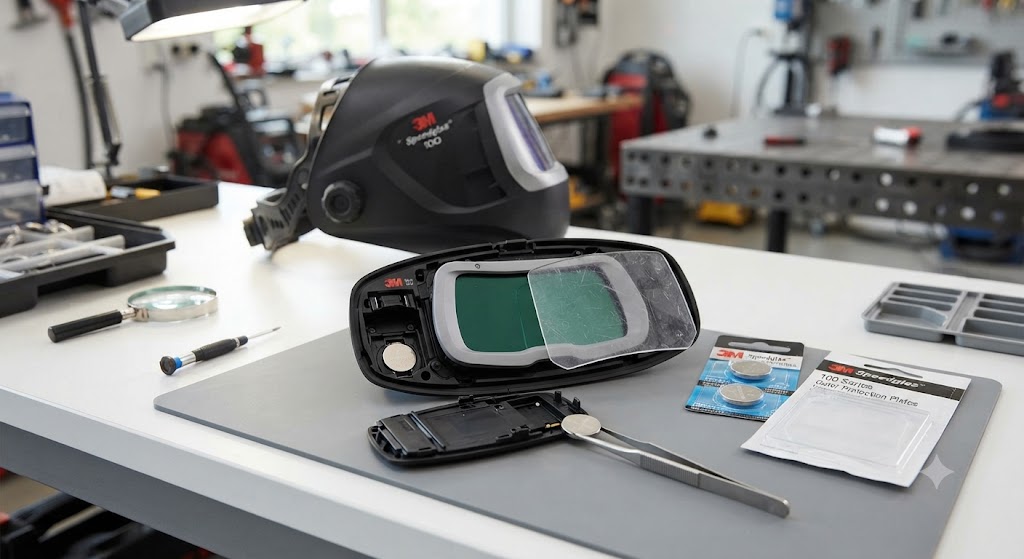
Aluminum spatter is minimal compared to MIG or stick welding, but aluminum oxide residue from the gas cup area can still foul a cover lens over time. Replace outer cover lenses when they show any frosting or pitting — a degraded cover lens changes the effective optical clarity of an otherwise excellent ADF. Both the Sentinel A50 and Digital Infinity use lens systems that can be replaced without tools.
FAQ
Do you need a special helmet to weld aluminum? You don’t need a dedicated aluminum-only helmet, but you do need one with a true-color or high-clarity ADF and a shade range of at least 9 to 13. Standard green-tint lenses make aluminum TIG puddle reading much harder and increase the risk of tungsten contamination from misjudging arc gap.
What is the best welding helmet for aluminum? For most TIG welders, the ESAB Sentinel A50 is the top choice because of its True Color ADF and low-amperage rating down to 2A. The Miller Digital Infinity with ClearLight 2.0 is the better pick if you want a larger viewing area and weld in varied positions.
Does aluminum welding need a different shade than steel? The OSHA minimum shades for TIG on aluminum are the same as for steel TIG (shade 8 for under 150A, shade 10 for 150-500A per OSHA 1915.153). In practice, most welders run shade 9 to 13 for aluminum TIG because the wider arc and faster puddle benefit from slightly more contrast at higher shades.
What does 1/1/1/1 optical clarity mean? The four numbers rate light diffusion, angular dependence of luminous transmittance, uniformity of luminous transmittance, and variations in luminous transmittance. A “1” in each position is the highest grade per EN 379 European standards, now commonly referenced in North American welding PPE. It means the lens distorts the view as little as physically possible.
Can I use the same helmet for aluminum and steel TIG? Yes. A true-color ADF helmet with shade 9 to 13 works for both processes. The shade adjustment handles the amperage difference. The true-color lens does no harm on steel — it simply shows you more accurate color tones on both materials.
Is a solar-powered helmet safe for aluminum TIG? Solar-assisted helmets are safe as long as they carry a proper backup battery. The concern is that TIG arcs — particularly at low amperage — produce less visible light than MIG or stick, and a dying solar cell that doesn’t trigger fast enough is a real hazard. Both the Sentinel A50 and Digital Infinity use battery-primary power with solar assist, which is the safer configuration.
What shade do I use for TIG welding aluminum at 100 amps? OSHA 1915.153 sets the minimum at shade 8 for TIG under 150 amps. Most welders prefer shade 10 to 11 at 100 amps for aluminum because the AC arc is brighter than a DC steel TIG arc at the same amperage.
References
- https://www.osha.gov/laws-regs/regulations/standardnumber/1915/1915.153
- https://www.osha.gov/sites/default/files/publications/OSHAFACTSHEET-EYEPROTECTION-DURING-WELDING.pdf
- https://www.aws.org/magazines-and-media/welding-digest/2025/november/wd-nov-2025—complete-welding-lens-shade-chart—safety-guide-for-eye-protection/
- https://www.esab.com/en/us/products/equipment/personal-protective-equipment/welding-helmets/sentinel-a50.cfm
- https://www.millerwelds.com
URL slug: aluminum-welding-helmet-guide Excerpt: Aluminum TIG demands a true-color ADF, a shade range of 9 to 13, and four arc sensors to catch low-amperage starts. This guide covers why standard green-tint lenses fall short and which helmets actually show you the puddle clearly.