How an Auto Darkening Welding Helmet Works, and What to Look For

Strike an arc with an old passive hood and there is a beat of darkness where you are welding on faith. An auto darkening welding helmet erases that beat. The lens reads the flash and switches to a protective shade before your eye registers anything, which is why once welders switch, almost nobody goes back.
An auto darkening welding helmet uses an electronic filter, called an ADF, built from liquid crystal layers, arc sensors, and a small power source (usually a solar cell paired with a lithium battery). In its resting light state you can see clearly, typically around shade 3 to 4. When the sensors detect an arc, the liquid crystal darkens to your set welding shade, then clears again a moment after the arc stops.
Here is the direct answer to how it works: arc sensors detect the sudden brightness, a circuit tells the liquid crystal layer to align and block light, and the lens darkens in a fraction of a millisecond. A quality lens does this in about 1/25,000 of a second. Nothing mechanical moves, so there is no lag you can feel when the electronics are good.
The four controls that actually change your welds
Shade
Variable-shade lenses cover roughly shade 5 to 13. You pick the darkness by process and amperage: lighter for low-amp TIG so you can see the puddle, darker for high-amp stick and MIG. The American Welding Society shade chart is the reference welders use to match shade to amperage instead of guessing.
Sensitivity
Sensitivity decides how much arc brightness is needed to trigger the lens. Low-amp TIG throws less light, so it needs higher sensitivity. Set it too high in a sunny shop and the lens trips on nothing; too low and it will not darken for a delicate TIG start.
Delay
Delay controls how long the lens stays dark after the arc stops. Short delay for tack welding so you can see immediately, longer delay for high-amp work where the puddle glows hot and would flash your eyes if the lens cleared instantly.
Grind mode
Grind mode locks the lens light so a shower of sparks off a grinder does not darken it. It is the feature that saves you from flipping the helmet up and down a hundred times a day.
Solar plus battery, and why it matters
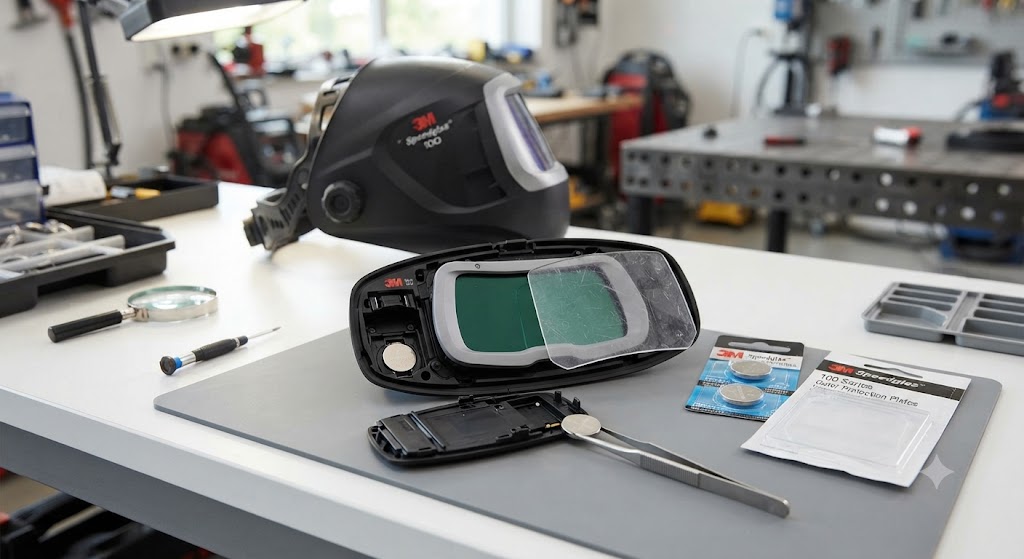
Most auto darkening helmets pair a solar cell with a replaceable coin battery, usually a CR2450. The solar cell trickle-charges the electronics while you work, and the battery covers low-light conditions. This hybrid setup is why a well-made helmet can run for years before the battery needs swapping.
The failure mode worth knowing: if a helmet lives in a dark drawer for months, the solar cell never charges and a marginal battery can drain, so the lens acts sluggish the next time you need it. Store it where it catches some light.
A verified example of the technology done right
The Lincoln Viking 3350 is a clean illustration of a modern ADF: four arc sensors, a 1/1/1/1 clarity rating, variable shade 5 to 13, and a switching speed around 1/25,000 of a second. It shows what the good version of every spec above looks like in one helmet.
Its flaw is not the lens, it is the weight, since a full-featured ADF and a large lens add mass that overhead welders feel. Someone who only does quick low-amp TIG at a bench might prefer a lighter helmet with a specialist low-amp rating, even if the lens tech is similar.
Are the cheap ones safe?
An auto darkening lens is safe if it carries a real ANSI Z87.1 marking, because that standard requires the filter to block ultraviolet and infrared radiation at all times, even in the light state and even if the electronics fail. What separates cheap from good is not whether you get burned by radiation, it is reaction speed and reliability. A slow or flaky lens lets visible arc flash reach your eyes and leaves them gritty, which is uncomfortable rather than blinding, but it is exactly the thing you bought the helmet to avoid.
Skip the no-name helmet with no verifiable standard marking. Choose one with the Z87.1 stamp and adjustable sensitivity, and the “are cheap ADFs safe” question mostly answers itself.
Putting it together
An auto darkening welding helmet is worth it for almost everyone because it lets you see before you weld and protects your eyes the instant you strike. Judge one by its clarity rating, its switching speed, and whether it gives you real control over shade, sensitivity, and delay. Get those right, store the helmet in the light, and confirm the Z87.1 marking. Do that and the technology disappears into the background, which is exactly what good gear is supposed to do.
Frequently asked questions
How does an auto darkening welding lens work? Arc sensors detect the flash of an arc, and a circuit darkens a liquid crystal layer to your set shade in a fraction of a millisecond. When the arc stops, the lens clears again after a short delay.
What shade lens should I use for MIG welding? Most MIG work sits around shade 10 to 13, going darker as amperage rises. A variable-shade auto darkening helmet lets you tune it, and the AWS shade chart gives amperage-based guidance.
Are cheap auto darkening welding helmets safe? They are safe from radiation if they carry a genuine ANSI Z87.1 marking, because the filter blocks UV and IR even when off. The risk with the cheapest models is slow or unreliable switching, not radiation leakage.
Can an auto darkening lens fail? Yes. Dead batteries, a drained solar cell, dirty sensors, or age can all cause a lens to darken slowly or not at all. Most failures trace back to power or sensitivity settings rather than a broken lens.
Do auto darkening helmets need batteries? Most use a solar cell plus a replaceable coin battery like a CR2450. The solar cell helps, but the battery still does real work, so it needs replacing eventually.
Why won’t my helmet darken for low-amp TIG? Low-amp TIG produces less light, so the lens may not trigger unless sensitivity is turned up and the helmet is rated for low-amp work. Raise sensitivity first, then check the helmet’s TIG amp rating.
References
-
NIOSH PPE-Info, ANSI/ISEA Z87.1-2020 standard details: https://wwwn.cdc.gov/PPEInfo/Standards/Info/ANSI/ISEAZ8712020
-
Lincoln Electric, VIKING 3350 Series specifications: https://www.lincolnelectric.com/en/Products/k3034-4
-
American Welding Society, Complete Welding Lens Shade Chart: https://www.aws.org/magazines-and-media/welding-digest/2025/november/wd-nov-2025—complete-welding-lens-shade-chart—safety-guide-for-eye-protection/
-
URL slug: auto-darkening-welding-helmet
-
Excerpt: An auto darkening welding helmet reads the arc and darkens in a fraction of a millisecond. This guide explains how the lens, sensors, and battery work, breaks down the shade, sensitivity, and delay controls, and shows how to tell a safe ADF from a cheap one.