Best Welding Helmet for Overhead PAPR Use: Why Powered Air Changes Everything Up Top
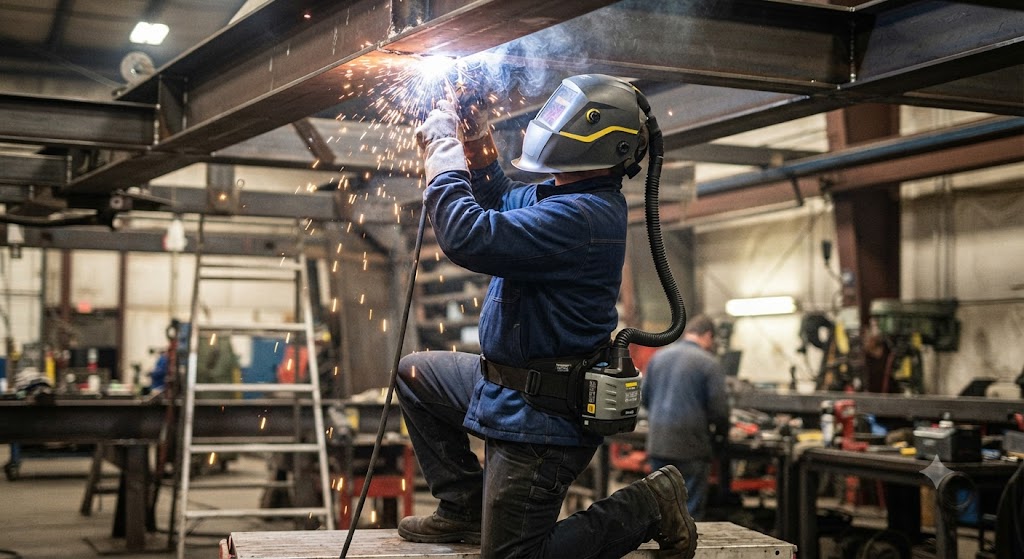
Overhead welding is where a standard half-mask respirator under the hood stops being practical and starts being a problem. Beads of sweat and condensation fog the lens, the mask seal breaks when your neck tips back, and after two hours the weight of everything above your shoulders turns productive work into endurance. The best welding helmet for overhead PAPR use solves all three problems by moving the air supply and blower to your belt or a vest, pumping filtered air up into the helmet so your face is clear, comfortable, and protected without a tight rubber seal on your face at all. Here is what PAPR actually means for overhead work and which systems genuinely deliver on it.
What a PAPR Does That a Half-Mask Cannot
A powered air-purifying respirator (PAPR) uses a battery-powered blower to pull air through a filter and deliver it to your breathing zone inside the welding helmet. Because it is positive pressure rather than negative pressure, you breathe in filtered air without effort, no inhalation resistance, and there is no rubber seal pressing against your face.[^https://www.3m.com/3M/en_US/speedglas-welding-helmets-us/adflo/] This means:
- No seal failure when your head tips back for overhead work
- No fogging because constant airflow moves moisture away from the lens
- No fatigue from breathing against a tight half-mask through a long pass
- Fit for welders with beards, where half-mask seals are compromised under OSHA standards
The trade is weight and cost. A PAPR system is heavier than a respirator-plus-helmet combination (the blower is on your hip, but the hose and airflow hardware add to the helmet), and the systems cost significantly more.
What to Look for in an Overhead PAPR System
Weight distribution. For overhead work, every ounce on your head and neck costs you. The best PAPR welding helmets for overhead use offload the blower to a belt unit or vest so the helmet stays light. The hose runs from blower to helmet but does not make the helmet itself heavier in a way that strains the neck backward.
Battery runtime. Overhead work is often long, interrupted by repositioning and setup. A PAPR that lasts a full shift without a swap is the benchmark: at least eight hours or a full workday of run time.
Airflow rate. Minimum airflow for PAPR welding applications is 170 liters per minute for a loose-fitting device under NIOSH standards. Systems that exceed this provide a larger margin of protection and better comfort through hot overhead passes.
Helmet optics and ergonomics for overhead positions. A PAPR system is only as good as the helmet it is paired with. For overhead, a wide viewing area and a large light-state shade help you see the puddle when the helmet is tilted back. Good flip-up tension so the hood stays at the right angle is important, and a comfortable suspension that distributes the forward weight helps.
The Systems That Stand Out
3M Speedglas G5-01 with Adflo PAPR. Widely regarded as the best overall PAPR welding helmet system, the Speedglas G5-01 pairs an excellent auto-darkening lens (Speedglas optics, shade 5-14, very high clarity) with the 3M Adflo blower unit, which delivers filtered air via a hose to the helmet. The Adflo’s long battery life covers full shifts, and the G5-01 shell is well-suited to overhead positions with a wide viewing area and ergonomic headgear.[^https://www.3m.com/3M/en_US/speedglas-welding-helmets-us/adflo/][^https://wcsafety.com/blogs/guides/best-papr-welding-helmet] The 3M system is the most popular choice in industrial welding where combined respiratory protection and overhead work are the daily requirement.
Optrel Panoramaxx 2.5 with e3000x PAPR. Optrel’s approach to overhead work favors a wider true-color view, with the Panoramaxx 2.5 pairing a panoramic auto-darkening lens with Optrel’s e3000x PAPR blower. The IsoFit headgear distributes the load well and the panoramic view is appreciated for out-of-position work where seeing past the arc to the joint geometry matters. Optrel is often preferred by welders who do construction and general fieldwork in addition to production overhead.[^https://www.reddit.com/r/Welding/comments/10d4vp8/best_papr/]
Miller T94i PAPR. Miller’s T94i combines a pancake shell with an integrated PAPR system in a compact format that is particularly well-regarded for pipeline work and tight spaces. Its pancake profile reduces the forward-of-head weight that strains the neck in sustained overhead positions.
The Honest Flaw in Every PAPR System
The hose. Every PAPR system has an air supply hose running from the blower to the helmet, and in confined spaces, overhead positions, or any work requiring a lot of repositioning, that hose becomes an obstacle. It catches on scaffolding, pulls on the helmet during extreme head angles, and is one more thing to manage. It is a real trade and worth thinking through before committing, especially for welders who move constantly versus those who hold a position for long overhead passes.
Who should skip PAPR: welders doing brief overhead tacks in a clean shop environment, where a properly fitted half-mask under the hood does the job. PAPR’s cost and complexity are justified by sustained overhead work in heavy-fume environments.
The Bottom Line
The best welding helmet for overhead PAPR use is a full PAPR system where the blower sits on your hip, the helmet stays light, and positive-pressure filtered air flows through the lens interior. The 3M Speedglas G5-01 with Adflo is the flagship of that approach for production overhead work; the Optrel Panoramaxx 2.5 with e3000x is the pick for welders who also need construction versatility and a panoramic view. Both solve the overhead seal-failure problem that makes half-masks impractical above the horizontal, and both provide the full-shift respiratory protection that production welding demands.
Frequently Asked Questions
What is a PAPR welding helmet? A PAPR (powered air-purifying respirator) welding helmet combines a welding lens with a battery-powered blower that pulls air through a filter and delivers it into the helmet. You breathe filtered air without a tight face seal.
Why is PAPR better for overhead welding than a half-mask? A half-mask seal breaks when your head tips back for overhead work, and the mask fogs and creates breathing resistance. PAPR has no tight seal, constant airflow prevents fogging, and you breathe without effort regardless of head position.
Which PAPR welding helmet is best for overhead use? The 3M Speedglas G5-01 with the Adflo blower unit is widely considered the best overall PAPR welding system. Optrel’s Panoramaxx 2.5 with e3000x is a strong alternative for construction and general fieldwork.
Does PAPR work if I have a beard? Yes. Because PAPR is positive pressure with no face seal, it provides protection regardless of beard length. A half-mask does not seal over a beard, which OSHA considers a fit failure.
What is the downside of a PAPR welding helmet? The air supply hose can catch on scaffolding and restrict movement in confined spaces. The systems also cost significantly more than a respirator and helmet combination.
How long does a PAPR welding helmet battery last? Quality systems like the 3M Adflo are designed for a full shift. Check the specific system’s rated runtime and carry a spare battery for long production days.
Do I still need a welding lens in a PAPR helmet? Yes. The PAPR provides respiratory protection; the auto-darkening or fixed-shade welding lens provides eye and face protection from the arc. Both are necessary.
References
- 3M Adflo PAPR System (features, airflow, and battery specs): https://www.3m.com/3M/en_US/speedglas-welding-helmets-us/adflo/
- Best PAPR Welding Helmet 2026 (WC Safety, ranked systems): https://wcsafety.com/blogs/guides/best-papr-welding-helmet
- Best PAPR recommendations (r/Welding, community preferences for 3M and Optrel): https://www.reddit.com/r/Welding/comments/10d4vp8/best_papr/