Cheap Welding Helmet Guide: What You Actually Get
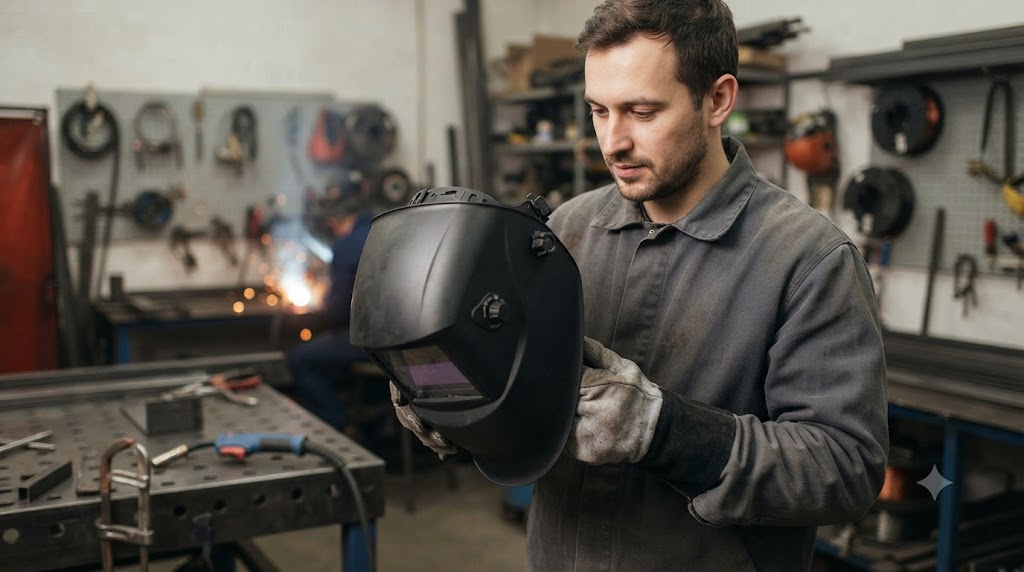
Walk into any hardware store and there is a wall of cheap welding helmets promising the same features as hoods that supposedly separate the pros. Some of them are honestly fine. Some are the reason a welder on a forum will tell you a cheap welding helmet almost cost them their eyesight. The trick is knowing which corners get cut when the price drops, so you can tell a smart bargain from a hazard.
A cheap welding helmet is usually an auto-darkening helmet built to a lower spend, with fewer arc sensors, a lower optical clarity rating, thinner shell plastic, and less consistent switching speed. The lens still blocks ultraviolet and infrared radiation if it is properly rated, so the danger is rarely radiation. The danger is a lens that reacts slowly or unevenly and lets arc flash sting your eyes.
Straight answer: a cheap welding helmet can be perfectly safe and useful for a hobbyist if it carries a genuine ANSI Z87.1 marking and has adjustable sensitivity. What you give up is not safety so much as clarity, comfort, viewing size, and the durability that lets a helmet survive daily professional use.
Where the money actually goes
When you compare a cheap helmet to a premium one, four things quietly change.
Optical clarity drops. Premium lenses hit 1/1/1/1; cheaper ones score lower, which shows up as a slight green tint, mild distortion, or shade that shifts when you look at an angle. You can weld through it, but your eyes work harder.
Sensor count and reaction consistency fall. Fewer sensors mean more chance of the lens missing a trigger in out-of-position work, and the cheapest lenses are more likely to lag or flicker at low amperage.
Build quality thins out. Lighter shells, simpler headgear, and cheaper knobs mean a shorter life and less comfort over a long session.
Parts support shrinks. Big brands keep cover lenses and headgear on every supplier’s shelf. Off-brand consumables can be hard to find when you need them.
Cheap done right: a helmet that earns its keep
The YESWELDER LYG-M800H is the example I use when someone insists all affordable helmets are junk. It gives you a large 3.93 by 3.66 inch window, four sensors, true color optics, and grind mode, which is genuinely more helmet than the low price suggests.
The flaw stays honest: the shell and headgear are lighter-duty than a Lincoln or Miller, and replacement lenses take more hunting. A production welder who needs parts today should skip it. A hobbyist or student who wants real capability without overspending should put it at the top of the list.
Cheap vs expensive, in plain terms
| Factor | Cheap helmet | Premium helmet |
|---|---|---|
| Radiation protection (if Z87.1) | Yes | Yes |
| Optical clarity | Lower, more tint | 1/1/1/1, cleaner view |
| Reaction reliability | Occasional lag or flicker | Consistent, fast |
| Durability | Lighter, shorter life | Built for daily abuse |
| Parts availability | Hit or miss | Widely stocked |
Read that table and the real difference becomes clear: you are not usually buying safety when you pay more, you are buying clarity, reliability, comfort, and the ability to keep the helmet running for years.
Who should buy cheap, and who should not
Buy the affordable helmet if you weld occasionally, you are learning, or you need a backup hood for a helper. The value is real and the protection is real when the rating is real.
Do not buy cheap if you weld for a living, if you do a lot of low-amp TIG where lens reliability decides whether you can even see the puddle, or if downtime waiting on off-brand parts would cost you a job. In those cases a mid-tier or premium helmet pays for itself in fewer headaches.
The honest takeaway
A cheap welding helmet is a smart buy when it is rated, adjustable, and matched to light-duty use, and a genuine hazard when it is an unrated no-name that lags on every strike. Check for the ANSI Z87.1 marking first, confirm you can adjust sensitivity, and be realistic about how hard you will use it. Get those three right and you can spend little without gambling with your eyes. Ignore them and the savings evaporate the first night your eyes feel like sandpaper.
Frequently asked questions
Are cheap welding helmets safe? They are safe from radiation if they carry a real ANSI Z87.1 marking, because the lens blocks UV and IR at all times. The risk is slow or unreliable darkening on the very cheapest models, not radiation exposure.
Are cheap welding helmets any good? Some are genuinely good for hobby and light use. A helmet like the YESWELDER LYG-M800H offers real features and protection, though it trades away durability and easy parts support.
What is a good affordable welding helmet? The YESWELDER LYG-M800H is a strong pick, with a large lens, four sensors, and grind mode. Confirm the Z87.1 marking and that sensitivity is adjustable before buying any affordable helmet.
What is the real difference between a cheap and expensive helmet? Mostly clarity, reaction reliability, comfort, and durability, not radiation protection. Premium helmets see cleaner, react more consistently, last longer, and have parts on the shelf everywhere.
Can I do low-amp TIG with a cheap helmet? Sometimes, but the cheapest lenses are more likely to flicker or fail to darken at low amperage. If low-amp TIG is your main work, step up to a helmet rated for it.
Will a cheap helmet damage my eyes? Not through radiation if it is rated, but a slow lens can let visible arc flash reach your eyes and leave them gritty and sore. Reaction speed is what you are really paying for at higher tiers.
References
-
OSHA, Eye Protection against Radiant Energy during Welding and Cutting: https://www.osha.gov/sites/default/files/publications/OSHAFACTSHEET-EYEPROTECTION-DURING-WELDING.pdf
-
NIOSH PPE-Info, ANSI/ISEA Z87.1-2020 standard details: https://wwwn.cdc.gov/PPEInfo/Standards/Info/ANSI/ISEAZ8712020
-
Miller Electric, Welding Helmet Clarity Ratings Explained: https://www.millerwelds.com/en-US/welding-solutions/product-details/welding-helmet-clarity-ratings-what-it-means-and-how-clearlight-compares
-
URL slug: cheap-welding-helmet
-
Excerpt: A cheap welding helmet is not automatically unsafe, but the price cut lands on clarity, reliability, comfort, and durability. This guide shows exactly what changes at the low end, names an affordable helmet that earns its keep, and explains who should skip cheap entirely.