Dekopro Welding Helmet Battery Replacement Guide
If your Dekopro welding helmet has started darkening slowly, flickering, or failing to trigger reliably, do not write it off yet. On budget auto-darkening hoods like these, that behavior almost always points to one cheap culprit: a tired coin cell battery. Replace it and the helmet usually comes right back to life for the cost of a couple of dollars.
The confusion is understandable, because these hoods advertise solar power, which makes it seem like they should never need a battery. But the solar panel only assists; a small replaceable coin cell runs the electronics the panel cannot cover on its own. When that cell fades, the symptoms look alarming even though the fix is trivial.
Confirm it is the battery first
A few symptoms point clearly at a dying cell rather than a broken filter.
The lens darkens slowly or lags behind the arc. It flickers or darkens unevenly. It fails to darken in dim conditions, where the solar assist has less light to draw on. These are classic weak-battery signs. If instead the lens is cracked, physically damaged, or does absolutely nothing even after a fresh battery and clean sensors, then the filter itself may be at fault. But battery first, always, because it fixes the large majority of cases.
Also rule out the simplest thing of all: make sure the hood is not switched to grind mode, which keeps the lens clear on purpose and fools people into thinking it has died.
Identify the right battery
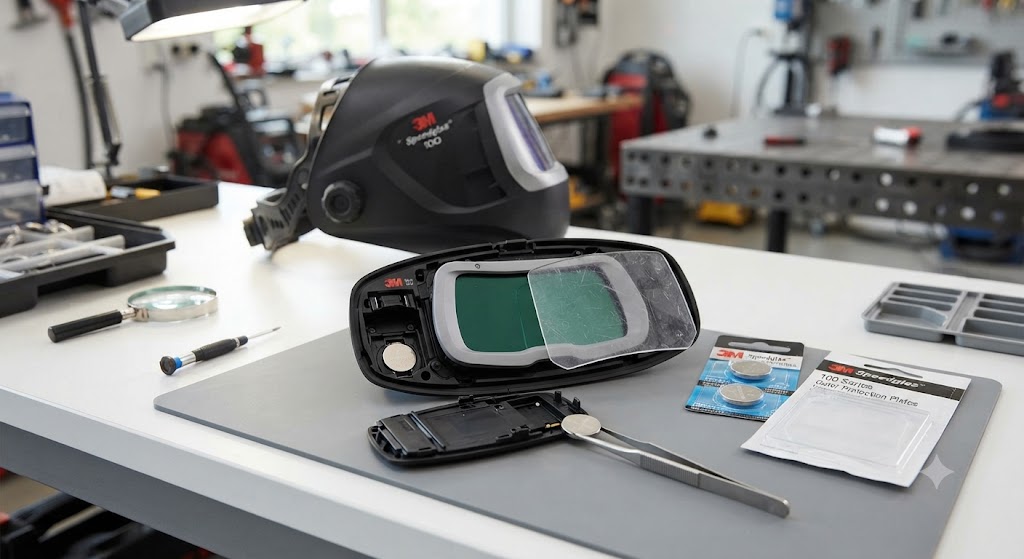
Budget auto-darkening helmets use one of a couple of common 3-volt lithium coin cells, and Dekopro-style hoods are typically in that group. The two you will most often encounter are the CR2032 and the larger, higher-capacity CR2450. Some models use a small replaceable lithium cell you access through a tray on the filter.
Do not guess. Open the battery compartment and read the number printed directly on the old cell, or check the manual. This matters because the cells are different sizes and are not interchangeable; a CR2450 will not seat in a CR2032 holder and vice versa. Matching the exact number takes ten seconds and saves a wasted order.
Once you know which you need, buy a fresh multipack so you are never stuck again. A CR2032 10-pack or a value CR2032 multipack covers years of swaps, while hoods that take the larger cell use a CR2450 pack instead.
Replace it step by step
The swap is quick once you have the right cell.
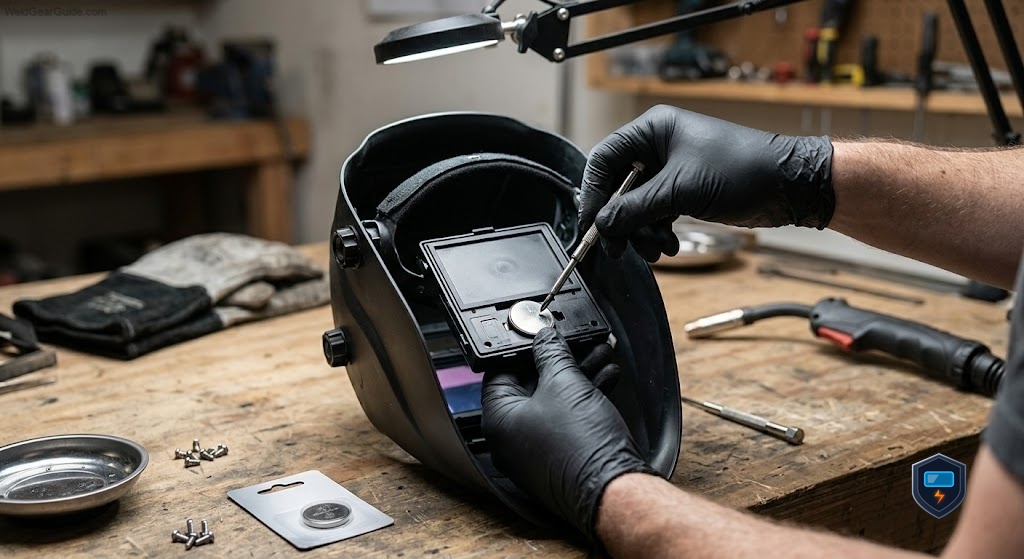
First, locate the battery compartment. On most of these hoods it is a small sliding tray or a door on the auto-darkening filter cartridge, reachable from the inside of the shell. Second, note how the old cell sits, positive side usually facing outward, before you remove it, so you can orient the new one the same way. Third, drop in the fresh cell in the same orientation, close the tray, and test by striking an arc or pressing the test button if the hood has one.
Handle the new battery by its edges to keep skin oils off the flat contact faces. If the lens works normally afterward, you are done, and it cost you almost nothing.
If a fresh battery does not fix it
On the rare occasion a new, correctly oriented cell does not solve the problem, work through the other cheap causes before giving up on the hood. Clean the arc sensors on the front of the filter with a soft cloth, since dust or spatter over them can stop the lens triggering. Confirm once more that you are in weld mode. Check that the solar panel is not covered. Only after all of that should you conclude the filter cartridge itself has failed, which on a budget hood often means replacing the helmet, since the filter is frequently not separately replaceable.
What to take away
A slow, flickering, or unreliable Dekopro helmet lens is almost always a dying coin cell, and replacing it is a quick, inexpensive fix rather than a reason to buy a new hood.
Three things to remember. Slow darkening, flicker, and failure in dim light are classic weak-battery symptoms, so try a fresh cell first. Identify the exact battery, usually a CR2032 or CR2450, by reading the number on the old cell rather than guessing, since the sizes are not interchangeable. And if a fresh battery does not help, clean the sensors and check for grind mode before concluding the filter has failed.
Frequently asked questions
What battery does a Dekopro welding helmet use? Usually a 3-volt lithium coin cell, commonly a CR2032 or the larger CR2450. Read the number printed on your old cell or check the manual, since models vary.
Why is my Dekopro lens slow or flickering? Almost always a dying coin cell. The solar panel only assists; the battery runs the electronics, so a weak cell causes slow darkening, flicker, or failure in dim light.
How do I replace the battery in my welding helmet? Open the tray on the filter cartridge, note the orientation of the old cell, drop in a fresh one the same way, close it, and test by striking an arc.
My helmet is solar powered, so why does it need a battery? The solar panel only assists. A coin cell powers the electronics the panel cannot cover alone, so a dead battery still stops the lens from working.
Are CR2032 and CR2450 batteries interchangeable? No. Both are 3-volt lithium coin cells, but the CR2450 is larger and higher capacity. They will not fit each other’s holders, so match the exact number.
My lens still won’t darken after a new battery. What now? Clean the arc sensors, confirm you are not in grind mode, and check the solar panel is uncovered. If it still fails, the filter cartridge itself may be faulty.
Can I replace the auto-darkening filter on a budget hood? Often not. On many budget helmets the filter is not separately replaceable, so a genuinely failed filter usually means replacing the whole helmet.
References
- Occupational Safety and Health Administration, Eye and Face Protection
- American National Standards Institute and ISEA, Z87.1 Occupational Eye and Face Protection
- National Institute for Occupational Safety and Health, Welding Safety