ESAB Sentinel A50 Review: The Touchscreen Hood That Started a Cult
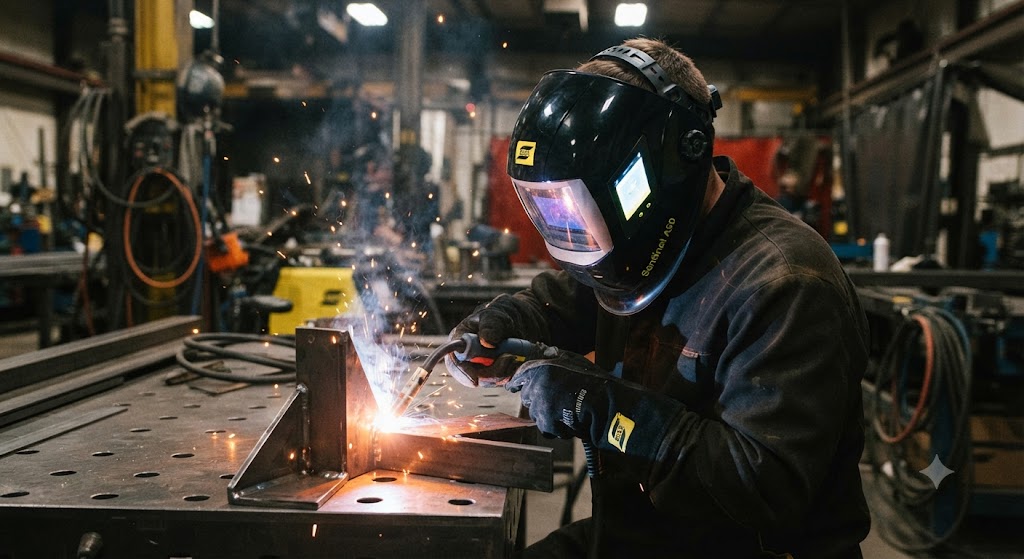
Few helmets have won as many converts as the ESAB Sentinel A50. Ask around any fabrication shop and you will find at least one welder who bought the stormtrooper-looking hood as a bit of a splurge and now refuses to weld in anything else. The ESAB Sentinel A50 earned that loyalty by doing something most helmets do not: it made setup genuinely pleasant, wrapped it in a comfortable shell, and priced it below the flagship crowd. This review looks at whether it still deserves the hype.
You can check the current Sentinel A50 listing here.
What sets the A50 apart
The headline feature is the color touchscreen control panel inside the shell. Instead of squinting at tiny buttons, you tap through graphical menus to set shade, sensitivity, and delay, and you can save up to eight memory settings and recall them instantly. If you switch between MIG in the morning and low-amp TIG in the afternoon, that memory system turns a fiddly reconfiguration into two taps.
The filter itself gives you a 3.93 by 2.36 inch viewing area with a 1/1/1/2 optical clarity rating and a shade 5 to 13 range that covers everything from cutting and prep to heavy stick. There is an externally activated grind button that drops the lens to a shade 4 grind state without you reaching inside the hood, which is exactly where a grind control should be.
The comfort story
The other reason welders fall for the A50 is the Halo headgear. It is an infinitely adjustable five-point suspension, and its low-profile central pivot gives you real head clearance when you flip the hood up, so you are not knocking the shell on pipe or steel above you. The high-impact nylon shell keeps the whole thing light and balanced. Welders who suffered neck fatigue in bulkier hoods routinely name the Halo system as the reason they switched and stayed.
How it compares
Set the A50 against the 3M Speedglas 9100XXi and the trade is clear. The Speedglas offers longer-proven optical consistency and a deeper parts ecosystem, while the A50 offers a slicker control interface and a lower price for a similar viewing size. Against the Miller Digital Elite, the A50 counters with its touchscreen and Halo comfort, while Miller answers with X-Mode arc detection for out-of-position work. Within ESAB’s own range, the A50 sits below the larger-window A60, which is the model to choose if you want the biggest possible view.
The honest read is that the A50 is one of the best-value premium hoods on the market. It gives you most of the flagship experience without the flagship sticker.
The flaws worth knowing
Two real drawbacks. First, the touchscreen is a wonderful feature and also one more piece of electronics that can fail; a handful of owners have reported control or screen issues after long, hard service, so treat the panel with a little respect. Second, the low-profile shell offers less coverage down the neck and around the sides than a bulkier hood, so for heavy overhead or out-of-position work you may want a bandana or additional protection. The viewing area, while good, is also smaller than the A60 and some rivals.
Who should skip it? Welders who need maximum neck and side coverage for constant overhead work, and anyone who distrusts touchscreen electronics on a shop tool and would rather have simple physical dials. For them a more traditional hood is the safer pick.
Who it is for
The Sentinel A50 is for the welder who wants premium comfort, an easy control interface, and a large clear view without paying flagship money. Hobbyists stepping up to their forever hood and professionals who value the memory settings both land here happily. It has earned its cult status.
Frequently asked questions
What is the viewing area of the ESAB Sentinel A50? Approximately 3.93 by 2.36 inches, with a 1/1/1/2 optical clarity rating and a shade 5 to 13 auto-darkening filter.
Does the Sentinel A50 have a grind mode? Yes. It has an externally activated grind button that drops the lens to a shade 4 grind state, plus eight memory settings for quick recall.
What battery does the Sentinel A50 use? It uses a replaceable CR2450 lithium coin cell, a common battery shared by many premium helmets.
Is the Sentinel A50 good for TIG welding? Yes. Its shade range starts at 5, sensitivity is adjustable, and the memory settings make switching to a TIG profile quick and easy.
What is the difference between the Sentinel A50 and A60? The A60 has a larger viewing area and improved optics, while the A50 has a smaller window at a lower price. Both share the touchscreen and Halo headgear.
Is the Sentinel A50 worth the money? For welders who value comfort, an easy interface, and a large view, yes. It delivers much of the flagship experience for less than the top 3M and Miller hoods.
References
- ESAB Sentinel A50 product listing and specifications, ESAB
- ESAB University, how to choose a welding helmet
- American Welding Society, welding lens shade chart and eye protection guide
- OSHA fact sheet, eye protection during welding