Welding Gear Setup Guide for Farm and Ranch Welding
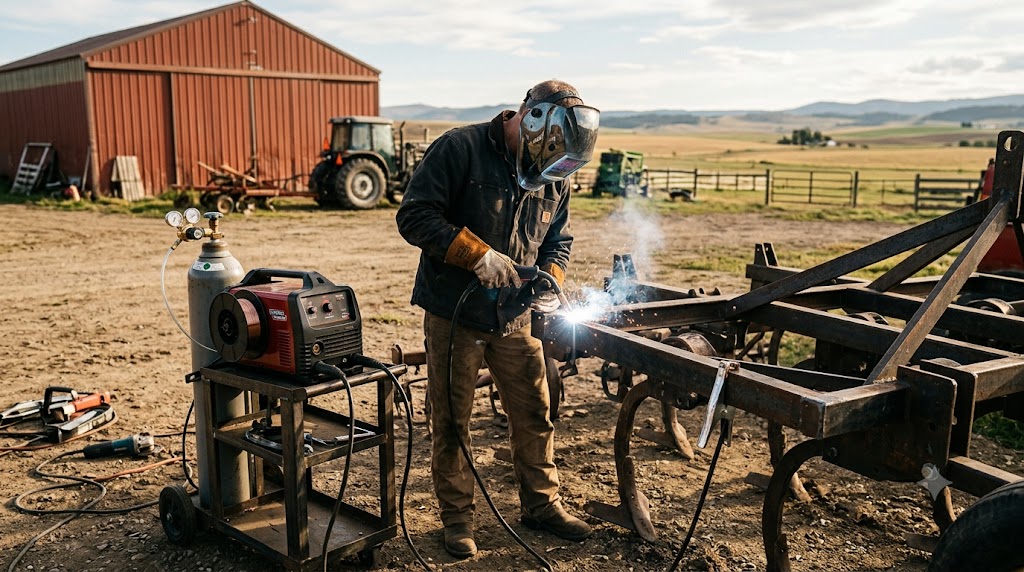
A fence post bracket snaps at 7 AM in January. You need it welded before the cattle move through that gate at noon. You’re not setting up a clean shop environment — you’re kneeling in frozen mud, working on a tractor drawbar that hasn’t been cleaned since 2019, with a cold electrode and gloves that are stiff from the cold. The helmet you reach for in that moment is probably not the same one you’d spec for a fabrication shop. And that’s fine. Farm and ranch welding has its own requirements, and they favor a different set of tools.
Farm welding is field work as much as it is shop work. It means stick and flux-core on dirty, rusty, painted metal. It means working outdoors in variable light. It means tacking parts together, repositioning, tacking again — repeated cycles of looking up, looking down, striking an arc. That workflow penalizes auto-darkening helmets that are slow to react in cold temperatures or that have small viewing areas that require precise head positioning every time you restart.
For farm and ranch use, the helmet that shows up most often on wire fences, grain bins, and equipment frames is the flip-front passive hood. Reliable, no batteries, no sensors, no electronic failure modes in the cold or the dust. The other strong option is a mid-tier auto-darkening helmet that’s rugged enough to survive being tossed in a truck toolbox without voiding a warranty. The gear priorities are durability, simplicity, and versatility across stick, MIG, and the occasional flux-core job.
Why Passive and Flip-Front Hoods Are Still Popular on Farms
A passive welding helmet has no electronics. There’s nothing to fail, nothing to drain, nothing to recalibrate. A flip-front hood adds the ability to flip the dark lens up for inspection and positioning without removing the helmet — which matters on a farm where you might be tacking twenty points on a piece of equipment and stopping between each one to position the next piece.
The argument for passive hoods isn’t that they’re better than auto-darkening. It’s that they’re simpler, and simplicity has value in a field environment. You don’t need to worry about the sensor triggering on bright afternoon sun before your arc fires. You don’t need to carry batteries. If the lens gets scratched or fouled, you swap a fixed-shade glass for a few dollars.
The tradeoff is the standard issue with passive hoods: every time you flip down or strike an arc without looking directly at the joint, you risk missing the start. But experienced stick welders on farm repair work have managed this for decades — you hear the arc before you see it, and you’ve already positioned the electrode.
Lincoln Electric Viking Industrial Passive
The Lincoln Electric Viking Industrial Passive is one of the most durable all-day passive hoods currently on Amazon with a verified listing. It uses the Viking shell — the same high-impact housing as the auto-darkening Viking series — so it survives the truck toolbox and the occasional drop off a grain bin ladder better than cheaper import shells.
The ANSI Z87.1 rated fixed shade 10 lens is appropriate for stick and MIG at most farm repair amperages (60-200A). The ratchet headgear adjusts smoothly even with gloved hands, which matters when you’re repositioning in the field.
The flaw: the fixed shade 10 lens is correct for stick at medium amperage but is darker than necessary for low-amperage tacking work, where some welders prefer shade 8 or 9. You can swap the lens for a lighter fixed glass without replacing the helmet, but it’s a step that shop-focused welders don’t have to think about.
A verified live listing: Lincoln Electric Viking Industrial Passive
Auto-Darkening on the Farm: When It Makes Sense
Not every farm welder prefers passive hoods. Ranchers who do a higher volume of welding — multiple repairs a week, shop work on trailers and loaders — benefit from the productivity gain of auto-darkening. You weld faster when you don’t have to reposition your electrode every time you flip the hood up, and at higher repair volumes that time adds up.
For farm auto-darkening use, the key requirements are different than for a precision TIG shop: you need a helmet that survives dust and temperature swings, has a large enough viewing area to see a rough joint on a trailer hitch without perfect positioning, and has a mode-switching system simple enough to operate in gloves.
Lincoln Electric Viking 3350
The Viking 3350 is a premium auto-darkening helmet, and that may seem like overkill for farm work. But the 12.5 square-inch viewing area earns its keep on the farm in a way it doesn’t always in a shop. When you’re reaching into an awkward angle on a piece of equipment and you can’t position your head exactly where you’d like it, the wider lens shows you the joint anyway.
The 4C lens technology provides better color rendering than a standard ADF, which helps when you’re welding on dark, rusty metal under variable outdoor light. You can see the weld pool against a dirty base metal without the muddy, low-contrast view that basic green-tint lenses produce on oxidized steel.
Four arc sensors ensure reliable triggering outdoors where bright ambient light can cause false darkening events with two-sensor helmets. The X6 headgear adjusts with fewer knob turns than most competing headgear systems.
The flaw: the Viking 3350 is not built for abusive storage. The lens assembly and shell are durable, but the 4C optics are a premium component, and the helmet doesn’t belong loose in a toolbox with chain hooks and wrenches. Farm welders who want auto-darkening but toss gear casually should stick with a less expensive ADF or the passive hood.
A verified live listing: Lincoln Electric Viking 3350
Farm Helmet Comparison
| Feature | Lincoln Industrial Passive | Lincoln Viking 3350 |
|---|---|---|
| Type | Passive fixed-shade | Auto-darkening |
| Shade | Fixed 10 | Variable 5-13 |
| Arc sensors | N/A | 4 |
| Durability | High (simple construction) | High (premium shell, needs care) |
| Best for | Stick repair, field work | Multi-process farm shop use |
| Flaw | Fixed shade limits versatility | Too expensive to treat roughly |
Other Gear Worth Considering for Farm Welding
Gloves: For stick and MIG on farm repairs, heavy cowhide MIG gloves are appropriate. Farm welding involves more ground-level and awkward-position work where spatter contact is more likely than in a clean shop. The extra thickness is an asset when you’re welding a hitch receiver in the mud rather than a square tube on a welding table.
Welding jacket or sleeves: FR cotton or leather jackets work for most farm repair welding. On hot days doing occasional stick repairs, FR sleeves and a cotton shirt keep you cooler than a full jacket while still covering your forearms. If you’re in and out of a repair truck all day, a simple leather apron for stick welding is a practical compromise.
Ground connection: Farm welding failures often trace back to the ground clamp more than the helmet or gloves. Dirty, painted, or corroded clamping surfaces create resistance that produces unstable arcs. A stainless brush and a few seconds to clean the clamp point saves more welds than a premium helmet ever will.
FAQ
What welding helmet works best for outdoor farm repairs? For pure field work on stick and MIG repairs, a flip-front passive hood like the Lincoln Industrial Passive is reliable and low-maintenance. For farm shop use where you’re doing higher volumes, the Lincoln Viking 3350’s four sensors and large viewing area handle outdoor light conditions and awkward positions better than most.
Do farm welders need a different helmet than shop welders? Not a categorically different type, but different priorities. Farm welders should prioritize durability, simple controls, and larger viewing areas over precision optics and digital features. A 1/1/1/1 optical clarity rating matters more for precision TIG than for stick welding a grain auger bracket.
What gear holds up best to dust and dirt on a farm? Passive hoods hold up best because they have no electronics to fail. Among auto-darkening helmets, the Lincoln Viking series and ESAB Sentinel use high-impact nylon shells that resist dust and light impacts well. Avoid helmets with exposed electronic controls on the outside face of the shell — those controls are vulnerable to physical damage in a field environment.
Is a flip-front helmet better for tacking on equipment? For repetitive tack welding where you’re positioning and repositioning between every pass, yes. The flip-front design lets you look at the joint, position the electrode, flip down, and weld without removing or fully replacing the helmet. Over the course of a long repair session that time savings is real.
What shade do I use for stick welding on a farm? For stick welding at 60-160 amps (the range covering most farm repair work with 3/32” to 1/8” rod), OSHA 1915.153 Table I-1 sets the minimum at shade 8, with shade 10 as the suggested comfort setting. A fixed shade 10 lens covers most farm stick welding without adjustment.
Does cold weather affect auto-darkening helmets on the farm? Yes. Most ADF lenses slow their switching speed below freezing, and some budget helmets fail to darken fast enough in extreme cold. Helmets with temperature-rated ADFs (the ESAB Sentinel A50 and Lincoln Viking are typically rated to -5C/23F and below) are safer in cold-weather field conditions than budget auto-darkening units.
What’s the most common helmet mistake for farm welders? Using a cheap two-sensor auto-darkening helmet outdoors. Two sensors work well indoors where you have full line-of-sight on the arc from every angle. Outdoors, bright ambient light and non-standard welding positions (low, at an angle) frequently fool two-sensor helmets into false darkening events or missed triggers.
References
- https://www.osha.gov/laws-regs/regulations/standardnumber/1915/1915.153
- https://www.osha.gov/sites/default/files/publications/OSHAFACTSHEET-EYEPROTECTION-DURING-WELDING.pdf
- https://www.lincolnelectric.com
URL slug: farm-welding-helmet-gear-guide Excerpt: Farm welding favors simplicity, durability, and large viewing areas over precision optics. Passive flip-front hoods are the field standard; the Lincoln Viking 3350 earns its place in the farm shop. Here’s what to buy and why.