Hobart Welding Helmet Guide: Honest Value From a Trusted Name
Hobart occupies a specific and useful place in the welding world. It shares engineering roots with Miller, it sells through farm and hardware stores where real working people shop, and it prices its gear for garages and small fabrication shops rather than industrial procurement departments. A Hobart welding helmet is rarely the flashiest option on the shelf, but it is almost always a sensible one. This guide walks the current lineup so you can pick the right Hobart hood for your work and your budget.
What Hobart is really about
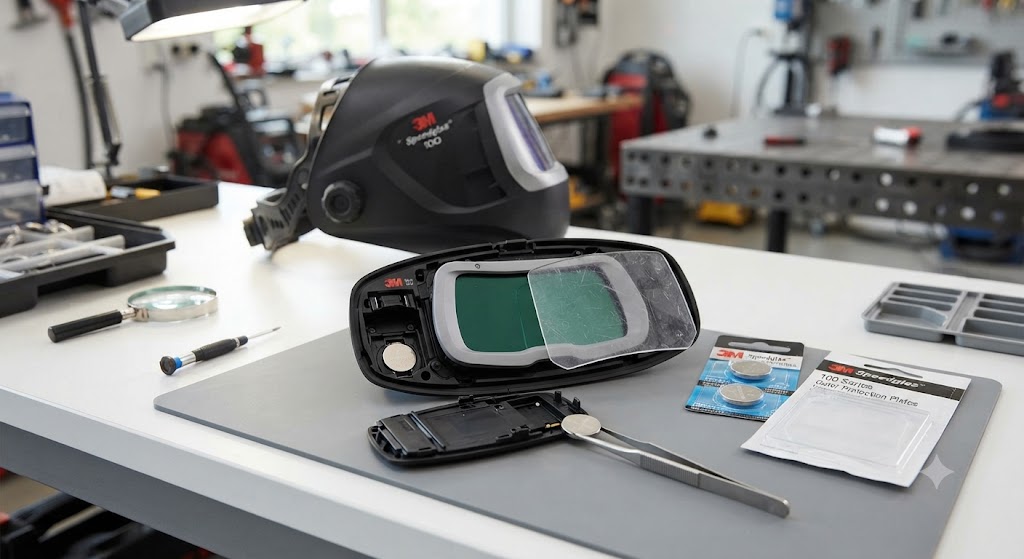
Hobart’s whole pitch is dependable value. The current auto-darkening helmets all use PureColor lens technology, which renders the arc and workpiece in more accurate, true-to-life color than older green-tinted lenses, and that clarity used to be reserved for pricier hoods. They pair that lens with grind modes, adjustable ratcheting headgear, and reliable arc sensing, and they run on the same CR2450 battery that Miller uses, which makes replacements easy to find. You are getting Miller-adjacent engineering at a farm-store price.
Every Hobart auto-darkening helmet also gives you continuous UV and infrared protection whether the lens is light, dark, or powered off, which is the safety floor that OSHA and the American Welding Society insist on. That protection never depends on the battery, so a dead cell darkens nothing but never exposes your eyes to the invisible part of the arc.
The lineup, from top to entry
Inventor Series. This is the flagship Hobart auto-darkening hood. It offers the largest view in the range at 9.3 square inches, four independent arc sensors, a fast reaction time around 1/25,000 of a second, grind mode, and PureColor optics. If you want the best Hobart, this is it, and it is the one I point most buyers toward.
Creator Series. The mid-range model. It steps down to a 7.1 square inch viewing area and three arc sensors while keeping PureColor optics, grind mode, and the adjustable headgear. It costs less than the Inventor and suits welders who do not need the biggest window or the fourth sensor.
Pillar Series and passive hoods. Below the Creator, Hobart offers simpler entry auto-darkening and traditional passive helmets for the most budget-conscious buyers and for shops that just need a basic backup hood.
Older Hobart lines such as the Impact and Endeavor series still turn up secondhand and share the same CR2450 battery, so parts and cells remain easy to source even for those.
How Hobart compares
Set a Hobart Inventor against a budget import and the Hobart wins on brand trust, sensor count, and PureColor clarity. Set it against a premium hood like the ESAB Sentinel A50 or Lincoln Viking 3350 and the comparison flips: the Sentinel and Viking offer larger views, better optical clarity ratings, and plusher headgear, but they cost considerably more. Hobart lives in the value middle, and that is exactly where a lot of welders should be shopping.
The honest drawbacks
The main flaw across the Hobart range is that the controls are internal, mounted inside the shell above the viewing area, so adjusting shade, sensitivity, or delay means lifting or removing the hood. For a welder who constantly tweaks settings that is a nuisance, though for someone who dials it in once and forgets it, it is a non-issue. The other limit is view size: even the Inventor’s 9.3 square inch window, while good, trails the largest premium hoods, and the Creator’s is smaller still.
Who should skip Hobart? Full-time professionals who want the largest possible view and external touchscreen controls, and low-amp TIG specialists who need the widest shade range and highest optical clarity. For them a Sentinel, Viking, or Speedglas is the better fit.
The bottom line
If you want a trustworthy auto-darkening hood from a name with real welding pedigree, at a price that respects a garage budget, Hobart delivers. Buy the Inventor for the best view and sensor count, drop to the Creator to save money, and go passive or Pillar only for backup or the tightest budgets.
Frequently asked questions
Which Hobart welding helmet is the best? The Inventor Series is the flagship, with the largest 9.3 square inch view, four arc sensors, and PureColor optics. It is the best all-round Hobart for most welders.
What is the difference between the Hobart Inventor and Creator? The Inventor has a larger 9.3 square inch view and four arc sensors, while the Creator has a 7.1 square inch view and three sensors at a lower price.
What battery do Hobart helmets use? Most current Hobart auto-darkening helmets use a CR2450 lithium coin cell, the same battery as Miller helmets, which makes replacements easy to find.
What is PureColor lens technology? It is Hobart’s lens tint that renders the arc and workpiece in more accurate, true-to-life color than traditional green-tinted lenses, improving clarity.
Are Hobart helmets good for beginners? Yes. They offer trusted engineering, reliable sensors, and PureColor clarity at an approachable price, making them a strong choice for hobbyists and new welders.
Do Hobart helmets have a grind mode? Yes. The current auto-darkening models include a grind mode that keeps the lens clear so you can grind without the lens darkening.
References
- Hobart Welders, Inventor and Creator Series helmet specifications, Hobart
- Hobart Welders, welding helmets overview and PureColor lens technology, Hobart
- American Welding Society, welding lens shade chart and eye protection guide
- OSHA fact sheet, eye protection during welding