Jackson PL280 Pipeline Review: The Flip-Front Specialist
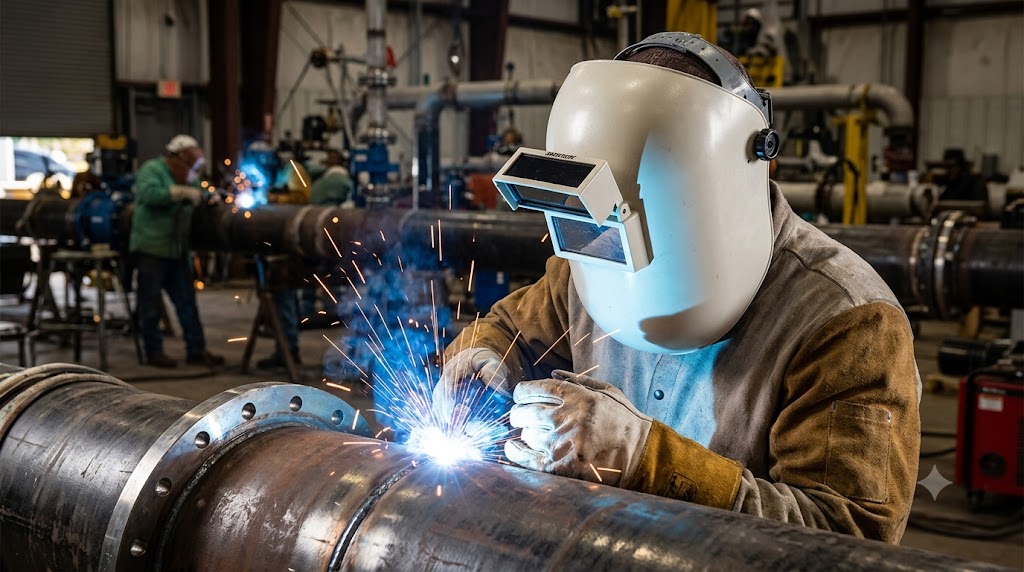
Most of this brand’s lineup chases auto-darkening clarity, but the Jackson PL280 answers a different question entirely: how do you build the perfect hood for a pipeline welder who has to inspect the bead constantly? The answer is a rugged, USA-made flip-front passive helmet that trades electronics for simplicity and durability. This Jackson PL280 Pipeline review explains why this specialist tool still earns its place in a shop full of auto-darkening hoods.
You can check the current Jackson PL280 listing here.
Why a flip-front helmet exists
The PL280 is not an auto-darkening helmet, and that is the point. It uses a passive fixed-shade lens, typically shade 10, mounted in a flip-up front. You weld with the dark lens down, then flip the front up to a clear safety window to inspect the bead, chip slag, or line up the next pass, without ever removing the hood from your head. For pipeline and structural welders who stop and check their work dozens of times an hour, that flip motion is faster and less disruptive than lifting an entire hood, and it keeps the helmet properly positioned for the next arc.
Because it is passive, there are no batteries to die, no sensors to blind with spatter, and no electronics to fail in the field. That reliability is exactly why many pipeline welders still prefer this style. The PL280 is made in the USA, is built to survive jobsite abuse, and comes in multiple headgear styles and colors so crews can set it up the way they like.
Living with it
The PL280 rewards the welder who values ruggedness and routine over technology. There is nothing to configure: you set your fixed shade and go. The flip mechanism becomes second nature within a day, and the lack of electronics means it simply keeps working in cold, heat, and grime that can trouble battery-powered hoods. It is a tool built around a specific workflow, and within that workflow it is excellent.
How it compares
Comparing the PL280 to an auto-darkening hood like the TrueSight II is really a comparison of philosophies. The TrueSight II gives you a true-color lens that darkens automatically and never needs flipping, which suits welders who stay on a continuous arc. The PL280 gives you a passive lens and a flip front, which suits welders who constantly interrupt to inspect and who want zero electronics. Neither is better in the abstract; they fit different jobs. If your work is stop-and-check pipeline or heavy structural welding, the flip front wins; if you run continuous MIG all day, an auto-darkening hood makes more sense.
The honest flaws
The PL280’s limits follow directly from its passive design. With a fixed-shade lens, you cannot fine-tune the shade to different amperages the way a variable ADF allows, and there is no grind mode, so you flip up or swap for grinding. You also have to flip the lens down before striking an arc every time, which is the tradeoff for not relying on sensors; there is no automatic protection if you forget. And the viewing experience is a plain passive lens, not a bright true-color ADF. This is a specialist’s tool, and it makes no apology for it.
Who should skip it? Welders who run continuous arcs and want automatic darkening, hobbyists who want one do-everything hood, and anyone who values a bright true-color view or a grind mode. For them an auto-darkening Jackson like the Insight or TrueSight II is the right call.
Who it is for
The Jackson PL280 Pipeline is for the pipeline, structural, and production welder who inspects constantly, works in tough conditions, and wants a rugged, battery-free, USA-made flip-front hood. If that describes your work, the PL280’s simplicity is a feature, not a compromise, and it will likely outlast several electronic hoods.
Frequently asked questions
Is the Jackson PL280 an auto-darkening helmet? No. It is a passive flip-front helmet with a fixed-shade lens, typically shade 10, designed for welders who inspect the bead frequently.
Why choose a flip-front helmet? The flip front lets you switch between welding and a clear inspection view without removing the hood, which is faster for pipeline and structural work that involves constant checking.
Does the PL280 need batteries? No. Because it is passive, there are no batteries, sensors, or electronics to fail, which is a key reason pipeline welders favor it.
Where is the Jackson PL280 made? It is made in the USA and built to withstand demanding jobsite conditions.
Can I adjust the shade on the PL280? No. It uses a fixed-shade passive lens, so you cannot fine-tune the shade the way a variable auto-darkening filter allows.
Who should buy the PL280 instead of an auto-darkening hood? Pipeline and structural welders who inspect constantly and want a rugged, battery-free helmet. Continuous-arc welders are better served by an auto-darkening hood.
References
- Jackson Safety by SureWerx, PL280 Pipeline welding helmet specifications, Jackson Safety
- American Welding Society, welding lens shade chart and eye protection guide
- OSHA fact sheet, eye protection during welding
- NIOSH, ANSI/ISEA Z87.1 eye and face protection standard