Miller Welding Helmet Lineup: Every Model Compared
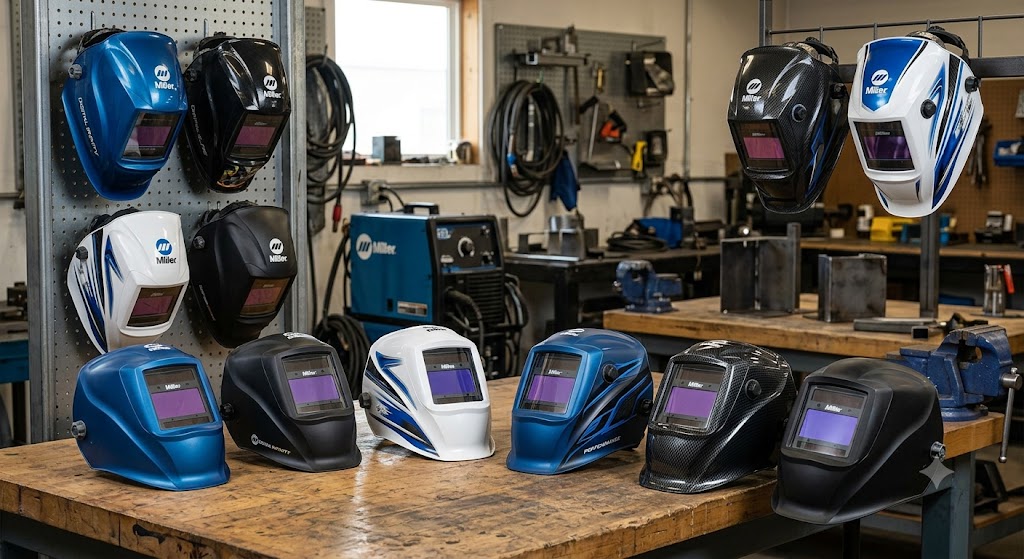
Few names carry the weight in a fabrication shop that Miller does, and choosing a Miller welding helmet means picking from a lineup that runs all the way from a simple bench hood to a powered air system that filters the fumes you breathe. That range is a blessing and a trap: buy the wrong tier and you either overpay for features you will never touch or come up short on the clarity you needed. This hub lays out the whole family so you can find your model without guessing.
What the Miller helmet family covers
Miller organizes its auto-darkening helmets around a signature lens family called ClearLight, now in its ClearLight 4x generation, which trades the old green tint for a brighter, more natural view. The lineup spans the flagship Digital Infinity with the largest viewing window, the all-day workhorse Digital Elite, the mid-tier Digital Performance, the value-focused Classic Series, the older Elite, and the T94i powered air purifying respirator helmet for fume-heavy work. Every current model carries ClearLight optics and meets the ANSI Z87.1 standard that OSHA references for welding eye protection.[^https://www.osha.gov/sites/default/files/publications/OSHAFACTSHEET-EYEPROTECTION-DURING-WELDING.pdf]
The quick answer: which Miller helmet is right for you
If you weld all day and want the best balance of clarity, comfort, and weight, the Digital Elite is the model most pros land on. If you want the biggest possible window and top-tier optics and do not mind extra weight, step up to the Digital Infinity. If you are a hobbyist or bench welder on a budget, the Classic Series gives you real ClearLight optics in a lighter, simpler package. And if you weld stainless, galvanized, or in a poorly ventilated space, the T94i PAPR is the one that protects your lungs, not just your eyes.
Match the tier to how often you weld and what you weld, and any of these will serve you well. The mistake is buying by brand loyalty alone instead of by workload.
The premium tier: Digital Infinity and Digital Elite
The two flagships share ClearLight optics, four arc sensors, and the four operating modes of Weld, Cut, Grind, and X-Mode, which reduces sunlight interference for outdoor and low-amp TIG work. The Digital Infinity leads with a 13.4 square inch viewing area, the largest Miller offers, while the Digital Elite counters with a lighter 18 ounce build and a 9.2 square inch window that many welders find is the better all-day compromise. Choose Infinity for maximum view, Elite for maximum comfort.
The value tier: Classic Series and Elite
The Classic Series is the entry point into genuine Miller optics, with ClearLight technology, two arc sensors, a variable weld shade of 8 to 13, and a compact 6 square inch window. It is lighter and far cheaper than the flagships, which makes it a smart hobbyist pick. The older Elite sits just above it historically, though it has largely been folded into the digital lineup and is harder to find new today, so most buyers should look at the Classic or Digital Elite instead.
The specialist: T94i PAPR
The T94i paired with Miller’s powered air purifying respirator is a different animal. It combines a flip-front ClearLight helmet with a belt-mounted blower and HEPA filtration that guards against hexavalent chromium, zinc oxide, manganese, and other welding fumes. It is heavy, expensive, and overkill for a hobbyist, but for a professional welding stainless or galvanized steel daily it is the responsible choice.
How to choose across the Miller lineup
Picking a Miller welding helmet comes down to three questions: how many hours a week you weld, how big a window you want, and whether your work produces fumes that demand respiratory protection. Hobbyists are well served by the Classic Series, daily welders by the Digital Elite, clarity chasers by the Digital Infinity, and anyone facing heavy fumes by the T94i PAPR. Whichever you pick, the ClearLight lens and ANSI Z87.1 certification are the common thread that make a Miller a Miller.
Frequently asked questions
Is Miller a good welding helmet brand? Yes. Miller is one of the most respected names in welding, and its ClearLight lens technology is regarded as among the best auto-darkening optics available.
What is the difference between the Digital Elite and Digital Infinity? Both share ClearLight optics and four modes. The Infinity has a larger 13.4 square inch window, while the Elite is lighter at 18 ounces with a 9.2 square inch view, making it easier to wear all day.
Which Miller helmet is best for beginners? The Classic Series. It offers real ClearLight optics at the lowest price in the lineup, in a light, simple package suited to hobby and bench work.
Do all Miller helmets use the same battery? Nearly all use the CR2450 lithium coin cell, part number 217043, except the analog Pro-Hobby series. This makes battery stocking simple across the range.
Which Miller helmet protects against fumes? The T94i paired with Miller’s PAPR system filters welding fumes with a HEPA blower, unlike the standard helmets that protect only the eyes and face.
Are Miller helmets ANSI certified? Yes. Current Miller auto-darkening helmets meet the ANSI Z87.1 standard that OSHA references for welding eye and face protection.
References
- Miller Electric, ClearLight 4x Lens Technology: https://www.millerwelds.com/en-US/technologies/clearlight-4x
- U.S. Occupational Safety and Health Administration, Eye Protection During Welding: https://www.osha.gov/sites/default/files/publications/OSHAFACTSHEET-EYEPROTECTION-DURING-WELDING.pdf