Optrel Galaxy Welding Helmet Review
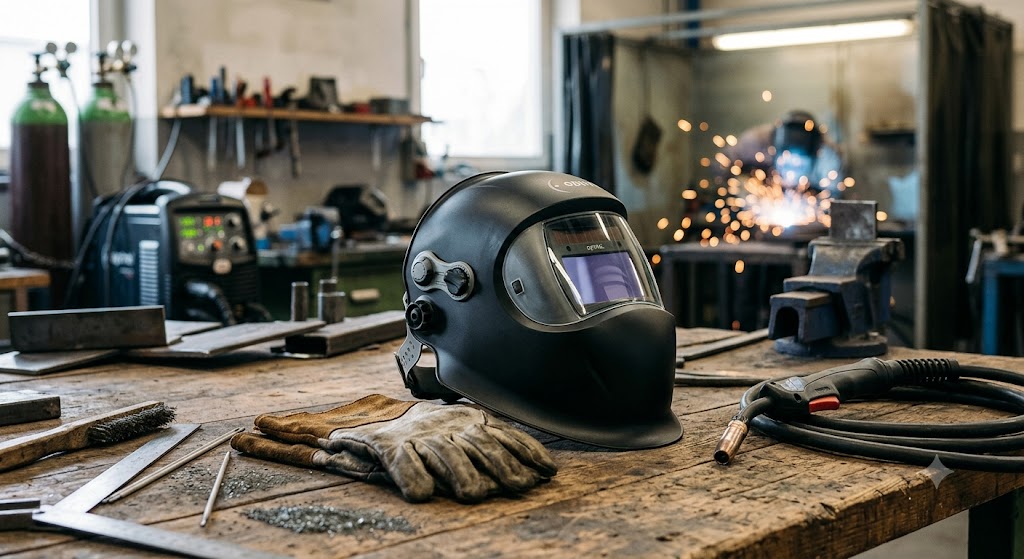
The Optrel Galaxy is the entry point of the Optrel family. While the Crystal 2.0, Sphere X CLT, and Panoramaxx represent Swiss precision auto-darkening technology at its highest development, the Galaxy takes a different approach: it does not darken automatically at all. The Galaxy is a passive welding helmet with a fixed shade 10 filter. No batteries. No ADF. No settings to adjust. You put it on and you weld.
Understanding what that means - and whether it is the right choice for your situation - is what this review is about.
What the Optrel Galaxy Is
The Galaxy (model 1000.565) is a fixed-shade passive welding helmet. It provides shade 10 protection through a standard passive lens plate. The viewing area is 4.25 in x 2 in - the standard 2 x 4.25 format used across passive welding helmets and most auto-darkening helmets in the same class.
It is ergonomically designed with a helmet shell rated to 220 degrees Celsius and a front cover lens rated to 137 degrees Celsius. The headgear provides adjustable fit for comfort during extended use. The helmet is available in black (1000.565) and the design is compatible with magnifying cheater lenses.
At 17.2 ounces, the Galaxy is a lightweight passive helmet. It meets the same EN175 and applicable ANSI impact standards as more expensive Optrel models.
Why Passive Still Matters
Auto-darkening technology has improved dramatically over 30 years, but passive helmets have not disappeared from professional shops. Here is why the Galaxy still has a place:
Reliability in extreme environments: Passive lenses have no electronics to fail, no batteries to discharge, and no sensor windows to contaminate. In environments with extreme heat, electromagnetic interference, or submersion risk, passive helmets are the only choice.
Pipeline and code welding: As covered in the Jackson PL280 article, many pipeline and code welding contexts still specify or prefer passive helmets. The Galaxy’s shade 10 glass and standard 2 x 4.25 format makes it compliant with those requirements.
Training environments: Teaching a student to use the nod technique - the practiced head movement that flips the helmet down just before striking an arc - is genuinely easier with a passive helmet. The arc strike discipline developed with passive helmets transfers to any auto-darkening helmet later.
Cost and simplicity: For a welder who welds rarely, stores the helmet for months, and does not want to think about batteries, the Galaxy requires nothing. It works every time, every year, without any maintenance beyond keeping the cover lens clean.
Named Limitation: Shade 10 Only
The Galaxy’s primary limitation is the fixed shade. Shade 10 covers most MIG and stick welding from approximately 60 to 175 amps - the range most common for hobby and maintenance welding. Outside that range, shade 10 is either insufficient (high-amperage work above 200 amps) or darker than necessary (low-amperage TIG below 60 amps).
Welders who do TIG at 20-30 amps should be using shade 8-9. Welders doing heavy SMAW at 250 amps should use shade 12. The Galaxy offers neither. This is not a design flaw - it is a deliberate product positioning decision. The Galaxy is for the welder whose work falls in the shade 10 zone.
For mixed-process welders who need variable shade, the next step up in the Optrel family is the Neo p550, which adds auto-darkening with shade 9-13 range while keeping the same ergonomic shell design.
The Galaxy with Nova Lens
The product description notes the Galaxy “Works with optrel Nova lens (shade level 3/10).” The Optrel Nova is an auto-darkening lens unit that can be inserted into certain Optrel passive helmet shells to convert them to auto-darkening function. If this is an option available for the Galaxy shell, it represents a meaningful upgrade path without replacing the entire helmet.
Verify Nova lens compatibility for your specific Galaxy model at optrel.us before purchasing.
Parts and Maintenance
The Galaxy requires no ADF parts and no batteries. Maintenance consists of:
-
Cover lens replacement: Standard 2 x 4.25 in clear polycarbonate outer cover lenses. Any ANSI-compliant plate in that format fits. Optrel also sells Galaxy-specific accessories.
-
Filter plate replacement: Standard 2 x 4.25 in shade 10 passive glass plates. Available at any welding supply house. The Galaxy’s shell accepts standard format plates across the available shade range.
-
Headgear: Standard headgear service if the adjustment mechanism fails.
The simplicity of passive helmet maintenance is a genuine advantage. There is nothing to troubleshoot beyond the physical components.
Galaxy Versus Neo p550: When to Step Up
The Galaxy and the Neo p550 are the two entry points of the Optrel family. Here is how to choose between them:
Choose the Galaxy if:
- You weld at a consistent process and amperage in the shade 10 range
- You weld infrequently and want no battery maintenance concern
- You are learning and want to develop proper helmet technique with a passive design
- Pipeline or code requirements specify passive protection
Choose the Neo p550 if:
- You weld multiple processes at varying amperages
- You value the convenience of auto-darkening
- You want true-color optics and digital ADF features
- You weld frequently enough that battery replacement is a normal, low-effort task
FAQ
Does the Optrel Galaxy have auto-darkening? No. The Galaxy is a passive helmet with a fixed shade 10 filter.
What battery does the Optrel Galaxy use? None. It is a passive helmet with no electronics.
What shade does the Galaxy use? Fixed shade 10. It does not have variable shade adjustment.
Is the Galaxy lens replaceable? Yes. The Galaxy uses standard 2 in x 4.25 in passive filter plates available at any welding supply house.
What is the Galaxy model number? 1000.565 for the standard black model.
Can the Galaxy be converted to auto-darkening? The Galaxy product description mentions compatibility with the Optrel Nova lens (shade 3/10). Verify current Nova lens compatibility for your specific Galaxy shell model at optrel.us.
What is the viewing area of the Optrel Galaxy? 4.25 in x 2 in - the standard passive helmet format.
How does the Optrel Galaxy compare to the Neo p550? The Galaxy is passive with fixed shade 10. The Neo p550 is auto-darkening with shade 4/9-13 and true-color optics. The Neo p550 costs significantly more but delivers significantly more capability.
Product information sourced from optrel.us, weldfabulous.com, and Uvex product listings (Optrel Galaxy K702).