Optrel Welding Helmet Guide: Swiss Optics at the Top of the Market
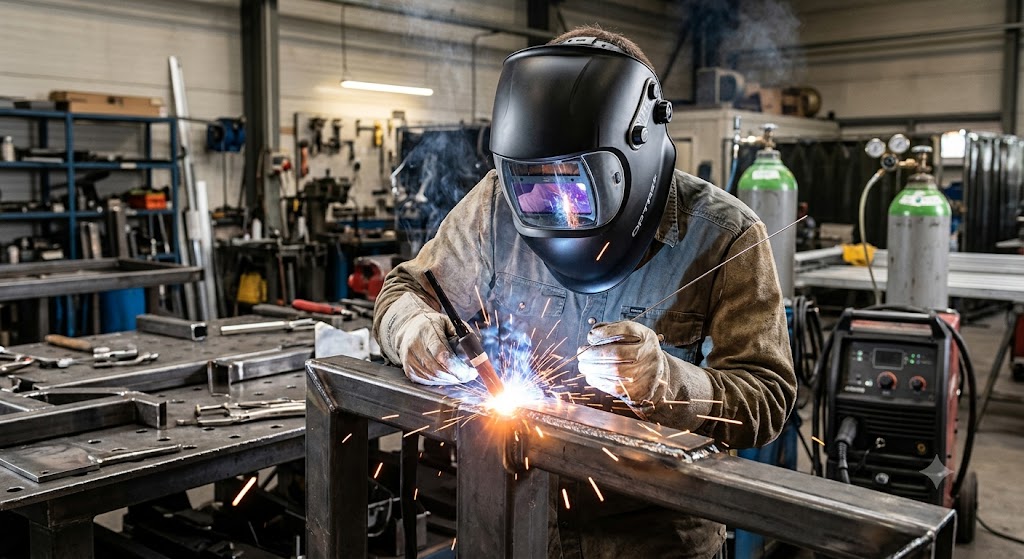
Ask a welder who obsesses over clarity what they dream about, and the answer is often an Optrel welding helmet. This Swiss brand sits at the very top of the market, and it got there by chasing one thing harder than anyone else: how bright and how true the view can be when the lens is not welding. Optrel’s helmets let you see your surroundings almost like ordinary safety glasses, then darken automatically the instant you strike an arc. This guide walks the lineup so you can decide whether that premium view is worth it for you.
What makes Optrel different
Two ideas define Optrel. The first is the exceptionally bright light state. Where a normal auto-darkening lens sits at shade 3 or 4 when idle, Optrel’s flagship lenses drop to shade 2.0 or 2.5, letting far more light through so you can see clearly without lifting the hood. The Crystal 2.0 transmits around 31 percent of light in its clear state, which welders describe as looking out a window. Combined with a special UV and IR filter, this delivers Optrel’s signature true-color view with no heavy green or blue tint.
The second idea is Autopilot. Instead of you choosing a shade number, Optrel’s Autopilot lenses read the brightness of the arc and set the correct shade automatically, adjusting continuously as your amperage changes. For welders who switch processes and materials constantly, that means one less thing to think about.
The lineup, from flagship to specialist
Crystal 2.0. The brightest-view flagship, built around Crystal Lens Technology with a shade 2.0 light state, Autopilot shade 4 to 12, the Twilight gradual-return function, and external controls so you can toggle grind mode and shade without removing the hood. It uses replaceable CR2032 batteries.
Panoramaxx CLT. The wide-view flagship, offering a panoramic field of vision roughly six times larger than a standard helmet while weighing only about 550 grams. It combines Crystal Lens Technology with the superb IsoFit headgear and was named a best-overall helmet of its year by reviewers. Note that it uses a sealed, built-in rechargeable battery rather than replaceable cells.
Vegaview 2.5. The value entry into Optrel brightness, with a world-record shade 2.5 light state, a shade 8 to 12 range, three arc sensors, external controls, and a featherweight 482-gram shell. It uses replaceable batteries and is the most affordable way into the Optrel view.
Liteflip Autopilot. A flip-up hood with full Autopilot across a wide shade 4/5 to 14 range, aimed at welders who want to flip to a clear shield for grinding and inspection.
Above these sit the Sphere and Helix series for industrial and PAPR use.
How Optrel compares
Against the 3M Speedglas G5 and Lincoln Viking 3350, Optrel counters with the brightest light state in the business and Autopilot, while those rivals answer with their own optics and often a lower price. Against the Jackson TrueSight II, it is a clarity-versus-clarity duel where Optrel’s shade 2.0 idle view is the differentiator. Against budget brands, there is simply no contest on view quality, though the price gap is enormous.
The honest drawbacks
Optrel’s biggest issue is price: these are among the most expensive hoods on the market, and the flagships cost several times what a capable mid-range helmet does. There are also real reliability and comfort complaints in the field, particularly around the Panoramaxx headgear padding and the sealed rechargeable battery, which cannot be swapped by the user and must be kept charged to preserve the warranty. Optrel is a premium buy, and it carries premium expectations.
Who should skip Optrel? Hobbyists and occasional welders who cannot justify flagship money, and anyone who wants a user-replaceable battery in their top helmet, who should look carefully at which Optrel model they choose or consider a rival.
The bottom line
An Optrel welding helmet is for the welder who puts view quality above all and can pay for it. Buy the Crystal 2.0 for the brightest true-color view, the Panoramaxx CLT for the widest field with that same clarity, and the Vegaview 2.5 as the most affordable route into Optrel brightness.
Frequently asked questions
What makes Optrel helmets special? Their exceptionally bright light state, as low as shade 2.0, and Autopilot technology that sets the shade automatically based on arc brightness, plus a true-color view with minimal tint.
Which Optrel welding helmet is the best? The Crystal 2.0 offers the brightest view, while the Panoramaxx CLT offers the widest panoramic field with the same Crystal Lens Technology.
What is Autopilot on an Optrel helmet? It is a feature that reads the arc brightness and automatically selects the correct shade, adjusting continuously so you never set a shade number manually.
Are Optrel helmets worth the price? For welders who prioritize the brightest, truest view and weld daily, yes. For occasional or budget-focused users, the cost is hard to justify.
Do Optrel helmets have replaceable batteries? It depends on the model. The Crystal 2.0 and Vegaview use replaceable CR2032 cells, while the Panoramaxx and Helix use a sealed built-in rechargeable battery.
What is the lightest Optrel helmet? The Vegaview 2.5 is among the lightest at roughly 482 grams, with the Panoramaxx CLT close behind at about 550 grams.
References
- Optrel, welding helmet comparison and product specifications, optrel.us
- Optrel, Crystal Lens Technology and Autopilot overview, optrel.us
- American Welding Society, welding lens shade chart and eye protection guide
- OSHA fact sheet, eye protection during welding