PAPR Welding Helmet Systems Compared
I spent a full year doing production stainless steel welding before my employer put a 3M Adflo PAPR on my station. My first session with it, I could not believe how much easier breathing felt compared to a half-mask with a P100 cartridge after an hour of sustained welding. The cool filtered air, the absence of any face seal pressure, and the fact that I did not need to take the system off to get a drink of water without breaking the respirator seal changed my entire relationship with respiratory protection in a welding environment. If you are doing production welding on stainless, galvanized, or chromium alloys, or if you work in confined or poorly ventilated spaces, this guide covers what PAPR welding systems are and how the three main options compare.
What a PAPR Welding Helmet Is
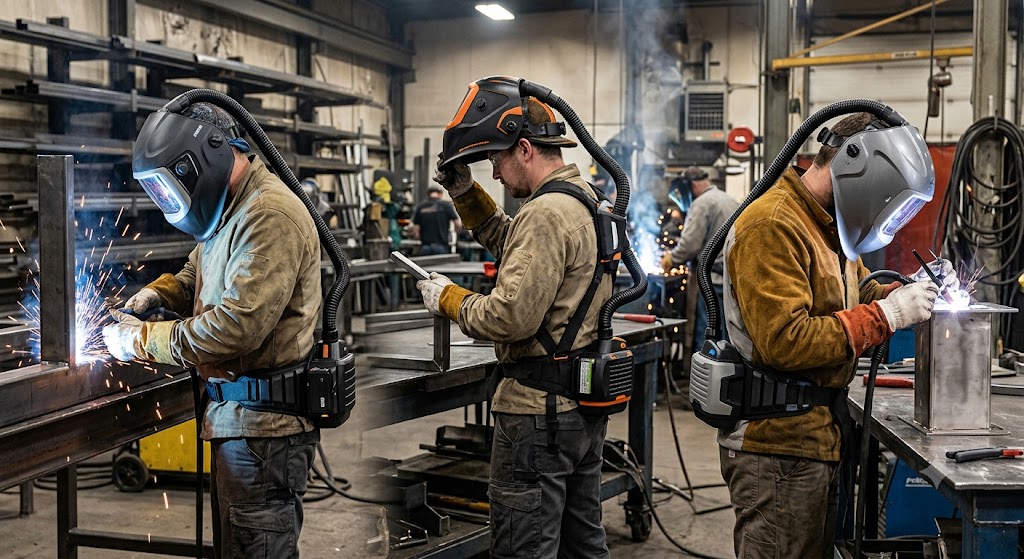
PAPR stands for powered air purifying respirator. A PAPR system draws ambient air through a filter using a battery-powered blower, then delivers the filtered air through a hose into a helmet or hood worn over the head. Unlike a half-mask or full-face respirator, a PAPR does not require a seal against your face. The positive air pressure inside the helmet hood prevents contaminated air from entering, so the system works without the tight facial fit that half-mask respirators require.
For welding specifically, PAPR systems integrate the air-purifying function directly with the welding helmet or with a hood that accepts a replaceable welding lens. You get both your arc flash protection and your respiratory protection in a single integrated piece of head protection.
Key components in any PAPR welding system are the blower unit (usually belt or harness mounted), the filter cartridge in the blower, a battery pack, an air delivery hose, and the helmet or hood. The airflow is adjustable on most systems to maintain positive pressure through different workloads.
Why Choose a PAPR Over a Half-Mask P100
For occasional welding on carbon steel in a well-ventilated shop, a half-mask P100 is adequate and costs far less than a PAPR. The PAPR makes sense when the exposure level is higher, the work duration is longer, or the comfort deficit of a half-mask respirator becomes a compliance problem.
Specific scenarios where PAPR is the right tool: stainless steel welding (hexavalent chromium exposure), galvanized steel welding (zinc oxide fumes), any welding in confined spaces, production welding with sustained arc time that makes a half-mask uncomfortable over hours, and any welder who has difficulty achieving a reliable face seal with a half-mask due to facial structure or beard.
The PAPR also eliminates the respirator-under-helmet compatibility problem entirely. There is no half-mask under the welding helmet. The helmet IS the respiratory delivery system.
3M Adflo PAPR Welding System
The 3M Adflo is the professional standard PAPR welding system and has been for many years. The Adflo blower unit is compact, clips to a belt, and delivers airflow through a thin hose to a 3M Speedglas welding helmet. The filter capacity handles standard welding particulates and organic vapors with appropriate filter selection. Battery life is sufficient for a standard production welding shift on most charged battery packs.
The 3M Adflo pairs specifically with the 3M Speedglas helmet series, which are some of the highest-performing auto-darkening helmets on the market. Reaction time on Speedglas lenses is among the fastest available, and the optical clarity ratings are consistently excellent. The Adflo and Speedglas combination represents the gold standard of integrated PAPR welding systems, and the price reflects that.
Miller T94i PAPR Welding System
Miller Electric’s T94i is their integrated PAPR welding helmet and the primary competitor to the 3M Adflo in the professional market. The T94i uses a similar belt-mounted blower with a hose delivery to a Miller-designed welding hood. The T94i helmet provides a large viewing area and excellent headgear adjustment. Miller’s auto-darkening lens performance is very good across the shade range.
The T94i is slightly less common than the Adflo in production industrial environments but widely used in professional fabrication and pipeline shops. Miller’s service network and accessory availability are strong in North America. For welders already invested in the Miller ecosystem for welders and gear, the T94i fits naturally.
YESWELDER LYG-Q800D PAPR Welding System
The YESWELDER LYG-Q800D represents the value-tier PAPR market. It provides integrated PAPR functionality at a price point significantly below the 3M Adflo and Miller T94i. For small shops, home shop professionals who have moved to serious production welding, and fabricators who want PAPR protection without the premium price of 3M or Miller, the LYG-Q800D is a legitimate consideration.
The tradeoffs are real. Filter cartridge availability is less universal than 3M cartridges. The auto-darkening lens specification is in the same tier as other YESWELDER helmets, which performs adequately but does not match the optical clarity and reaction time of Speedglas or Miller T94i lenses. Battery life and blower durability data over extended production use is less established than the Adflo and T94i track records.
PAPR Welding System Comparison
| Feature | 3M Adflo + Speedglas | Miller T94i | YESWELDER LYG-Q800D |
|---|---|---|---|
| Filtration rating | P100 equivalent | P100 equivalent | P100 equivalent |
| Lens quality | Best in class (Speedglas) | Excellent | Good for price tier |
| Reaction time | Ultra-fast | Fast | Adequate |
| Blower unit size | Compact | Compact | Compact |
| Battery life | Full shift | Full shift | Moderate |
| Filter cartridge availability | Excellent (3M supply chain) | Good (Miller supply chain) | Limited (YESWELDER only) |
| Production use track record | Decades, proven | Over a decade, proven | Newer, limited data |
| Best for | Highest demand production welding | Professional shops, Miller users | Budget entry into PAPR category |
The Bottom Line
For daily production welding on stainless, galvanized, or in confined spaces, the 3M Adflo with Speedglas is the system I would choose and have chosen. The combination of proven filtration performance, outstanding lens quality, and global filter cartridge availability makes it the most reliable long-term choice. The Miller T94i is a genuine alternative for Miller-aligned shops. The YESWELDER LYG-Q800D is a reasonable entry point for welders who want PAPR protection and cannot yet justify the premium price tier.
Frequently Asked Questions
What does PAPR stand for in welding? PAPR stands for powered air purifying respirator. It is a battery-powered system that draws air through a filter and delivers it through a hose to a helmet or hood, providing respiratory protection without requiring a face-seal mask.
Do I need a PAPR for welding stainless steel? For production volume stainless steel welding, yes. Stainless steel welding generates hexavalent chromium fumes, which are a known human carcinogen. A PAPR provides the highest practical respiratory protection for this scenario.
How long does a PAPR battery last during welding? Most professional PAPR systems for welding are designed for a full production shift on a single charge. Actual battery life varies by system and airflow setting. Check the manufacturer’s stated battery life at your planned airflow rate.
Is a PAPR better than a P100 half-mask for all welding? No. For occasional carbon steel MIG welding in a well-ventilated shop, a P100 half-mask is adequate and much cheaper. PAPR provides superior protection and comfort for high-exposure, high-duration welding on hazardous materials.
Can I use a PAPR for welding without a welding helmet? PAPR welding systems are designed with an integrated welding lens. The hood or helmet is part of the system and provides arc flash and UV protection as part of the design.
How do I replace filters on a PAPR welding system? Filter replacement procedures vary by system. Consult the manufacturer’s documentation for your specific unit. Replace filters when airflow decreases noticeably or on the manufacturer’s stated replacement schedule.
References
https://www.osha.gov/laws-regs/regulations/standardnumber/1910/1910.134 https://www.cdc.gov/niosh/topics/welding https://www.3m.com/3M/en_US/respiratory-protection-us https://www.millerwelds.com
SEO Title: PAPR Welding Helmet Systems Compared