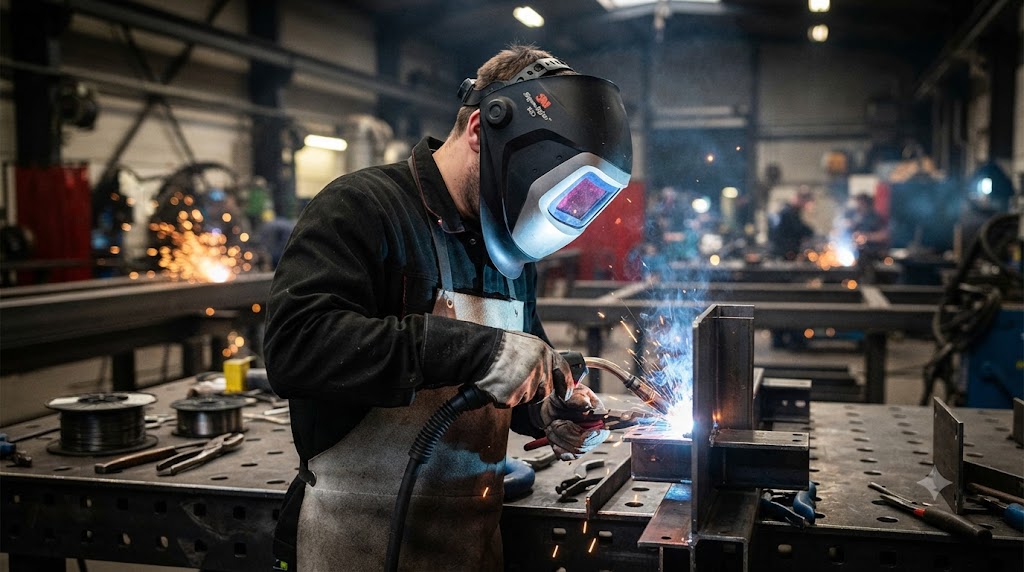
Welding Helmet Buying Guide for Professional and Commercial Use

A production welder running eight hours a day doesn’t replace helmets on a whim. The decision is a real one with real tradeoffs: a professional-grade helmet costs three to five times what a hobbyist unit does, and the delta had better show up in your work and your body by the end of the week. For some welders it does. For others, the features they’re paying for are genuine and the price is justified. The question is knowing which tier you’re buying into and why.
Professional-grade welding helmets are defined by four characteristics that separate them from prosumer and hobbyist units: 1/1/1/1 optical clarity across all four EN 379 criteria, four independent arc sensors, a durable shell rated for industrial use, and a warranty tier of three years or better. Below that threshold, you’re in the prosumer tier — capable helmets, but not built for the daily abuse and performance demands of commercial production work.
The 1/1/1/1 optical clarity standard means the lens distorts light as little as physically possible. In practical terms: after a full shift, your eyes are less fatigued. You can see the weld pool edge more accurately. You make fewer starts and restarts because you saw what was happening rather than guessing. These are compounding advantages over the course of a production week that justify the cost difference over a 1/1/1/2 or 1/2/1/2 rated lens.
What Makes a Welding Helmet Professional Grade
Optical clarity 1/1/1/1: The four numbers rate light diffusion, angular dependence, transmittance uniformity, and transmittance variation per EN 379. A “1” in each position represents the highest grade. Budget helmets often rate 1/2/2/2 or worse, which means the view is acceptable but not optically clean. The difference is subtle in the first hour and meaningful over the first week.
Four arc sensors: Independent sensors in all four corners of the lens frame give reliable triggering at every welding angle. For production work involving vertical, overhead, or pipe positions, two-sensor helmets miss starts often enough to disrupt workflow. Four sensors is the production standard.
Industrial shell and build quality: Professional helmets use shells rated for heat resistance, chemical exposure, and repeated physical impact. The lens frame, headgear pivot points, and external controls on professional units are built to a higher tolerance than prosumer versions. This shows up in longevity: a professional helmet used daily in a production shop should survive three to five years before replacement.
Warranty: The leading professional-tier helmets carry three-year warranties on the helmet and separate coverage on the ADF. A warranty claim after two years in a production shop is a meaningful real-world guarantee, not just a marketing number.
The Three Professional Helmets Worth Buying
ESAB Sentinel A50
The Sentinel A50 occupies an interesting position: it’s priced at the top of the prosumer range but performs at the professional level for most welding processes. The True Color ADF is a genuine differentiator — the color rendering quality approaches 1/1/1/1 performance in practice, even though the official rating is 1/1/1/2. The low-profile shell, Halo headgear, and 3-year warranty (on the ADF) round out a helmet that most production TIG and MIG welders would consider fully professional.
The case for the Sentinel A50 over higher-cost alternatives: it is the lightest helmet in its performance tier. For welders who stand at a bench or work in varied positions all day, the weight difference from a larger helmet compounds significantly over a full shift. The headgear ergonomics are genuinely better than the industry average.
The flaw: the 3.93” x 2.36” viewing area is the smallest in this comparison. Production welders doing wide multi-pass work or structural overhead runs will find the smaller lens limiting compared to the Viking 3350 or Digital Infinity. If your work is consistent-position TIG or MIG at a bench, the size is no hardship. If you’re on structural steel in varying positions all day, you’ll want more glass.
A verified live listing: ESAB Sentinel A50
Lincoln Electric Viking 3350
The Viking 3350 is the closest thing to an industry-standard professional welding helmet in North American production shops. The 12.5 square-inch lens with 4C lens technology, four arc sensors, and X6 headgear combination is what you’ll find on the heads of most professional TIG and MIG welders in fabrication shops, shipyards, and structural steel operations.
The 4C lens technology delivers genuine 1/1/1/1 optical clarity with improved color rendering in both light and dark states. The large viewing area reduces head repositioning in all positions, which over a production day means fewer interruptions to the weld cycle. The X6 headgear distributes weight across six points rather than four, which makes the helmet feel lighter than its specs suggest.
For shops that do a mix of processes — TIG root passes, MIG fill, flux-core cap passes — the Viking 3350 handles all of them without adjustment beyond shade setting. It’s a one-helmet shop solution at the professional level.
The flaw: the Viking 3350 is heavier than the Sentinel A50. On paper the difference is modest. After a full shift of overhead structural work, it’s noticeable. Welders with pre-existing neck issues or who do high percentages of overhead work should handle both helmets before committing. The Viking 3350 is also more expensive to maintain, with proprietary cover lenses that cost more than generic replacements.
A verified live listing: Lincoln Electric Viking 3350
Miller Digital Infinity with ClearLight 2.0
The Miller Digital Infinity is the high end of the professional tier. It has the largest standard ADF viewing area on the market at 13.4 square inches, a genuine 1/1/1/1 optical clarity rating with ClearLight 2.0 technology, four arc sensors, and Miller’s X-Mode for reliable triggering in low-amperage TIG and outdoor welding conditions. The InfoTrack 2.0 system logs arc time and arc count, which is useful for shops that quote by the hour or track weld productivity.
For professional TIG welders specifically, the Digital Infinity is the premium choice. The large lens gives you a wide view of the weld pool and adjacent base metal, ClearLight 2.0 renders colors more naturally than competing technologies in the dark state, and the X-Mode ensures consistent triggering even when the arc is partially obstructed by torch angle or work geometry. Miller’s professional warranty coverage on the ADF is among the strongest in the category.
The flaw: the Digital Infinity is the heaviest helmet in this comparison. The 13.4-inch lens assembly adds mass that some welders accept as a tradeoff for the viewing area and others won’t. If you’re sensitive to helmet weight or do significant overhead production work, the Digital Infinity’s mass is a genuine concern — not a spec-sheet footnote.
A verified live listing: Miller Digital Infinity ClearLight 2.0
Professional Helmet Comparison
| Feature | ESAB Sentinel A50 | Lincoln Viking 3350 | Miller Digital Infinity |
|---|---|---|---|
| Optical clarity | 1/1/1/2 | 1/1/1/1 | 1/1/1/1 |
| Viewing area | 3.93” x 2.36” | 12.5 sq. in. | 13.4 sq. in. |
| Arc sensors | 4 | 4 | 4 |
| Shade range | 5-13 | 5-13 | 5-13 |
| Color technology | True Color ADF | 4C Lens | ClearLight 2.0 |
| Weight | Lightest | Medium | Heaviest |
| Best for | TIG, bench work, all-day comfort | Multi-process production, structural | Production TIG, large-view fabrication |
| Named flaw | Smaller viewing area | Heavier than A50; proprietary lenses | Heaviest in class |
The Jackson Safety EQC
The Jackson Safety EQC is a professional-tier helmet worth discussing. Jackson (now a SureWerx brand) has a long history in industrial welding PPE, and the EQC series has been a production shop staple in pipe welding and structural applications. The EQC features a 1/1/1/1 optical clarity ADF, variable shade 9-13, and the Jackson 370 headgear system, which uses an easy-grip knob for size adjustment that gloved hands can operate without removing gloves — a specific advantage in production pipe welding where you’re frequently adjusting helmet fit.
The EQC is available through welding supply distributors and some online retailers. If your shop already runs Jackson safety equipment and values system consistency (lenses, covers, and accessories from a single supplier), it’s a legitimate professional option worth evaluating alongside the Big Three brands above. Verify availability and current before purchasing online, as the EQC line has had multiple variants over its production run.
Is a Professional Helmet Worth the Extra Cost?
For welders who work 30 or more hours per week, yes. The eye fatigue reduction from 1/1/1/1 optics versus 1/2/2/1 optics is real and compounding over a career. The four-sensor reliability in out-of-position work reduces missed starts and rework. The warranty coverage means a two-year-old helmet isn’t a write-off if the ADF fails.
For hobbyists and occasional welders, a prosumer helmet with 1/1/1/2 optics and two sensors handles weekend projects without meaningful limitation. The professional tier earns its premium when welding is your income and your daily environment.
FAQ
What makes a welding helmet professional grade? 1/1/1/1 optical clarity, four arc sensors, an industrial-rated shell, and a three-year or better warranty are the four markers. Below any of those thresholds, you’re in the prosumer tier — capable but not built for full-shift production demands.
Is a professional helmet worth the extra cost? For welders working 30-plus hours per week, yes. Reduced eye fatigue from better optics, more reliable arc triggering from four sensors, and better durability from industrial-grade construction all have real-world returns at production volumes. For occasional welders, the premium is harder to justify.
What features separate commercial from hobbyist helmets? Primarily optical clarity (1/1/1/1 vs. lower ratings), sensor count (four vs. two), shell durability (impact-rated nylon or comparable vs. lightweight ABS plastic), and warranty length. The headgear quality also differs significantly — professional headgear systems adjust precisely under load and last longer under daily use.
What is the jackson eqc professional welding helmet? The Jackson Safety EQC is a professional-grade auto-darkening helmet with 1/1/1/1 optical clarity and a variable shade 9-13 ADF. It’s well regarded in pipe welding and structural applications for its 370 headgear system, which adjusts easily with gloved hands. Verify current availability through welding supply distributors or confirmed Amazon listings before purchasing.
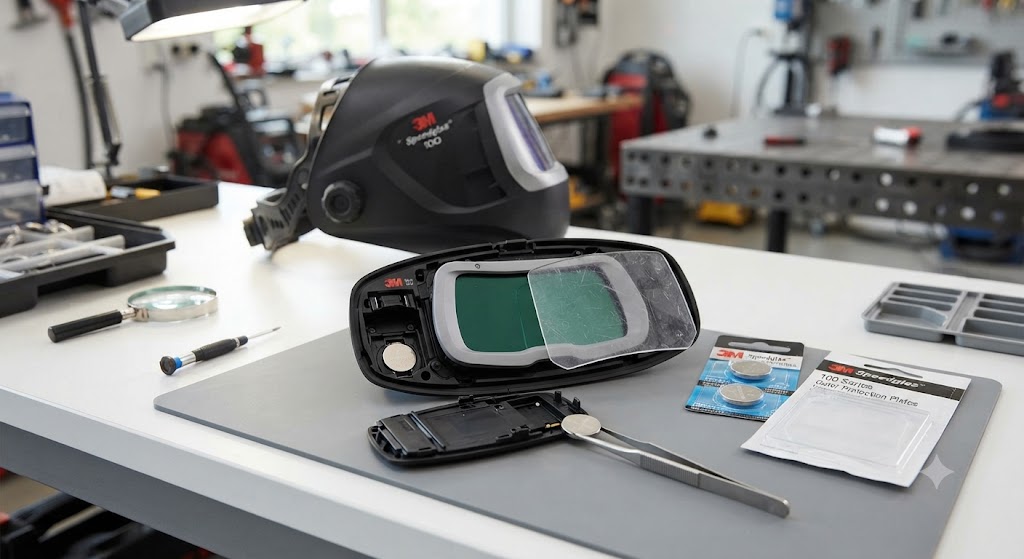
How long should a professional welding helmet last? A professional-grade helmet used daily in a production shop should last three to five years for the shell and headgear. The ADF (auto-darkening filter) typically has a manufacturer warranty of one to three years and may need replacement before the shell does. Budget for ADF replacement as a separate maintenance item.
Can I use a professional helmet for hobby welding? Yes. A professional helmet works for any welding application — the features that make it better for production work (better optics, four sensors, durable shell) don’t harm occasional use. You’re simply paying for capabilities you won’t fully use in a hobby context.
What is the lightest professional welding helmet? Among the top professional-tier helmets, the ESAB Sentinel A50 is generally the lightest at approximately 1.8 pounds. The Miller Digital Infinity is the heaviest due to its large lens assembly. The Lincoln Viking 3350 sits between the two.
Does optical clarity affect eye health over time? Yes. Optically poor lenses create inconsistent light transmission that causes the eye to work harder to focus on the weld pool. Over years of full-shift welding, this contributes to eye fatigue and can accelerate conditions that affect visual sharpness. 1/1/1/1 lenses reduce that strain compared to lower-rated lenses.
References
- https://www.osha.gov/laws-regs/regulations/standardnumber/1915/1915.153
- https://www.esab.com
- https://www.lincolnelectric.com
- https://www.millerwelds.com
- https://jacksonsafety.com
- https://www.aws.org/magazines-and-media/welding-digest/2025/november/wd-nov-2025—complete-welding-lens-shade-chart—safety-guide-for-eye-protection/
URL slug: professional-welding-helmet Excerpt: Professional welding helmets earn their premium through 1/1/1/1 optical clarity, four arc sensors, and industrial-grade build quality. This guide ranks the top picks for production shops and commercial welders, with honest flaws for each.