Solar Auto Darkening Welding Lens Guide

I have had exactly one solar-only auto-darkening helmet fail on me mid-weld. I was welding inside a metal building with poor overhead lighting, the solar cells were not seeing enough ambient light to power the lens, and the lens flashed clear during a stick bead that was well above safe shade level. I saw spots for ten minutes. After that I learned the difference between pure solar and hybrid solar-battery systems, and I have only run hybrid systems since. If you are buying an auto-darkening welding helmet and trying to understand how the power systems work, this guide covers everything that actually matters.
How Auto Darkening Welding Lenses Work
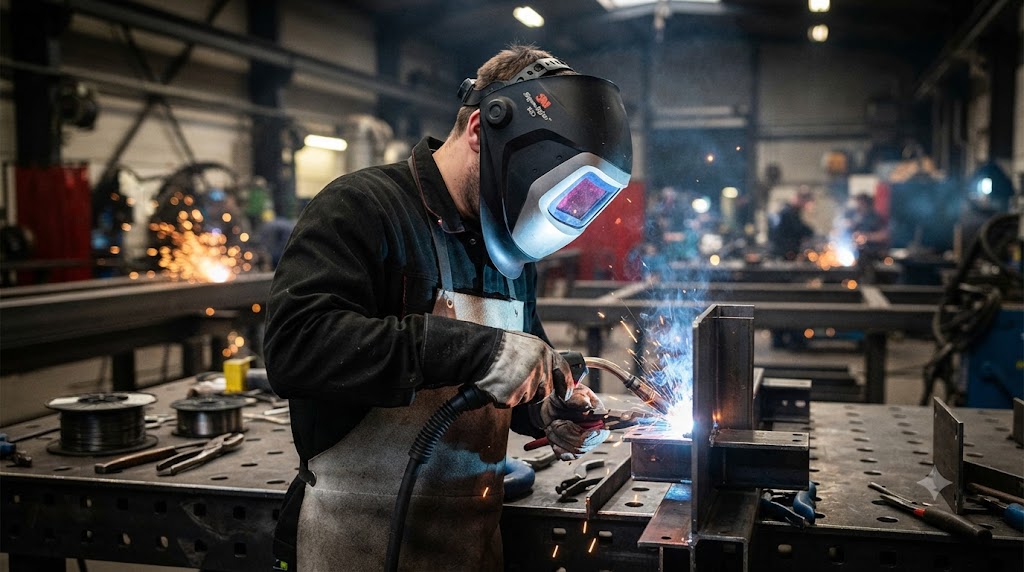
An auto-darkening welding lens uses liquid crystal technology to switch from a light state to a dark shade in response to arc light. The liquid crystal layer sits between the UV and IR filter plates and changes its orientation when voltage is applied, blocking visible light to the programmed shade level. The switching is triggered by arc sensors that detect the sudden increase in light intensity when an arc is struck.
The entire switching process, from clear to dark, must happen faster than the eye can respond to prevent arc flash exposure. Quality lenses specify their switching speed in fractions of a millisecond. A response time of 1/25,000 second is considered fast. Response times above 1/3,600 second are considered adequate for most welding applications. Slower response times on very budget lenses can leave a brief window of arc flash exposure at arc strike.
The power source for the lens electronics is what distinguishes the three system types: pure solar, hybrid solar-battery, and battery-only.
Pure Solar vs Hybrid vs Battery Only
Pure solar auto-darkening lenses use only the solar cells on the lens face to power the switching electronics. This sounds efficient and maintenance-free, but it creates a critical operational problem. Solar cells only generate power when they are receiving adequate light. In a dim shop, shaded workspace, or when welding at an angle that puts the solar cells in shadow, the solar cells may not generate enough power to reliably switch the lens.
The failure mode of an underpowered solar lens is exactly the worst possible outcome: the lens fails to darken at arc strike, leaving the welder’s eyes exposed to arc flash UV radiation at full welding intensity. This is not a theoretical risk. It is documented and has caused real injuries.
Hybrid solar-battery lenses combine solar cells with a battery backup. In a hybrid system, the battery provides instantaneous switching power at arc strike, regardless of ambient light conditions. The solar cells recharge the battery and reduce battery drain during operation. The battery handles the power demand that requires a reliable fast response. The solar cells extend battery life but are not required for reliable operation.
Hybrid is the current industry standard for professional and prosumer auto-darkening helmets. Nearly every reputable helmet sold today uses a hybrid system.
Battery-only lenses use a replaceable or rechargeable battery with no solar assistance. Battery-only systems are reliable in any lighting condition. The tradeoff is battery management: when the battery dies, the lens fails, and you need to have a replacement battery available. Battery-only systems are less common in current production than hybrid designs.
Solar Power System Comparison
| System | Reliable in Low Light | Battery Maintenance | Typical Battery Life | Failure Risk |
|---|---|---|---|---|
| Pure solar | No | None | No battery | Fails in dim or shaded conditions |
| Hybrid solar-battery | Yes | Periodic replacement | Several years | Very low with maintained battery |
| Battery only | Yes | Regular replacement | 1 to 3 years | Low with proactive replacement schedule |
How to Care for Solar Cells
For hybrid systems, the solar cells extend battery life but require ambient light to do so. Store your welding helmet where the solar cells receive light, not in a dark bag or case where they cannot charge. After extended storage, the battery in a hybrid system may have partially discharged. Run the helmet in normal ambient light for a few hours before taking it to a low-light welding session.
Keep the solar cell surfaces clean. Weld spatter and grinding dust on the solar cell lens reduce their light collection efficiency. Wipe the cell windows gently with a damp cloth or the same anti-spatter spray you use on your lens cover.
Battery Replacement in Hybrid Systems
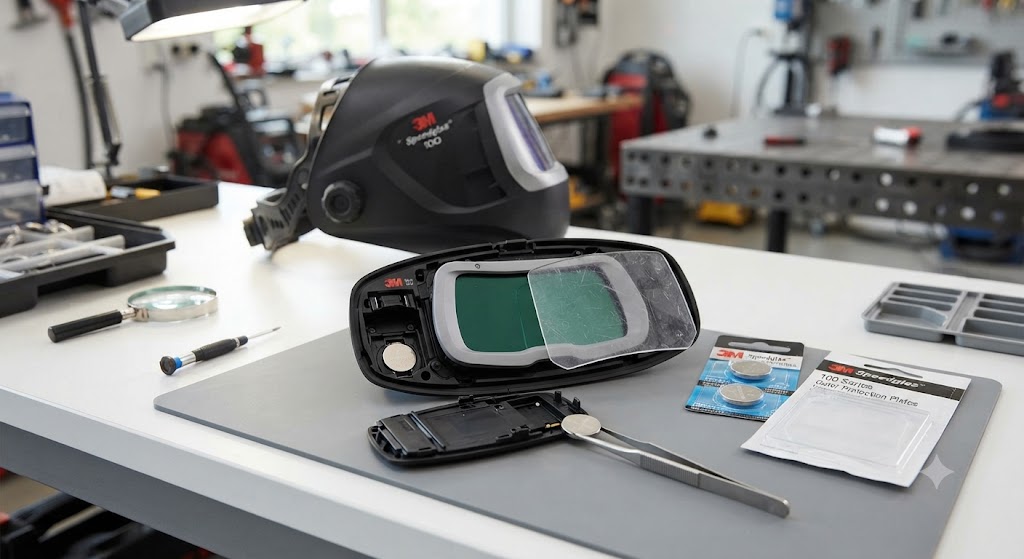
Even in a hybrid system, the battery requires periodic replacement. Most hybrid welding helmet batteries are standard coin cell sizes, commonly CR2450, though check your specific helmet’s documentation. Battery life in a well-used production helmet is typically two to five years. In a home hobbyist helmet used occasionally, the battery may last longer but should be replaced proactively every few years regardless of perceived performance.
A failing battery in a hybrid system shows up as slow or inconsistent arc response, failure to darken in low-light conditions, or the lens remaining in a darkened state. Replace the battery at the first sign of inconsistent behavior. Do not weld on a lens that is showing unreliable arc response.
Shade Range and Arc Sensors
For a hybrid auto-darkening lens, the shade range and number of arc sensors also matter for reliable switching. A lens with only one or two arc sensors can miss the arc strike if the sensors are positioned away from the arc. A lens with three or four arc sensors switches reliably from most working angles. For welding in corners and tight spaces where sensor line of sight is restricted, more sensors provide better coverage.
The shade range should cover the process you weld. Most hybrid lenses provide shade 5 to 13 for MIG, stick, and plasma. TIG welding at very low amperages may require a lens that extends down to shade 5.
The Bottom Line
Buy a hybrid solar-battery auto-darkening lens. Do not buy a pure solar-only lens for any welding application. The reliability difference in low-light conditions is not a minor spec gap, it is the difference between a lens that darkens reliably every time and one that fails when you cannot predict the ambient light. Replace the battery in your hybrid lens every two to five years or at the first sign of inconsistent performance. Store your helmet where the solar cells can receive ambient light when not in use.
Frequently Asked Questions
What is a hybrid solar auto darkening welding lens? A hybrid lens uses both solar cells and a battery to power the auto-darkening electronics. The battery provides instantaneous reliable switching at arc strike regardless of ambient light. The solar cells extend battery life by recharging the battery during use.
Can a solar welding lens fail to darken? Yes. A pure solar-only lens can fail to darken in low-light conditions when the solar cells are not generating enough power. This is a serious safety hazard. Hybrid lenses use battery backup to prevent this failure.
How long do batteries last in auto darkening welding helmets? Most hybrid welding helmet batteries last two to five years under regular use. Replace proactively rather than waiting for symptoms of failure.
What battery size does my auto darkening welding helmet use? The most common battery is a CR2450 coin cell, but this varies by brand and model. Check your specific helmet documentation or the battery compartment label.
How do I store a solar auto darkening welding helmet? Store it where the solar cells receive ambient light rather than in a dark bag or case. This keeps the battery charged in a hybrid system. Before welding in a low-light location after extended storage, allow the helmet to sit in normal light for a few hours.
What shade range should an auto darkening welding lens cover? For most MIG and stick welding, shade 9 to 13 covers the range. For TIG and light plasma work, a lens that extends to shade 5 provides coverage for low-amperage processes.
How many arc sensors should a welding helmet have? Minimum two for basic use. Three or four sensors provide significantly better coverage for awkward angles, corner welding, and any position where one sensor may be blocked.
References
https://www.osha.gov/laws-regs/regulations/standardnumber/1910/1910.133 https://www.aws.org https://www.millerwelds.com https://www.lincolnelectric.com
SEO Title: Solar Auto Darkening Welding Lens Guide