Welding Helmet Battery Keeps Dying: The Real Causes
You pull the hood down for the first weld of the week and the lens is sluggish, or it does not darken at all. You replaced the battery not long ago. It feels like the helmet is eating cells for no reason, and at what a good CR2450 costs across a year, that adds up and it is genuinely annoying.
When a welding helmet battery keeps dying, it is rarely one dramatic fault. It is usually a stack of small drains: the electronics never fully switch off, ambient light keeps waking the lens, and cold storage quietly shortens each cell’s life. Understand those three and you can usually double how long a battery lasts.
First, know what is in your helmet
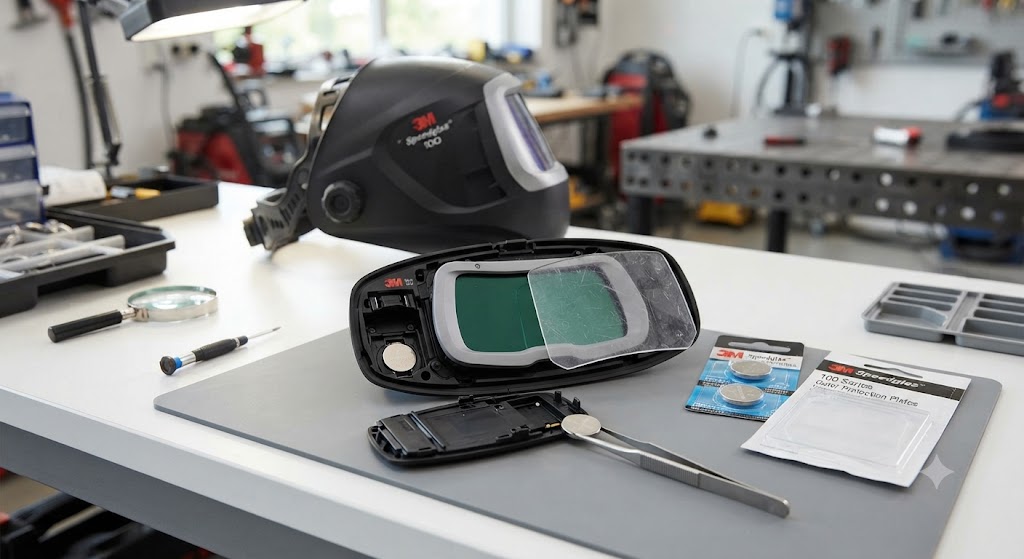
Most auto-darkening helmets run on a lithium coin cell, commonly a CR2450 or a pair of CR2032 cells, often with a solar assist panel. The important part, and the one that trips people up: lithium coin cells are not rechargeable. The welding arc and the sun do not refill them. The solar panel only assists the electronics while you work; it does not bring a flat coin cell back to life. So the question is never “why won’t it recharge,” it is “what is draining it faster than it should.”
Cause 1: parasitic drain from always-on electronics
Many auto-darkening lenses have no true off switch. The sensing circuit stays powered so the lens can react instantly when you strike an arc. That constant low draw is called parasitic drain, and it is the single biggest reason a helmet chews through batteries even when you barely use it. Experienced welders on the MIG Welding Forum describe exactly this and simply pull the batteries out when the helmet will sit unused for a while.
The LCD shading circuit typically pulls the most current, with the sensitivity and delay circuits secondary. None of it is a defect. It is just how an instant-on lens works.
Cause 2: ambient light waking the lens
Here is the drain most people miss. If your helmet sits on a bench where sunlight, a window, or shop lights sweep across the front, the sensors can keep partially triggering the lens, running the electronics far more than if it were stored in the dark. One welder tracked persistent battery loss to the helmet catching light as it sat out between jobs.
Store the helmet face-down or in a bag or case, in a dark drawer or cabinet, and you remove a real source of daily drain for free.
Cause 3: cold and heat
A lithium coin cell has a long shelf life at room temperature, but higher storage temperatures cut that life, and cold does not do the chemistry any favors either. A helmet that lives in an unheated garage, a truck bed, or a metal shop that swings from freezing to baking is going to see shorter battery life than one kept indoors at a stable temperature. If your batteries die over winter layoffs, storage temperature is a prime suspect.
Cause 4: a genuinely weak or wrong battery
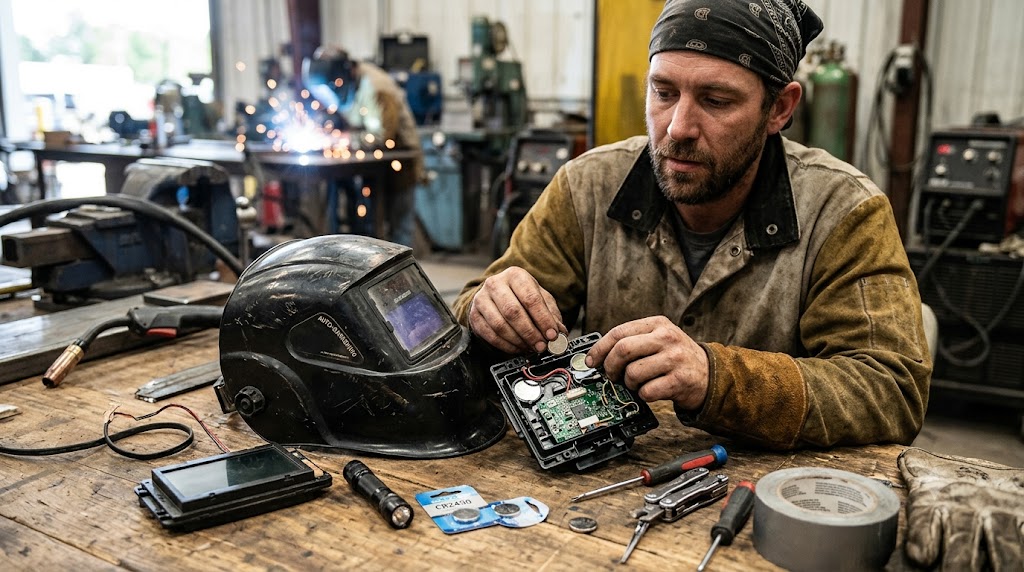
Not all coin cells are equal, and a cheap or old cell can read fine on paper and still sag under load. Some helmets are also fussy about battery fit, and a cell that does not seat firmly in the holder can make intermittent contact that looks like a dead battery. Use a fresh, reputable CR2450 (or the exact type your manual lists) and make sure it clicks in solidly.
How to make a helmet battery last
- Pull the battery if the helmet will sit unused for weeks. This kills parasitic drain entirely.
- Store it in the dark, face-down or in a case, so ambient light stops triggering the lens.
- Keep it indoors at a stable temperature, not in a cold garage or hot truck.
- Use the correct, fresh cell and seat it firmly. Buy a quality lithium coin cell, not the bargain multipack that has been on a shelf for years.
- Check the solar panel is clean if your lens has one, so it can carry more of the electrical load while you weld.
When it is the lens, not the battery
If you do all of the above and a helmet still drains a fresh cell in days, the ADF cartridge itself may have a fault drawing excess current, and on a cheaper hood that can make the whole helmet a throwaway item. Some welders solve chronic drain on budget helmets by modifying them to add a manual battery cut-off switch, which tells you how real the parasitic-drain problem is. On a quality helmet under warranty, contact the maker instead.
The honest tradeoff worth naming: helmets with sealed, non-replaceable batteries dodge the fitment and contact problems, but when that cell finally dies you may be replacing the entire lens rather than a coin cell. Replaceable-battery designs are more economical over time, as long as you manage the drain.
FAQ
Why does my welding helmet battery die so fast even when it is not in use? Most auto-darkening lenses never fully power down, so a constant parasitic drain runs the battery down even in storage. Ambient light triggering the sensors and cold or hot storage make it worse.
Does ambient light drain the battery through the sensors? Yes. If light sweeps across the front of the helmet in storage, the sensors can keep partially activating the lens and running the electronics. Store it in the dark to stop this.
Does cold storage shorten battery life? It can. Lithium coin cells last longest at stable room temperature. A helmet stored in a freezing garage or a hot truck will generally go through batteries faster.
Can I use a rechargeable battery instead? Generally no. Standard lithium coin cells are not rechargeable, and the solar assist cannot recharge them. Rechargeable coin cells exist but require a proper charger the helmet does not provide.
What is the single best habit to extend battery life? Remove the battery, or store the helmet in a dark case, whenever it will sit unused for a while. That eliminates the biggest drain.
Is a fast-draining battery a sign the helmet is broken? Not usually. It is normal behavior made worse by storage habits. Only suspect a fault if a fresh, correct cell drains within days despite good storage.
References
- Miller Electric, MillerWelds discussion forum notes on lithium coin-cell chemistry and helmet battery behavior (manufacturer community documentation).
- Manufacturer operator manuals for auto-darkening welding helmets specifying battery type (CR2450 / CR2032) and storage guidance.