Welding Helmet Buying Guide for Aluminum Welding
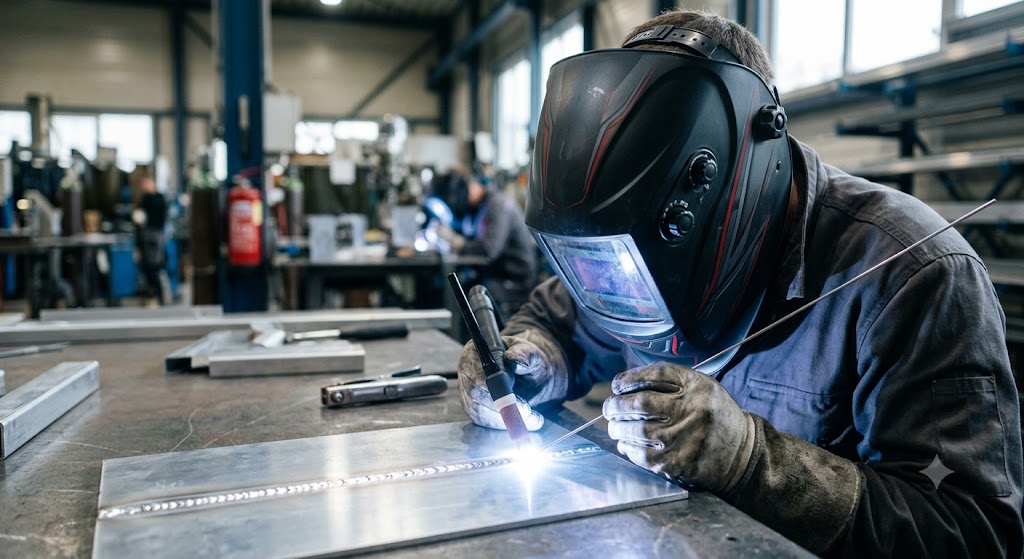
Aluminum welding, specifically TIG welding on aluminum, is the application that most clearly separates a competent auto-darkening helmet from an excellent one. The arc characteristics, the visual demands, and the process sensitivity all push hard on the same lens qualities that budget helmets handle least well. If aluminum TIG is your primary work or a significant part of your welding, choosing the right helmet makes a tangible difference in what you can see and therefore what you can weld.
Why Aluminum Welding Is Harder on Helmets
The aluminum arc is brighter and less forgiving at low amperage. Aluminum TIG welding often runs AC current at relatively low amperages for thin sheet work. The AC arc produces a distinctive bright light that is visually different from DC steel TIG. The arc cleaning action on aluminum creates a white oxide boundary visible around the puddle that gives you important heat control feedback, but only if your lens renders it faithfully.
Color rendering matters more. Steel TIG produces an orange-red puddle in natural light that is still visible through a standard green-tint lens as a recognizable color gradient. Aluminum TIG produces a silver-gray puddle with subtle color differentiation between the molten zone and the surrounding metal. A green-tint lens flattens this already low-contrast image further. A true color lens with good optical clarity preserves the subtle gray-tone differentiation that helps you read the aluminum puddle accurately.
Low amperage sensitivity must be reliable. Aluminum thin sheet work may run at 60 to 80 amps or lower. Many budget auto-darkening helmets have sensitivity ranges that are calibrated for higher-amperage MIG and stick arcs. The low-amperage TIG arc may not reliably trigger these helmets, or it triggers them late. A helmet with a well-calibrated low-amperage sensitivity mode is essential.
What Shade to Use for Aluminum Welding
Aluminum TIG welding typically uses shade 9 to 11 depending on amperage and personal preference. The AC arc’s brightness means some welders prefer a shade 11 for moderate amperages where they might use shade 9 for equivalent DC steel work. A shade range of 5 to 13 on a variable auto-darkening helmet covers all aluminum TIG applications.
Do not weld aluminum at shade 7 or below for any sustained work. The UV and IR output of the aluminum TIG arc at typical amperages requires adequate shade regardless of the lower apparent brightness compared to stick or MIG.
Key Helmet Features for Aluminum TIG
True color lens (1/1/1/1 optical rating). This is the single most impactful feature for aluminum TIG. The silver-gray puddle on aluminum has very little inherent color contrast. A true color lens preserves what contrast exists. A green-tint lens reduces it further. For aluminum work, this is not an optional upgrade.
Low-amperage TIG sensitivity. Look for a helmet with explicit low-amp TIG sensitivity adjustment or a dedicated TIG mode. Miller’s Digital Elite and Digital Infinity include X-Mode, which detects welding current rather than arc light, making low-amperage TIG detection essentially independent of arc brightness. Optrel helmets have well-regarded TIG sensitivity across their lineup.
Variable shade with fine control. Some helmets have broad shade steps (shade 9, 10, 11 as discrete settings). Others offer continuous variable adjustment. Fine shade control helps you dial in the exact viewing comfort for your specific aluminum amperage and torch distance.
Viewing area size. Aluminum TIG requires precise torch positioning and careful puddle-to-filler-rod coordination. A larger viewing area helps you see both simultaneously without losing track of one or the other.
Recommended Helmets for Aluminum TIG
Optrel Crystal 2.0 or Panoramaxx CLT. For aluminum TIG, Optrel’s true color implementation with 1/1/1/1 optical rating is among the best available. The silver-gray aluminum puddle is significantly more readable through an Optrel lens than through most competitors.
Miller Digital Elite or Digital Infinity. X-Mode eliminates the low-amperage TIG detection problem entirely. ClearLight lens technology improves color rendering substantially over standard lenses. A proven option for daily aluminum TIG work.
3M Speedglas 9100XXi. The 9100XXi has excellent TIG sensitivity and is a longstanding choice among professional TIG welders. Compatible with Adflo PAPR if fume control is also a priority.
Lincoln Viking 3350. The 4C lens does well for aluminum TIG. Four sensors and a large viewing area add to its suitability for TIG bench work.
Does Aluminum Welding Need a Different Shade Than Steel?
Not categorically, but aluminum TIG is often done at a slightly higher shade than equivalent-amperage DC steel TIG because the AC arc appears brighter. The exact preference is individual. Start with shade 10 for moderate amperages and adjust from there.
Frequently Asked Questions
Do you need a special helmet to weld aluminum? Not a completely different type, but you need a helmet with a true color lens, reliable low-amperage TIG sensitivity, and variable shade control for best performance. Budget helmets with poor optical quality and limited sensitivity adjustment are genuinely inadequate for serious aluminum TIG work.
What is the best welding helmet for aluminum? Optrel Crystal 2.0 or Panoramaxx CLT for optical quality, Miller Digital Elite for X-Mode TIG sensitivity, 3M Speedglas 9100XXi for TIG-specific proven track record.
Does aluminum welding need a different shade than steel? Not categorically. Shade 9 to 11 covers most aluminum TIG work at typical amperages. Adjust based on personal comfort and arc brightness.
Why is true color lens helpful for aluminum? The aluminum puddle is silver-gray with low inherent color contrast. A true color lens preserves this contrast rather than reducing it further with a green tint, making puddle reading more accurate.
Can I use a MIG welding helmet for aluminum TIG? Only if it has variable shade down to at least shade 9 and reliable low-amperage TIG sensitivity. Many helmets set up for MIG may not trigger reliably for low-amperage TIG arcs without sensitivity adjustment.
References
https://www.aws.org https://www.optrel.com https://www.millerwelds.com https://www.3m.com/speedglas
SEO Title: Welding Helmet Buying Guide for Aluminum Welding