Welding Helmet Buying Guide for Left-Handed Welders
Left-handed welders spend an inordinate amount of time adjusting to tools designed by and for a right-handed majority. Most of the weld process itself - stinger angle, travel direction, wire feed gun position - is something you adapt to with practice. But a welding helmet is supposed to be passive protection, not something that requires constant compensation. If your helmet is making your life harder because of how its controls are positioned or how it interacts with your torch hand, it is worth understanding what actually matters and how to evaluate helmets with a left-handed workflow in mind.
The Actual Issue: Sensor Blocking
The primary functional concern for left-handed welders is not control placement - it is sensor exposure. Every auto-darkening helmet relies on arc sensors (typically two to four) to detect when welding starts and trigger the lens darkening. On most helmets, those sensors sit at the top of the ADF cartridge, either centered or slightly to the outer edges.
Right-handed welders holding a MIG gun in the right hand approach the joint from the right, which typically keeps the gun body away from the upper left sensor cluster. Left-handed welders approaching the same joint from the left side may position their gun body or torch in a way that partially shadows the sensors on the left side of the helmet.
The solution is not to find a mirror-image helmet. The solution is to choose a helmet with four sensors instead of two, positioned at all four corners of the ADF cartridge. With sensors at top-left, top-right, bottom-left, and bottom-right, there is always a sensor with an unobstructed line to the arc regardless of torch approach angle.
Control Placement: What Actually Matters
The controls on an auto-darkening helmet adjust shade, sensitivity, and delay. They are used before welding starts and occasionally between passes - not during the weld itself. This means control placement is a convenience issue, not a safety issue. But convenience still matters across a long day.
External knob controls (like those on Lincoln Viking helmets) sit on the outside of the ADF cartridge, typically accessible from the front of the helmet. These are equally accessible whether you reach in from the left or the right, and they do not require removing the helmet to adjust. Verdict: works fine for left-handed welders.
Internal digital controls (like Miller Digital Elite and Digital Infinity) have push-button controls on the inside face of the ADF cartridge, accessed by tipping the helmet forward. The buttons are centered and can be operated with either hand. Verdict: works fine for left-handed welders.
External side knobs on some budget helmets may sit exclusively on the right side of the shell. These are less convenient for left-handed welders who may prefer to reach with the left hand. Verdict: a minor nuisance on the minority of helmets that do this.
The honest summary: the vast majority of helmets in the mid and upper price tiers have centered or internally accessible controls that do not disadvantage left-handed users.
The Grind Mode and Left-Hand Transition
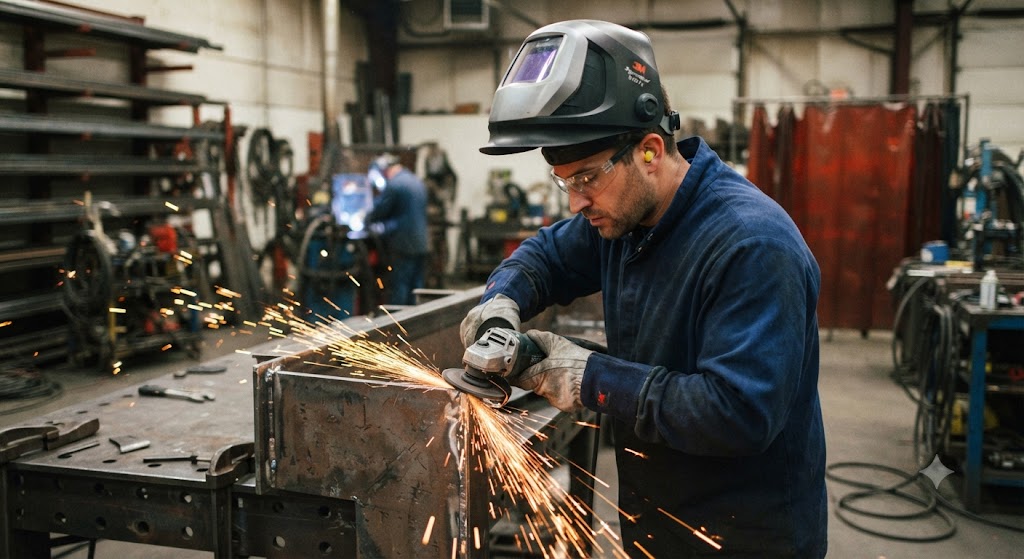
One genuinely useful feature for left-handed welders is grind mode - a fixed-shade setting (typically shade 3) that keeps the lens slightly tinted so you can see clearly while grinding without the lens activating. When a left-handed welder grinds with an angle grinder in the left hand, sparks travel in a different arc than they do for a right-handed grinder operator. Grind mode prevents the sensor-triggered darkening that can happen when sparks briefly flash in front of the sensors.
X-Mode (available on Miller helmets) is even better for this scenario. X-Mode uses electromagnetic detection of weld current rather than light sensing, which means bright ambient sources - including grinding sparks - do not trigger false darkening. For left-handed welders who work in bright environments or frequently transition between welding and grinding, X-Mode is a genuine productivity feature.
Helmets That Perform Well for Left-Handed Welders
Miller Digital Elite
Four arc sensors, X-Mode, ClearLight 4x lens, digital internal controls accessible from either side. The four-sensor configuration is the key benefit. Nothing about the design penalizes left-handed torch approach angles.
Miller Digital Infinity
Four sensors, the largest viewing area in Miller’s line at 13.4 square inches, X-Mode, InfoTrack arc-time logging. The wide-view format is genuinely helpful because it gives more peripheral context regardless of which side you approach from. At 23 oz (650 g) it is heavier than most helmets, but the viewing area advantage is real.
Lincoln Viking 3350
Four sensors, 4C lens technology, 12.5 square inches of viewing area. External controls accessible from the front. Lincoln’s 4C lens reduces the green tint common in lower-cost helmets, which helps with seeing the puddle regardless of approach angle. A consistent performer in both left- and right-handed use.
Lincoln Viking 2450
Two sensors, 7.44 square inches of viewing area. At this price point, the two-sensor configuration is the main tradeoff. Left-handed welders who do a lot of overhead or out-of-position work where one sensor can be easily shadowed will notice this limitation more than in straight-ahead flat-position work.
3M Speedglas 9100XXi
Four sensors, Natural Color Technology for true-color arc visibility, compatible with the Adflo PAPR system. The headgear system on Speedglas helmets allows for a wide range of shell adjustment that can help optimize sensor position for consistent left-handed torch approach.
Jackson Safety Truesight II
Two-sensor configuration but a wide 9.27 square inch viewing area. Good entry-level option, but the two-sensor setup means careful attention to torch position so neither sensor is blocked during the weld.
Headgear Fit Considerations
Headgear ratchet mechanisms on most helmets are designed to tighten from the back, which is the same for left- and right-handed users. The primary fit issue that affects left-handed welders more than others is cheek clearance: when you hold a torch in the left hand and look slightly right to view the joint, your head may tilt differently than a right-handed welder, and shells with a narrower cheek flare can catch on the shoulder or feel constrictive in that position.
Shells with a more rounded, flared profile - Miller Digital Infinity, Speedglas 9100 series - accommodate a wider range of head tilt without edge contact. Narrower-profile helmets that cut in sharply at the cheeks can feel limiting when you tilt your head to the left to view a right-side joint with a left-hand torch approach.
Summary Recommendation
For a left-handed welder buying a new helmet, prioritize in this order:
- Four arc sensors - this is the non-negotiable requirement for reliable darkening regardless of torch approach angle
- X-Mode or similar electromagnetic sensing - eliminates ambient light and partial-occlusion false triggers
- Wide viewing area - more visual context makes left-handed approach angles easier to manage
- Centered or accessible controls - convenient but not critical
The Miller Digital Elite, Miller Digital Infinity, Lincoln Viking 3350, and 3M Speedglas 9100XXi all hit items one and two. From there, it is a matter of budget and personal fit preference.
The Honest Verdict
A left-handed welder does not need a special helmet. The industry settled on roughly symmetric, centered designs for the mid-tier and above, and the four-sensor ADF configuration is common enough in the 300-and-above range that you have good options. Where left-handedness genuinely creates a disadvantage is in budget two-sensor helmets - there, the limited sensor coverage makes torch approach angle matter a lot more, and a left-handed welder making an approach that shadows the left sensor may experience delayed darkening. Spend a bit more to get four sensors and you eliminate most of the concern entirely.
Frequently Asked Questions
Are any welding helmets specifically designed for left-handed welders? No major manufacturer currently makes a left-handed-specific helmet. The good news is that most mid-range and premium helmets are genuinely symmetric in their sensor placement and control access, making them suitable for either hand.
Why does my helmet sometimes not darken when I weld left-handed? Most likely one of the sensors is being partially blocked by your torch body or hand in your natural torch approach angle. Repositioning slightly or switching to a four-sensor helmet with X-Mode eliminates this.
Does X-Mode work differently for left-handed welders? X-Mode uses electromagnetic current detection rather than light sensing, so torch position relative to the sensors does not affect its triggering. This makes it especially useful for left-handed welders who frequently shadow optical sensors.
Is a wider viewing area better for left-handed welding? Yes, in practice. A wider viewing area gives more peripheral context and reduces the need to tilt or angle the head sharply to see the joint clearly when approaching from the left.
What is the minimum sensor count I should accept in a welding helmet? Four sensors for any helmet used in out-of-position, overhead, or varied-approach welding. Two sensors can work in flat-position straight-ahead welding but leave little margin for obstructed angles.
Can I adjust sensitivity to compensate for a partially blocked sensor? Raising sensitivity helps on low-amperage processes but cannot fully compensate for a sensor that has no line-of-sight to the arc. Sensitivity adjustment is a fine-tuning tool, not a substitute for proper sensor exposure.
Keywords: welding helmet for left handed welders, left handed welding, best welding helmet ambidextrous, four sensor welding helmet, X-Mode left hand welding