Welding Helmet Buying Guide for Overhead and Pipe Welding
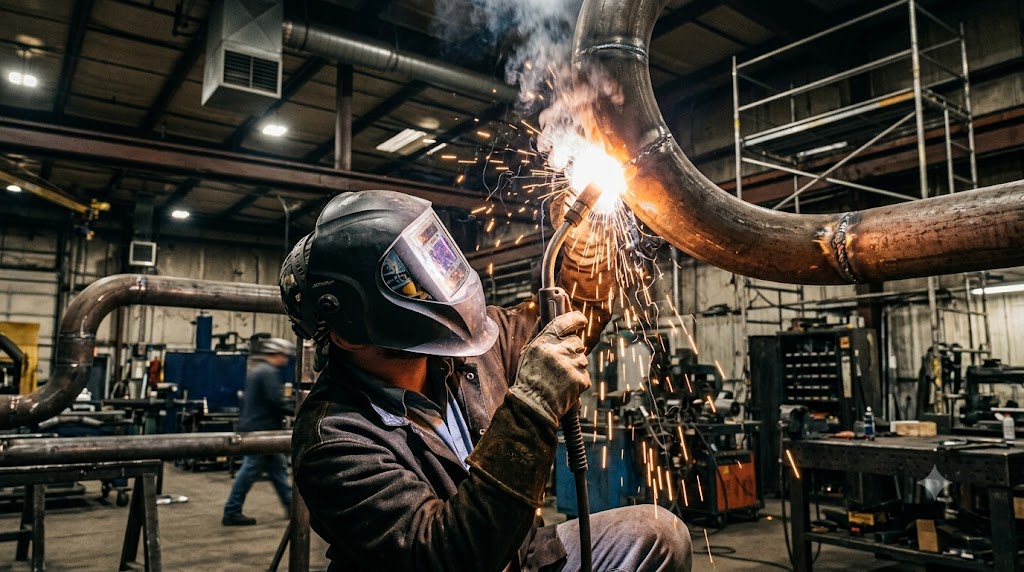
Overhead welding and pipe welding are two of the most demanding contexts a welding helmet can encounter. Both put the welder in positions where standard helmet designs develop frustrating limitations, and both have histories of welders adapting their equipment to compensate. If you are doing overhead work regularly or running pipeline, the helmet choice matters in ways that do not apply to flat-position shop work.
Why Overhead Welding Changes Everything About Helmet Selection
When you weld overhead, the helmet is no longer hanging naturally from headgear with gravity keeping the shell level and the face seal consistent. Instead, the shell pivots forward, the front loading shifts, and the headgear has to hold the helmet in a tilted position while you look up. The problems this creates:
Neck fatigue. Any helmet mass at the front of the shell is felt as leverage against your neck when tilted back. Heavier helmets become dramatically more fatiguing in overhead position than they feel in flat welding. A helmet that feels fine for horizontal work may cause real neck strain on an overhead structural pass.
Sensor obstruction. In overhead position, your arm raising the torch toward the ceiling creates a different geometry relative to the arc sensors. The sensors, typically positioned on the front of the lens, may have their line-of-sight partially blocked by your arm or by structural members above the work. This is exactly the scenario where four-sensor helmets or X-Mode (Miller’s current-sensing technology) outperform two-sensor standard detection.
Headgear stability. The headgear has to hold the helmet reliably in a tilted-back position without the shell sliding forward or the seal at the crown shifting. A ratchet headgear with a well-designed suspension is significantly more stable for overhead work than a simple strap system.
Viewing angle. In overhead position, you may be looking up at a shallow angle to see the puddle. Helmets with large, vertically oriented viewing areas give you more usable sight line in this position. A small vertical dimension viewing window can cut off your view of the puddle at steep tilt angles.
What to Look For in an Overhead Helmet
Weight under 600 grams total. Lighter helmets are disproportionately better for overhead work. Optrel’s Crystal 2.0 is one of the lightest premium helmets. Miller’s Digital Elite and Lincoln’s Viking 3350 are heavier but their headgear designs distribute weight reasonably well.
Four-sensor auto-darkening or X-Mode. Four sensors reduce the risk of failed detection when your arm shadows the sensors. Miller’s X-Mode on the Digital Elite and Digital Infinity eliminates the sensor obstruction problem entirely by detecting welding current rather than arc light.
Large vertical viewing area. The Lincoln Viking 3350’s viewing area at 3.74 x 3.34 inches has good vertical dimension. The ESAB Sentinel series have tall shells that accommodate varied viewing angles.
Ratchet headgear with top head support. Look for headgear with an adjustable top strap or crown rest that bears some of the helmet weight when tilted back.
Why Pipe Welders Use Different Helmet Shapes
Pipeline welding historically developed a distinct helmet culture around the pipeliner or pancake shell shape. Pipeliner helmets are narrow and deep from front to back rather than wide and tall like standard helmets. This shape lets the pipeliner welder get into tight wrapping positions around the pipe without the wide shell of a standard helmet running into the pipe or surrounding structure.
Most pipeliner helmets are passive fixed-shade designs, though auto-darkening lens inserts are available for pipeliner shells from Jackson Safety (PL280) and other sources. The fixed-shade pipeliner remains the preference of many experienced pipeline welders because they have learned to flip the shield rather than rely on auto-darkening mechanics.
For someone new to pipeline work transitioning from auto-darkening helmets, a Jackson Safety PL280 or Fibre-Metal/Honeywell pipeliner shell with an auto-darkening insert is a reasonable middle path.
Specific Helmet Recommendations for Overhead Work
Miller Digital Elite. X-Mode solves the sensor obstruction problem definitively. Weight is manageable. Replacement parts widely available.
Lincoln Viking 3350. Large viewing area, four sensors, comfortable headgear for overhead. Not as light as some competitors.
Optrel Crystal 2.0. Among the lightest premium helmets available. Reduces neck fatigue for extended overhead sessions significantly.
Frequently Asked Questions
What helmet shape is best for overhead welding? A standard helmet with ratchet headgear, four sensors or X-Mode, large vertical viewing area, and minimum weight. The pancake/pipeliner shape is specific to pipeline work, not overhead structural welding.
Why do pipe welders avoid bulky helmets? Bulky helmets physically interfere with wrapping positions around pipe. The narrow pipeliner shell shape allows positions that a standard wide helmet cannot achieve in tight pipe clearances.
Does helmet weight matter more for overhead work? Yes. The front mass of the shell acts as a lever against your neck in tilted-back overhead position. Even 100 grams difference is noticeable over a full shift of overhead work.
Can you weld overhead with a standard auto-darkening helmet? Yes, with the right settings and four-sensor or X-Mode detection. The challenge is managing weight and ensuring sensor coverage in non-standard arc strike positions.
What is the best four-sensor helmet for overhead welding? The Miller Digital Elite with X-Mode is the strongest option for sensor reliability overhead. The Lincoln Viking 3350 with four standard sensors is a close second.
References
https://www.aws.org https://www.millerwelds.com https://www.lincolnelectric.com https://www.optrel.com
SEO Title: Welding Helmet Buying Guide for Overhead and Pipe Welding