YESWELDER PAPR Welding Helmet Review (LYG-Q800D)
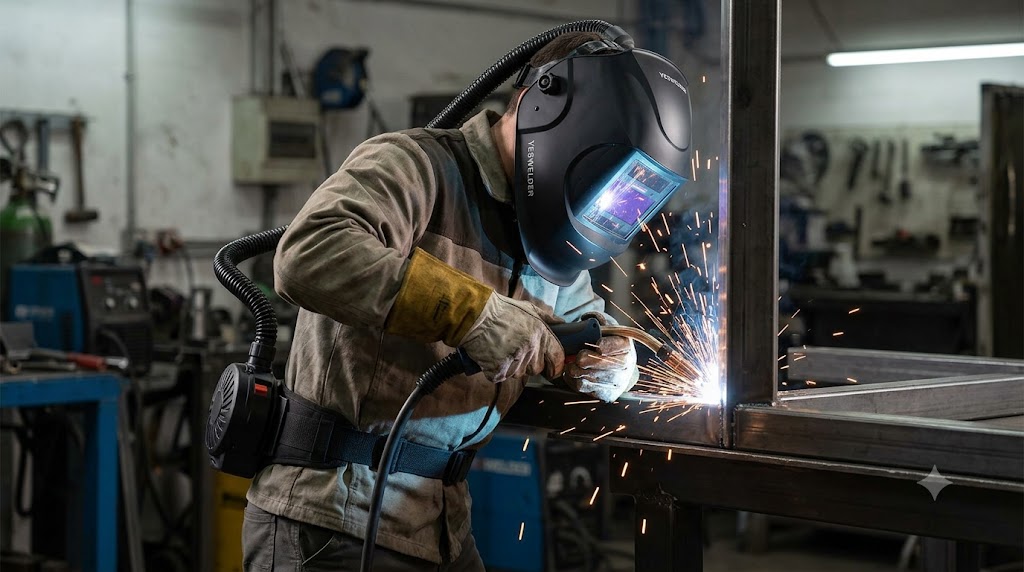
Most welders reach for a half-mask respirator and call it a day. But if you’re spending full production shifts in a shop with poor exhaust ventilation, welding galvanized or stainless repeatedly, or working in a space where ambient fume concentration climbs through the shift, a half-mask APR isn’t always the right tool. That’s where a PAPR-integrated welding helmet starts to make sense, and the YESWELDER LYG-Q800D is one of the few units at this price point that puts a powered air-purifying respirator behind a proper auto-darkening lens.
Here’s what it does well, how it compares to the 3M Adflo and Miller T94i, and the honest limits of what this unit is built for.
What Is the YESWELDER LYG-Q800D PAPR?
The LYG-Q800D is an auto-darkening welding helmet with an integrated powered air-purifying respirator (PAPR) system. Instead of filtering air through static P100 cartridges, a battery-powered blower draws ambient air through a filter assembly and supplies it inside the helmet under positive pressure. The positive pressure design means any leak in the face seal has filtered air escaping outward rather than unfiltered air being drawn in.
PAPR systems are classified as loose-fitting respirators when used as helmet-integrated units. Under OSHA 29 CFR 1910.134 and NIOSH 42 CFR Part 84, loose-fitting PAPRs carry an Assigned Protection Factor (APF) of 25 - two and a half times the APF of a standard half-mask APR. They also do not require the fit testing that tight-fitting respirators demand, which simplifies compliance in some workplace respiratory protection programs.
The LYG-Q800D features a 180-degree panoramic viewing area with a 100 x 83 mm main auto-darkening lens (variable shade 5 to 9 and 9 to 13), non-auto-darkening side panels, and 1/1/1/1 optical clarity rating. Response time is rated at 1/30,000 second. Power is solar with a CR2450 backup battery.
Who the LYG-Q800D Is For
The PAPR format is not for every welder. It makes sense when:
- You’re welding in a confined or poorly ventilated space where fume concentration builds across a shift
- You’re working with galvanized, stainless, or coated materials consistently, where hexavalent chromium, zinc oxide fumes, or manganese exposures are regular concerns
- You’ve failed fit tests on half-masks due to facial hair, facial anatomy, or scarring, and a tight-fitting respirator can’t achieve a reliable seal
- Your employer’s industrial hygiene monitoring shows fume concentrations where APF-25 is required rather than APF-10
For welders doing occasional light mild-steel work in a well-ventilated shop, a half-mask P100 respirator is simpler and costs less. OSHA’s hierarchy of controls puts engineering controls first - local exhaust ventilation, fume extraction guns - before respirators. A PAPR doesn’t replace good ventilation; it supplements it when ventilation alone isn’t enough.
LYG-Q800D vs 3M Adflo vs Miller T94i
These three represent different tiers in the PAPR welding helmet market.
3M Adflo PAPR (with 3M Speedglas series helmet): The Adflo is the industrial standard for PAPR welding helmets. It is NIOSH-approved as a powered air-purifying respirator, carries a documented APF of 25 as a loose-fitting PAPR, and has a comprehensive filter ecosystem covering particulates, organic vapors, and welding fumes specifically. The 3M Speedglas helmets it pairs with have outstanding optical quality and large viewing areas. The Adflo system is significantly more expensive than the LYG-Q800D and is sold as a professional industrial respiratory protection device with corresponding documentation, certifications, and replacement part availability. Flaw: the blower unit weight and hose add setup complexity.
Miller T94i PAPR: Miller’s premium integrated PAPR helmet. Also targets professional production welding environments with high fume exposure. Carries full NIOSH documentation and is designed specifically for environments requiring formal respiratory protection programs. Priced at the high end of the market. Flaw: same weight and bulk concerns as the Adflo, plus a premium price.
YESWELDER LYG-Q800D: Positioned as a more accessible entry point into PAPR-style welding helmets. The helmet optics are legitimate - 1/1/1/1 optical clarity, wide shade range, panoramic view. The PAPR-style airflow provides comfort and some degree of fume dilution inside the helmet cavity. Flaw (and an important one): at time of research, the LYG-Q800D’s respiratory protection claims have not been verified against a documented NIOSH APF rating in the same way the 3M Adflo has. If your workplace respiratory protection program requires a NIOSH-certified PAPR with a documented APF, verify the LYG-Q800D’s current NIOSH certification status before relying on it for regulatory compliance. The 3M Adflo and Miller T94i have that documentation clearly published.
For welders outside a formal industrial program who want panoramic optics with supplemental airflow and added comfort, the LYG-Q800D is a reasonable choice. For compliance-driven industrial environments, verify the certification before purchasing.
Helmet Optics and Features
The 180-degree panoramic design with side panels is the LYG-Q800D’s strongest selling point as a helmet independent of the PAPR function. The wide field of view reduces the need to tilt your head on angle grinds and tight corners. The 1/1/1/1 optical clarity rating means the lens scores at the top ANSI category for optical quality in each of the four test criteria: optical class, diffusion of light, variation in luminous transmittance, and angle of dependence.
The side panels are fixed shade, not auto-darkening, which means they darken your peripheral view permanently during use. In most welding positions this is not a problem. In scenarios where you need clear peripheral vision for positioning, it requires awareness.
Named Flaw
The LYG-Q800D’s critical limitation is the ambiguity around its formal NIOSH PAPR certification and documented APF. The 3M Adflo publishes its NIOSH approval number, its assigned protection factor, and its filter specifications in compliance documentation suitable for an OSHA-required respiratory protection program. At time of research, YESWELDER’s documentation for the LYG-Q800D’s PAPR system does not provide the same level of regulatory transparency. If your use case is comfort and airflow in personal shop use, this may not matter to you. If your use case is formal workplace compliance under 29 CFR 1910.134, that documentation gap is a genuine problem.
Getting the LYG-Q800D
Comparison Table
| YESWELDER LYG-Q800D | 3M Adflo + Speedglas | Miller T94i | |
|---|---|---|---|
| PAPR type | Integrated helmet PAPR | Separate blower + helmet | Integrated helmet PAPR |
| Optical clarity | 1/1/1/1 | 1/1/1/2 to 1/1/1/1 | 1/1/1/1 |
| Panoramic view | Yes (180 deg) | Varies by helmet | Yes |
| NIOSH APF documentation | Verify before purchase | APF 25, documented | APF 25, documented |
| Fit testing required | No (loose-fitting) | No (loose-fitting) | No (loose-fitting) |
| Target user | Personal/light industrial | Professional industrial | Professional industrial |
| Amazon available | Yes (Check on Amazon) | Check distributor | Check distributor |
FAQ
What is the YESWELDER PAPR used for? The LYG-Q800D is an auto-darkening welding helmet with a powered air-purifying respirator system. The blower moves filtered air inside the helmet shell, providing fume dilution and improved comfort over passive half-mask respirators. It’s suited for welders who need wider field of view, helmet-integrated respiratory protection, or who cannot achieve a proper fit-test seal with tight-fitting respirators.
How does it compare to the 3M Adflo and Miller T94i? The 3M Adflo and Miller T94i are professional industrial PAPR systems with clearly documented NIOSH APF-25 ratings and comprehensive compliance documentation for formal respiratory protection programs. The LYG-Q800D offers a more accessible entry point with strong optics, but buyers should verify its current NIOSH certification status before relying on it for regulated workplace environments. For personal shop use focused on comfort and fume dilution, the LYG-Q800D is a viable option.
Is it good for fume-heavy environments? For environments requiring formal respiratory protection under OSHA 29 CFR 1910.134, confirm the unit’s NIOSH certification and APF documentation before purchasing. For personal use in environments with moderate fume exposure where engineering controls are in place, the PAPR airflow provides meaningful comfort and additional protection versus no respirator. It is not a substitute for local exhaust ventilation.
Does a PAPR require fit testing? Loose-fitting PAPRs do not require fit testing under OSHA 29 CFR 1910.134. This is one of their practical advantages in workplaces where facial hair, anatomy, or other factors make tight-fitting respirator qualification difficult. A medical evaluation and training are still required under the standard.
When do you need a PAPR instead of a half-mask? A PAPR is appropriate when: half-mask APF-10 is insufficient for the fume concentration, when the welder cannot achieve a successful fit test on a tight-fitting respirator, or when continuous long-duration work in high-fume environments makes the positive-pressure comfort advantage worth the added equipment weight and cost.
What is OSHA’s standard for PAPR use in welding? OSHA 29 CFR 1910.134 governs all respirator use. For welding-specific guidance, OSHA’s welding fume publications (including guidance on hexavalent chromium under 1910.1026) address when APF-25 or higher protection is needed. NIOSH also publishes specific guidance on respiratory protection for welding fumes.