Can a 125V Flux Core Welder Weld 3/8 Inch?
Type the question into any forum and you get two answers shouting past each other. One says yes, absolutely, here is a photo. The other says never, you will die. Both are missing the actual point, which is not whether metal sticks together but whether the joint is fused all the way through or just capped on top.
A 125-volt flux-core welder can make 3/8 inch steel stick together. Whether it makes a joint you should trust depends entirely on how you do it and what the joint has to hold.
What a 125V flux-core welder actually is
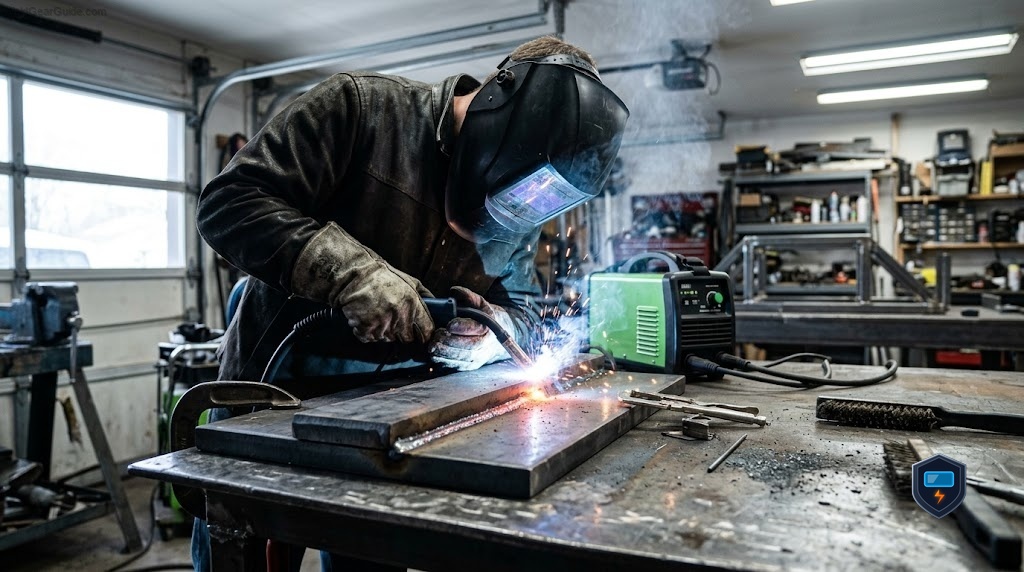
A 125V flux-core welder is a compact, self-shielded wire-feed machine running on a standard 120-volt outlet, with a maximum output around 125 amps. Common examples are the Harbor Freight Titanium Easy-Flux 125, the Chicago Electric Flux 125, and similar machines from other brands.
The manufacturer ratings are consistent and honest. These machines are specified for mild steel from about 18 gauge up to 3/16 inch in a single pass. That 3/16 inch figure is the number that answers the question directly: a single-pass, full-penetration weld tops out around 3/16 inch, not 3/8 inch.
Why penetration is the real question
Welding two pieces of 3/8 inch plate is not about melting the surface. It is about getting the arc’s heat deep enough to fuse the two pieces into one along the joint. That depth is penetration, and penetration depends on amperage.
A 125-amp machine running at roughly 90 amps into cold 3/8 inch steel simply does not carry enough energy to fuse the full thickness in one pass. What you get instead is a bead sitting on top of the joint, bonded to the surface but with unfused metal underneath. It can look completely acceptable and fail under load, which is exactly the failure mode that makes people distrust cheap welders when the real problem was asking too much of them.
The titanium torture-test videos that show a Flux 125 welding 3/8 inch or even thicker are real, but read them carefully. They are demonstrations that metal fuses, not endorsements for structural use, and the people making them usually say so.
How to actually join 3/8 inch on a small machine
If the joint is non-structural and you understand the limits, there are legitimate techniques that improve fusion on thick material with a small machine.
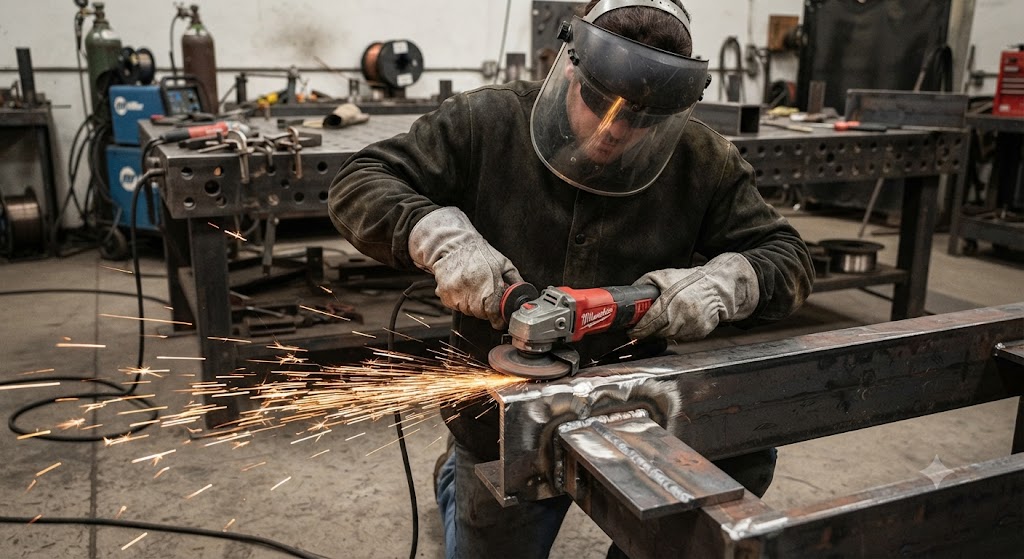
Bevel the edges. Grinding a V into the joint edges gives the arc access to the root, so you are filling a prepared groove rather than trying to blast through a square edge. This is the single biggest improvement available.
Preheat the metal. Warming 3/8 inch steel before welding, with a torch, reduces how much heat the cold mass steals from the puddle, which lets the limited arc energy go into fusion instead of fighting the thermal mass.
Multiple passes. A root pass followed by fill and cap passes builds the weld up in layers, each of which the machine can actually fuse, rather than attempting the whole thickness at once.
Slow down and manage the duty cycle. At 30 percent duty cycle around 90 amps, you get roughly three minutes of arc time in ten. Rushing to beat the thermal cutout produces cold, shallow welds.
Done together, these let a small machine make a sound weld on thick material for non-load-bearing work. What they cannot do is turn a 125-amp machine into a structural welder for anything holding weight, hauling a trailer, or sitting overhead.
The honest recommendation
If you are regularly welding 3/8 inch material, the right answer is not a technique, it is a bigger machine. A 125-amp flux-core unit welding thick steel is working at the very edge of its ability every time, and the margin for error is thin.
The Forney Easy Weld 140 FC-i gives you 140 amps and a rated capacity up to a quarter inch, with infinite voltage and wire speed control that helps you dial in fusion on the thicker end of its range. It is still a 120V flux-cored machine, still 30 percent duty cycle at 90 amps, so it does not turn 3/8 inch into an easy job, but it has more headroom than a 125-amp unit.
For genuine 3/8 inch and thicker work, step up to a dual-voltage machine. The Lincoln POWER MIG 215 MPi reaches 220 amps on 230V input and is rated for 3/8 inch steel, and it does it with the current and duty cycle to fuse properly rather than fight the thickness. That is the difference between a weld that looks strong and a weld that is strong.
Anyone who wants only occasional thick welds and mostly does thin work should skip the bigger machine and either bevel-and-preheat within the limits or take the occasional thick job to someone with the right equipment.
The verdict
Can a 125V flux-core welder weld 3/8 inch? It can join it. It cannot reliably fuse it in the way a load-bearing joint requires. That distinction is the entire answer, and ignoring it is how people build things that look welded and are not.
Three things to hold onto. The 3/16 inch single-pass rating is honest and describes where full penetration ends, so treat it as a real ceiling. Beveling, preheat and multiple passes genuinely improve fusion on thick metal and make non-structural thick welds viable. And for anything that carries load, the right tool is more amperage, which in practice means a 140-amp machine at minimum and a dual-voltage 200-amp-plus machine for regular thick work.
Match the machine to the load the joint has to carry, not to the thickness you can make stick. Those are not the same number.
Frequently asked questions
Can a 125 amp flux core welder weld 3/8 inch steel? It can make 3/8 inch steel stick together with beveling, preheat and multiple passes, but it cannot reliably achieve full-penetration fusion suitable for load-bearing joints. The single-pass rating is around 3/16 inch.
What is the thickest a 125V welder can weld? About 3/16 inch mild steel in a single, full-penetration pass. Thicker material requires joint preparation and multiple passes, and even then is only appropriate for non-structural work.
Is it safe to weld structural steel with a small flux core welder? No. Load-bearing and overhead joints require reliable full penetration that a 125-amp machine cannot consistently deliver on thick material. Use a machine rated for the thickness and the load.
Does beveling help a small welder weld thicker metal? Yes. Grinding a V into the joint edges gives the arc access to the root and allows the weld to be built up in a prepared groove, significantly improving fusion on thick material.
Should I preheat before welding thick steel? On a small machine, gentle preheat helps by reducing how much heat the cold metal draws away from the puddle, letting the limited arc energy go into fusion. Do not overheat heat-treated or alloy steels.
What welder do I need for 3/8 inch steel? For reliable full-penetration welds on 3/8 inch, a machine that can deliver around 200 amps or more, which typically means a dual-voltage machine running on 230V such as the Lincoln POWER MIG 215 MPi.
Why do my thick welds look good but break? Because the bead is bonded to the surface but not fused through the joint, a condition called lack of penetration. It is the classic failure of asking a small machine to weld beyond its amperage.
Can I do multiple passes to weld thicker metal? Yes, a root pass followed by fill and cap passes builds a weld in layers the machine can fuse. Combined with beveling and preheat, this is the correct technique for thick non-structural work on a small machine.
References
- Harbor Freight Tools, Flux Wire Welder Owner’s Manual and Safety Instructions
- Lincoln Electric, TECHNICAL SPECIFICATIONS 125 and 140 Amp wire feeder welders
- Forney Industries, 140 FC-i Welder specification sheet
- Lincoln Electric, POWER MIG 215 MPi Multi-Process Welder specifications