190 Hobart Welder: A Practical Owner's Guide
The farm shop had a 230V outlet welded to the wall by the previous owner, and the 120V welder I had been using for two years was finally showing its ceiling. I needed more amperage for 1/4-inch plate, and I needed it to hold a bead longer than two minutes at a time. That is the moment the 190 Hobart welder enters the conversation.
The 190 Hobart welder, known officially as the Handler 190, is a 230V MIG machine that outputs 25 to 190 amps and welds 24-gauge to 5/16-inch mild steel in a single pass. It is a transformer-based machine weighing 68 pounds, with seven voltage settings, infinite wire feed speed control, and a built-in spool gun connection for aluminum welding.
If you have outgrown your 120V welder and need a 230V machine that can handle 1/4-inch plate and thicker farm repair work, the Hobart Handler 190 is a proven choice. The real limitations are its weight, its tap-style voltage control, and the fact that Hobart has discontinued it in favor of the Handler 210 MVP.
The Machine
The Handler 190 runs on 230V single-phase power, which means you need a dedicated 230V circuit in your shop. The rated output is 130 amps at 21.5 VDC with a 30% duty cycle. That 30% number matters more than the 190-amp maximum, because it tells you what the machine can sustain. At 130 amps, you get three minutes of welding out of every ten. At lower amperages, the duty cycle climbs, and you can weld longer.
The seven voltage settings give you tap-style control, which means you select from fixed voltage points rather than dialing in an infinite voltage like you would on an inverter machine. For most farm and fabrication work, seven settings are enough. The infinite wire feed speed control lets you fine-tune the amperage within each voltage tap.
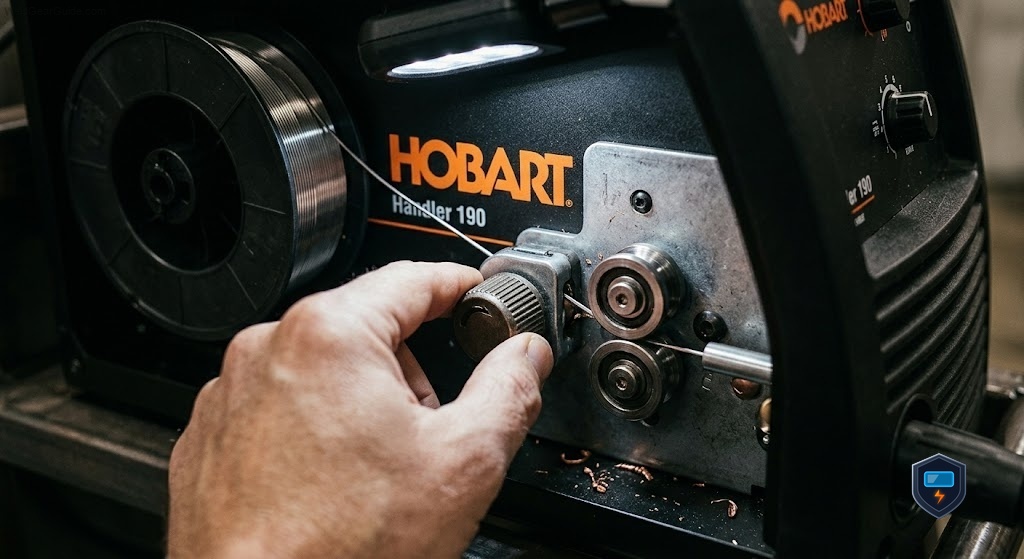
The wire feed speed range is 40 to 700 inches per minute under load, and the machine accepts both 4-inch and 8-inch wire spools. That 8-inch capacity is important. It means you can buy 10-pound spools of wire, which hold more wire and require fewer changes than the 2-pound spools that smaller machines accept. The open-circuit voltage is 31 volts.
The Handler 190 comes with a 10-foot H100S4 MIG gun, a work cable with ground clamp, and a setup chart on the inside of the side door. It is spool gun ready, which means you can plug in the Hobart SpoolRunner 100 spool gun directly for welding aluminum without any adapter.
What It Does Well
The wire feed mechanism is the Handler 190’s strongest point. Users consistently report smooth, reliable feeding, and the Quick Select drive rolls make wire changes toolless. The machine has a reputation for durability. On the Garage Journal forum, one longtime user noted that the 190 is a good machine and you will not need any parts for it.
The 5/3/1 warranty from Hobart gives five years on the transformer and rectifier, three years on the electronics, and one year on the gun. That warranty structure reflects the machine’s transformer-based design, where the core components are built to last decades.
The Handler 190 handles mild steel, stainless steel, and aluminum (with the spool gun). The thickness range of 24-gauge to 5/16-inch covers most farm, auto, and fabrication work that a home shop will encounter.
The Named Flaws
The weight is the first thing you feel. At 68 pounds, this is not a machine you carry to the job. It is a machine you mount on a cart and wheel around the shop. The transformer design is the reason for the weight, and it is also the reason the machine cannot run on 120V. If your shop does not have a 230V circuit, this welder is not an option without an electrician’s visit.
The tap-style voltage control is the second flaw. Seven fixed settings work, but they leave gaps. If the ideal voltage for your joint falls between two taps, you compensate with wire speed, which is a workaround rather than a solution. Inverter machines like the ESAB Rogue EM 190 Pro offer infinite voltage control, which gives you finer adjustment.
The third issue is availability. Hobart has discontinued the Handler 190 and replaced it with the Handler 210 MVP, which adds dual-voltage capability (120V and 230V). You can still find the 190 as a refurbished or used unit, and parts remain available through Hobart’s distribution network, but the machine is no longer in current production.
Who should skip this: If you do not have a 230V circuit and do not plan to add one, skip the Handler 190. If you want infinite voltage control rather than tap settings, look at an inverter machine. If you are buying new and want current production, the Handler 210 MVP is the replacement.
ESAB Rogue EM 190 Pro: The Inverter Alternative
The ESAB Rogue EM 190 Pro is the most direct competitor to the Handler 190, and it solves two of the three problems above. It weighs 37.3 pounds instead of 68, and it uses inverter technology with full-featured controls that let you fine-tune arc characteristics based on the material you are welding.
The Rogue EM 190 Pro runs on 230V single-phase power, same as the Handler 190. It is compatible with 11 kVA (10 kW) generators, which makes it a viable field machine if you have generator power. The ESAB offers synergic MIG modes, which means the machine suggests parameters based on your wire and material, reducing setup time.
The tradeoff is build weight in a different sense. The ESAB uses lighter-gauge sheet metal and plastic handles compared to the Hobart’s heavier construction. One WeldingWeb forum user described the ESAB as a great machine for a clean, dry, stationary jobsite but noted that the boards are not coated and the strain relief on the plug is not very durable. The Hobart, by contrast, is built like a tank, which is why it weighs nearly twice as much.
Who should skip the ESAB: If you work in harsh environments where the machine will get bounced around, rained on, or exposed to dust and grinding debris, the Hobart’s heavier construction is the safer bet. The ESAB is the better workshop machine, but the Hobart is the better field machine.
Ownership Considerations
Hobart welding products are manufactured by Hobart Brothers, which was acquired by Illinois Tool Works (ITW) in 1996. ITW is also the parent company of Miller Electric. This means Hobart and Miller are sister companies under the same corporate umbrella, which is why you will sometimes hear people ask whether Hobart is owned by Miller. The answer is that both are owned by ITW, and they share some engineering resources and distribution channels, but they operate as separate brands with separate product lines.
Parts availability for the Handler 190 remains strong. Hobart maintains a parts network through welding supply distributors, and common consumables like drive rolls, contact tips, and gun liners are widely available. The SpoolRunner 100 spool gun is still sold as an accessory.
The Handler 190 uses a standard Tweco-style MIG gun, which means replacement guns and consumables are easy to find from multiple manufacturers, not just Hobart. This is a real ownership advantage over machines that use proprietary gun designs.
Where It Lands
The Hobart Handler 190 is a machine for someone who has a 230V circuit, wants a durable transformer-based MIG welder, and does not need the lightest package or the most advanced controls. If you find one used or refurbished, it is a solid buy for a farm shop, home fabrication shop, or maintenance facility. The wire feed is smooth, the spool gun option works, and the 8-inch spool capacity keeps your wire supply efficient.
If you are buying new, the Handler 210 MVP gives you dual voltage and current production support. If you want an inverter with finer control and half the weight, the ESAB Rogue EM 190 Pro is the alternative that earns its place. Both are good machines. The Hobart 190 earned its reputation the hard way, and even discontinued, it is still a tool that belongs in the right shop.
Frequently Asked Questions
Is the Hobart Handler 190 still being made?
No. Hobart has discontinued the Handler 190 and replaced it with the Handler 210 MVP, which offers dual-voltage input (120V and 230V). The 190 is still available as a refurbished or used unit, and parts remain in production.
What is the duty cycle of the Hobart Handler 190?
The rated duty cycle is 30% at 130 amps, meaning you can weld for three minutes out of every ten at that output. At lower amperages, the effective duty cycle increases. At full 190-amp output, the duty cycle is lower than 30%.
Can the Hobart 190 weld aluminum?
Yes, with the optional SpoolRunner 100 spool gun, which plugs directly into the machine without an adapter. You will need a roll of aluminum wire and a cylinder of argon shielding gas.
What input power does the Hobart Handler 190 require?
It requires 230V single-phase power on a dedicated circuit. It cannot run on 120V household current. You will need a 230V outlet installed by an electrician if your shop does not already have one.
How much does the Hobart Handler 190 weigh?
The machine weighs 68 pounds. It is a transformer-based design, which is heavier than inverter machines in the same amperage class. Most owners mount it on a welding cart rather than carrying it.
Is Hobart owned by Miller?
Hobart and Miller are both owned by Illinois Tool Works (ITW), which acquired Hobart Brothers in 1996. They operate as separate brands with separate product lines, though they share a parent company and some distribution channels.
What wire sizes does the Hobart 190 accept?
It accepts .023 to .035 solid wire and .030 to .045 flux-cored wire. The Quick Select drive rolls accommodate multiple wire sizes without tools.