AC-225-S Lincoln Welder: What It Can and Cannot Do
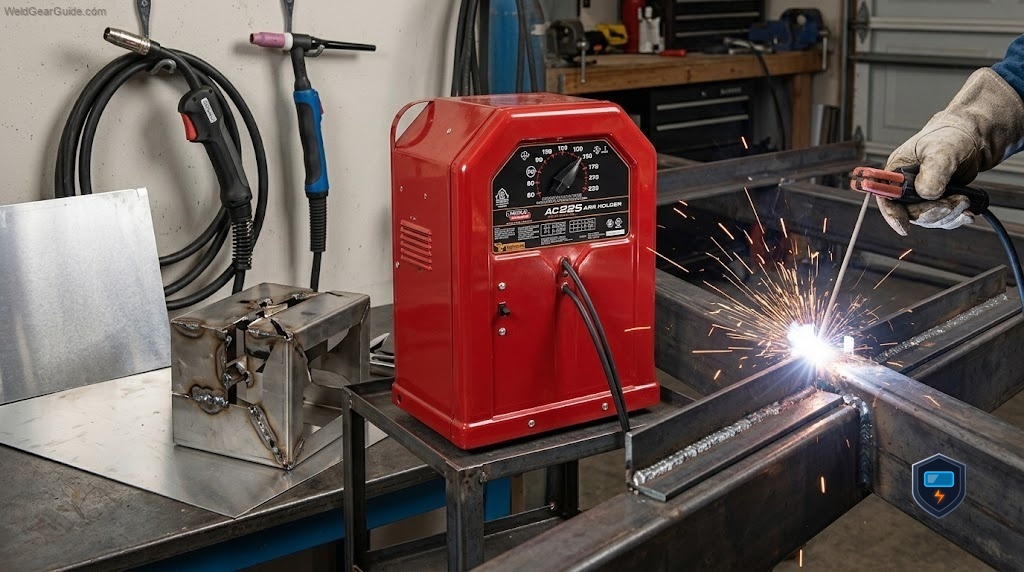
Go to any farm auction in the Midwest and there will be a gray tombstone sitting on a pallet with a frayed electrode lead coiled on top. Somebody will buy it for the second time in forty years and it will keep working. The AC-225-S Lincoln welder is the machine that taught most of a generation to stick weld, and it is still on shelves at the same hardware stores, essentially unchanged.
That longevity gets mistaken for universal capability. It is not. This machine does one thing, does it stubbornly well, and does nothing else at all.
The AC-225-S, sold as the K1170, is a single phase transformer stick welder that runs on 230 volt input and produces alternating current only. You set current with a big rotary selector anywhere from 40 to 225 amps, clamp on a ground, and burn rod. There is no wire feeder, no torch, no display and no circuit board to fail.
The direct answer most people are looking for: this machine is right for you if you weld mild steel 16 gauge and heavier, in short sessions, in a fixed location with a 230 volt 50 amp circuit. It is wrong for you if you need DC output, if you weld thin sheet, or if you need to weld anywhere away from that outlet.
The Spec Sheet Without the Sales Language
Lincoln rates the K1170 at 225 amps, 25 volts, 20 percent duty cycle, drawing 50 amps at 230 volt single phase input. The output range is 40 to 225 amps with a maximum open circuit voltage of 79 volts. It weighs 109 pounds and measures 24 by 17.25 by 12 inches. It ships with an attached input cable and a NEMA 6-50P plug, an insulated electrode holder and lead, and a work clamp and lead.
Two of those numbers deserve more attention than they usually get.
The 79 volt open circuit voltage is high, and that is deliberate. AC arcs are harder to start and harder to keep stable than DC, so the transformer gives you a lot of voltage sitting there waiting. That high OCV is exactly why the machine strikes an arc easily on rusty, painted, farm grade steel. It is also why you treat this machine with respect: dry gloves, dry boots, dry ground, no welding in the rain, no bare skin against the work.
The 20 percent duty cycle is where the sales copy goes quiet. Lincoln’s manual is blunt about it: the 60 hertz machines are rated 20 percent duty cycle at the current shown for each switch position. Not 20 percent at 225 amps and unlimited at 90. Twenty percent, everywhere on the dial. Duty cycle is figured over a ten minute period, so you get two minutes of arc time and eight minutes of cooling. Leave the machine switched on during the rest so the fan keeps pulling air through it.
For a fence repair or a mower deck bracket, two minutes of arc time is more than you need. For laying out a trailer frame, you will spend your Saturday watching a cooling fan.
Why AC Only Changes What Rods You Can Buy
This is the limitation that catches people out and gets mentioned the least.
The AC-225-S has no rectifier. The output is alternating current, and alternating current will not run every electrode on the shelf. E6010, the rod pipeline welders reach for because of how hard it digs into dirty root passes, is a direct current electrode. It will not run properly on this machine. E7018, the low hydrogen rod most people want for structural work, needs the AC rated version, and even then it starts stickier and runs less sweetly than it does on DC.
What the machine does like is E6011 and E6013 for general work, plus stainless and hardfacing electrodes in AC compatible grades. Lincoln rates the 225 amp output as enough for 3/16 inch general purpose mild steel electrodes and 5/32 inch in other types.
So the practical rule: if your welding lives in the 6013 and 7018AC world, the machine is fine. If you have watched videos of somebody running 6010 uphill on a pipe joint and that is what you want to learn, this machine cannot teach you that, ever. That is a hard stop, not a workaround.
Who should skip the AC-225-S over this alone: anybody planning to weld pipe, anybody chasing a certification that specifies DC electrodes, and anybody who wants the cleaner arc and easier out of position control that DC gives beginners.
What It Genuinely Does Better Than Newer Machines
There is a reason these keep selling.
It is a transformer with taps and a fan. There is no inverter board to die from a voltage spike, no display to fog up, no firmware. Pop the case on a forty year old unit and you will find contacts you can clean with a wire brush and a rag. When a modern inverter machine fails, you replace the machine. When this one acts up, you fix it.
The arc characteristic is also more forgiving on filthy metal than people expect. That high open circuit voltage plus the smooth AC waveform means it starts and keeps burning on the kind of scaled, rusted, half painted steel that shows up in actual repair work rather than in a booth.
And the amperage range genuinely reaches. Metals 16 gauge and heavier are in range, and at the top of the dial there is enough current to run heavy rod on thick material. What limits you on thick steel is not power, it is the two minute clock.
The flaw inside that strength: 109 pounds of transformer with no wheels. There is a wheel kit available, but out of the carton this thing is a two person lift onto a bench and it never leaves the building on its own.
Where the Lincoln 225 Welder Sits Against the Alternatives
The lincoln ac 225 arc welder is one point on a ladder, and it helps to see the whole ladder before you commit.
One rung up in the same physical package is the AC/DC 225/125, which adds a rectified DC circuit at up to 125 amps. That single change opens up 6010, makes 7018 behave, and makes out of position work noticeably easier for a learner. It carries the same transformer simplicity and roughly the same footprint. If both are available to you, take the DC.
A long way up the ladder are the engine driven machines people compare when they search for a lincoln ranger 225 review. The Ranger 225 is a different category of tool: a Kohler powered, multi-process, engine driven welder rated 225 amps DC at 25 volts and 40 percent duty cycle, 210 amps at 100 percent duty cycle in constant current, with 10,500 watts of peak single phase generator output and 9,000 watts continuous. It welds stick and it will run MIG, flux cored and TIG with the right add on equipment, and it powers grinders and lights while it does it. It also weighs 514 pounds and burns gasoline. The Hobart Champion Elite 225 occupies a similar spot for buyers who want an engine driven stick machine with generator output in a lighter, inverter based package, and a hobart champion elite 225 review is really a review of that whole category rather than of a tombstone.
The comparison people should actually be making, though, is not against engine drives. It is against a small modern inverter stick machine. Those weigh a fraction of 109 pounds, run DC, often accept either 120 or 240 volt input, frequently include lift TIG capability, and give you hot start and arc force controls that make bad technique look less bad. What they give up is the thing the tombstone is famous for: the ability to be ignored for a decade and still work.
So the trade is honest and clean. The Lincoln 225 welder buys you durability and simplicity. An inverter buys you process range, portability and an easier learning curve. Neither answer is wrong, and pretending the old machine wins on merit alone is how people end up frustrated three weekends in.
Reading the Rest of the Feature List
A few things that show up in every welding machine comparison, answered plainly for this one.
Multi-process capability: none. Stick only.
Spool gun support: none. There is no wire feeder and nowhere to connect one.
High frequency TIG: none. There is no HF start circuit and no gas solenoid. Scratch start DC TIG is not available either, because there is no DC.
Generator output: none. This is a shop machine plugged into a wall, not an engine drive. If you want welding power and auxiliary power in one unit, you are shopping in the Ranger category.
Inverter: no. Transformer, by design.
Thermal overload: the AC-225-S relies on its rated duty cycle and its cooling fan rather than an internal breaker on the AC output. In practice this means you manage heat with the clock, not with a warning light.
The Buzz Box Verdict
The Lincoln Electric AC225 is still the right machine for one specific person: someone with 230 volt power in a garage or barn who fixes broken steel occasionally, wants a machine their grandchildren could still use, and has no ambition to weld pipe or thin sheet. For that person it is close to perfect and nothing modern beats it on stubbornness.
For almost anyone else, the AC only output is a bigger limit than the amperage rating suggests. Rod selection narrows, out of position work stays hard longer, and the two minute duty cycle rules out sustained fabrication.
Three things to carry away. First, decide on DC before you decide on brand, because that choice constrains every rod you will ever buy. Second, treat 20 percent duty cycle as a real schedule, not fine print, and plan your work in short runs with cooling breaks. Third, wire the circuit before you buy the machine: a 230 volt 50 amp receptacle is not optional, and a dryer outlet will leave you unable to use the top of the dial.
The tombstone is not outdated. It is just narrow, and narrow tools are only the right answer when the work fits them.
Frequently Asked Questions
What is the duty cycle of the Lincoln AC-225-S?
Twenty percent at the rated output of 225 amps and 25 volts on 60 hertz models. Lincoln’s manual applies that 20 percent rating to the current shown at every switch position, not just the top setting, so plan on roughly two minutes of arc time in each ten minute period.
Can the AC-225-S run 7018 rod?
Yes, but you need electrodes labeled for AC use, commonly sold as 7018AC. Standard 7018 formulated for DC will stick badly and give you a difficult puddle on this machine. Keep low hydrogen rods dry, because they absorb moisture and the resulting welds crack.
Will a Lincoln AC 225 welder run 6010 electrodes?
No. E6010 is a direct current electrode and the AC-225-S produces alternating current only. If running 6010 matters to you, look at the AC/DC version of the same machine or a DC inverter stick welder instead.
What size circuit does the Lincoln 225 arc welder need?
It draws 50 amps at 230 volt single phase at rated output and ships with a NEMA 6-50P plug, so it wants a properly sized 230 volt circuit with a matching receptacle. Have an electrician install and size the circuit rather than adapting a dryer outlet, which will limit your usable output.
How thick of metal can the AC-225-S weld?
Lincoln lists it as suitable for metals 16 gauge and heavier, with 225 amps being enough for 3/16 inch general purpose mild steel electrodes and 5/32 inch in other electrode types. Thicker sections are possible with beveling and multiple passes, but the 20 percent duty cycle limits how much of that you can do in a session.
Is the Lincoln AC-225 an inverter welder?
No. It is a conventional transformer machine, which is why it weighs 109 pounds and why it has no electronics to fail. Modern inverter stick welders in the same amperage class weigh far less and add DC output, but they are not as simple to repair.
Can I use the AC-225-S for TIG welding?
Not in any practical sense. There is no high frequency start, no gas solenoid and no DC output, so the machine has none of the parts a TIG setup depends on. Buy a dedicated TIG or multi-process machine if that is the work you want to do.
Is the AC-225-S a good first welder?
It is a good first welder if your goal is repairing thick steel around a property and you like simple equipment. It is a frustrating first welder if you want to learn broadly, because the AC arc is less forgiving than DC and half the popular practice electrodes are off the table.
What is the difference between the AC-225 and the AC/DC 225/125?
The AC/DC model adds a rectified DC output rated up to 125 amps alongside the same 225 amp AC circuit. That DC side makes 6010 usable, improves 7018 behavior, and generally makes learning easier, at the penalty of a somewhat larger and heavier machine.