AC225 Stick Welder: Where It Works and How to Set It Up
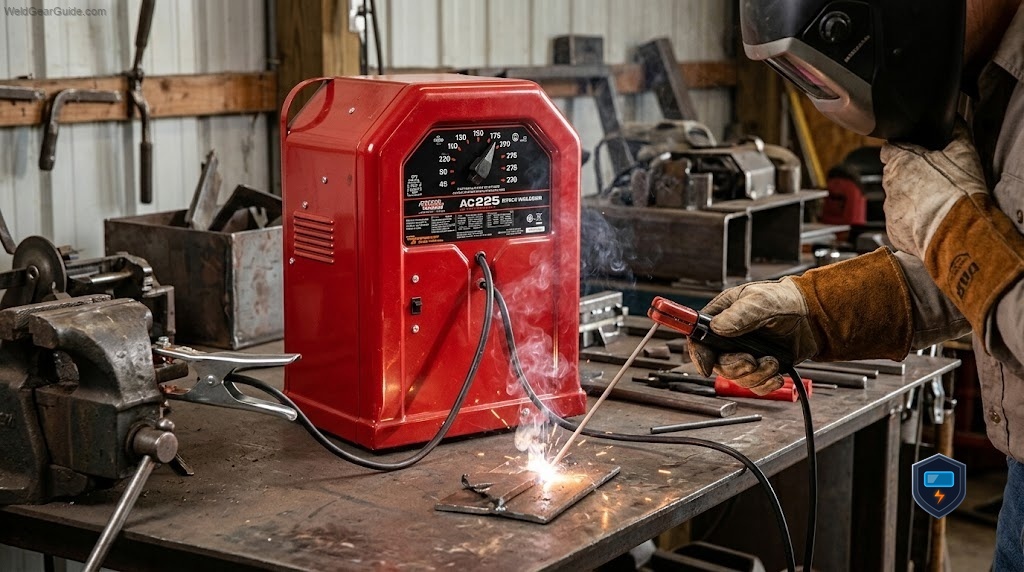
There is a sound an old transformer welder makes that no inverter reproduces. A low, steady hum under the arc, unbothered, as if the machine could keep doing this until the building falls down. That sound is the reason people keep buying the AC225 in an era of ten pound welders with digital displays.
It is also a machine that will disappoint anyone who buys it without understanding one hard limit: it makes alternating current, and only alternating current.
What the AC225 stick welder is
The AC225 stick welder is a single-phase transformer arc welder that produces up to 225 amps of AC welding output from a 230 volt circuit. There is no inverter board, no software, and no display. A crank on the front moves a shunt inside the transformer to select amperage, and that is the entire user interface.
The direct answer for buyers: an AC225 is an excellent value for heavy mild steel repair and fabrication in a fixed shop with 240 volt power, running AC-friendly rods like E6011, E6013 and E7018AC. It cannot run DC-only electrodes, cannot weld aluminium with stick rod, and cannot be carried anywhere convenient. Those limits are permanent, not something you work around with technique.
Why the arc feels different
A transformer welder has enormous thermal mass. When you strike an arc, the machine barely notices. That translates into two things you feel at the handle: consistency across a long bead, and no sudden output shifts when line voltage sags.
The Lincoln Electric AC-225 is the archetype, and the reason it appears in so many shops is that it does one thing with almost no drama. Set the crank, strike, weld until the rod is a stub.
Its flaws are equally concrete. AC output means slightly more arc blow control but a harsher, less refined arc than DC on some rods. Low-end control is coarse, so delicate work on thin material is genuinely difficult. There is no hot start, so cold strikes stick more than on a modern inverter. And it weighs enough that it lives where you put it, permanently.
Skip it entirely if your welding happens in the field, if you need to weld sheet metal, or if you want to run DC-only rods like most 6010 or aluminium electrodes.
The AC/DC variant, and why it changes the math
The Lincoln Electric AC225/DC125 model adds a rectified DC range to the same transformer body. That opens up DC-only electrodes, smoother 7018 operation, and better low-amperage behaviour.
The catch is right there in the model name. DC output tops out well below the AC range, so the DC side is for lighter work rather than heavy plate. Buyers sometimes expect 225 amps of DC and get a fraction of that. If your main reason for wanting DC is running 1/8 inch 7018 on structural joints all day, a dedicated DC inverter serves you better.
Setting one up so it behaves
Circuit first. These machines want a dedicated 240 volt circuit with adequate breaker sizing per the manufacturer’s plate. Running one on an undersized circuit is the single most common cause of poor performance and nuisance breaker trips.
Ground clamp discipline. Clamp to bare metal on the workpiece itself, not to a bench that is merely near the workpiece. On a machine with no arc force compensation, a poor return path shows up immediately as a wandering, sticky arc.
Rod selection is where AC lives or dies. Not all electrodes run on AC. The ones that do:
| Rod | AC behaviour | Best use |
|---|---|---|
| E6011 | Excellent | Rusty, painted or oily steel, deep penetration |
| E6013 | Excellent | Clean light material, tidy appearance |
| E7018AC | Good | Structural joints, low hydrogen strength |
| E6010 | Poor to unusable | DC machines only |
| E4043 aluminium | Will not run | DC electrode positive only |
Amperage. The crank scale is a starting point, not a measurement. Set 1/8 inch 6011 around 110 to 130 amps and read the puddle. Too cold gives a high, narrow bead sitting on the surface; too hot undercuts the edges and burns through.
Rods that make this machine shine
Forney E6011 1/8 inch and the AC225 are a natural pair. This rod was made for exactly this kind of machine: it lights on AC without hesitation, chews through surface contamination, and penetrates deeply on heavy steel. The bead is rough and the spatter is real, so plan for cleanup time and do not choose it for anything decorative.
Hobart 6011 1/8 inch offers a smoother arc for the same purpose and comes in a smaller container that stays fresher in a home shop. Bulk buyers pay a premium per pound for that convenience, which is not worth it if you weld daily.
For strength work, use an AC-rated low hydrogen rod. Standard DC 7018 will run poorly or not at all on an AC-only machine, which surprises people every year. Check the box before assuming.
Keeping low hydrogen rod dry matters here as much as on any machine. A portable electrode oven solves it cleanly, though its single preset temperature limits it to holding rather than reconditioning, and occasional welders are better served by buying small sealed packs.
AC225 against a modern inverter
This is the real decision most buyers face.
| AC225 transformer | 160 to 200 A DC inverter | |
|---|---|---|
| Arc consistency on long beads | Outstanding | Good, thermal limits appear |
| Portability | Effectively none | Carry with one hand |
| Rod compatibility | AC rods only | Nearly all rods |
| Fine low-amperage control | Coarse | Precise |
| Arc aids (hot start, arc force) | None | Standard |
| Repairability in 20 years | Very high | Uncertain |
A machine like the Hobart Stickmate 160 beats the AC225 on every axis except sheer endurance and long-term serviceability. It runs on 120 or 240 volt power, weighs almost nothing, and handles DC rods the transformer never will. What it gives up is the ability to weld heavy plate hour after hour without pausing to cool.
That is the fork in the road. Fixed shop, heavy steel, long beads, 240 volt power: transformer. Anything mobile, anything varied, anything thin: inverter.
Practical work the AC225 does well
Trailer frames, gates, equipment repair on 1/4 inch and heavier stock, structural brackets, and general farm fabrication. Anywhere the metal is thick, the joint is dirty, and the finish will be painted rather than admired.
What it does badly: exhaust tubing, sheet metal panels, small precise brackets, and anything requiring the arc to be soft at low current.
Gear and safety
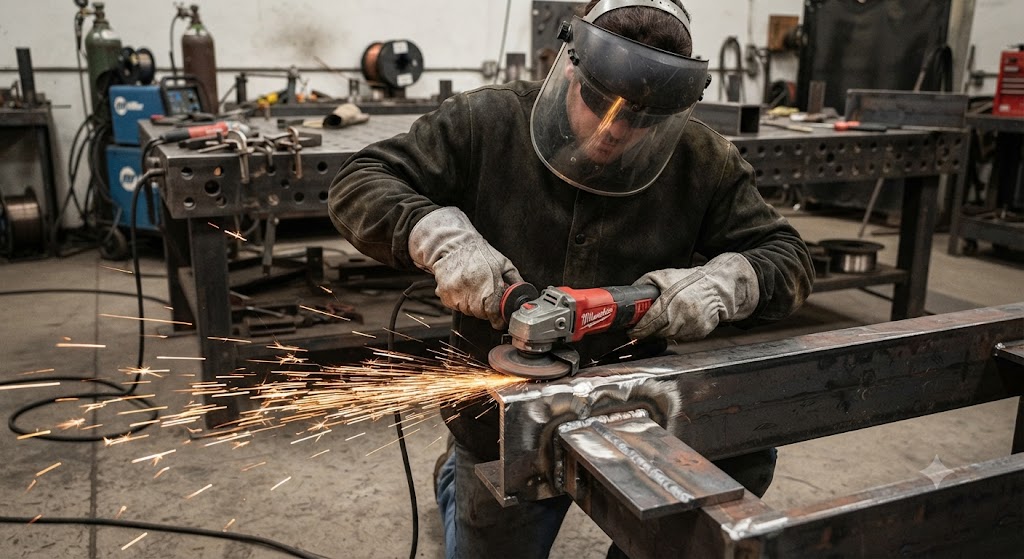
AC arcs are bright and the spatter from 6011 travels. A lined, long-cuff glove such as the Lincoln Electric traditional MIG and stick glove keeps forearms protected during long beads, though the thickness costs you dexterity when handling small parts. Ventilation is not optional either. Stick electrodes generate significant fume, and low hydrogen rods on galvanised or coated steel produce fume you should never breathe.
Final verdict
The AC225 stick welder remains one of the best value pieces of equipment in metalworking, provided your work matches its shape: heavy mild steel, in a fixed location, on a 240 volt circuit, with AC-compatible rods. Within that envelope, it produces welds that a machine ten times its price cannot meaningfully improve on.
Step outside that envelope and it becomes an anchor. Before buying, walk to the place you plan to weld, look at the outlet on the wall, and picture moving 100 pounds of transformer there. If that picture is fine, buy it and use it for thirty years. If it makes you hesitate, buy the inverter and never think about the weight again.
Frequently asked questions
Can an AC225 stick welder run 7018? Only AC-rated low hydrogen rod, usually labelled 7018AC. Standard DC 7018 runs poorly or not at all on an AC-only machine.
Can an AC225 weld aluminium? No. Aluminium stick electrodes require DC electrode positive. An AC-only transformer cannot supply that.
What thickness can an AC225 weld? Comfortably from about 1/8 inch up through heavy plate with multiple passes. It is poorly suited to sheet metal because low-amperage control is coarse.
What circuit does an AC225 need? A dedicated 240 volt circuit sized per the machine’s rating plate. Undersized circuits cause weak arcs and breaker trips.
Is the AC/DC version worth the extra cost? If you want to run DC-only rods or need smoother low-amperage behaviour, yes. Understand that the DC range is much lower than the AC range, so it will not replace a proper DC machine for heavy work.
Why does the rod stick when I strike? No hot start on transformer machines, plus possibly low amperage or a poor ground connection. Strike with a quick scratching motion and clamp the ground to bare metal.
Is a transformer welder better than an inverter? For long, heavy beads and long-term durability, transformers still hold an advantage. Inverters win on weight, features, rod compatibility and low-current control.