Acetylene Gas Welding Equipment: Gas Selection, Flow and Setup
Before electric welders became common, most metal was joined with a flame, and the oxy acetylene torch is still one of the most versatile tools in a shop. With a change of tip it welds, cuts, brazes, and heats, all from two cylinders and a hand held torch. That flexibility is why acetylene gas welding equipment has stayed in service long after newer processes arrived.
This is a different family from the shielding gases used in MIG and TIG. Here the gases are the heat source, not a shield. Oxygen and acetylene mix at the torch and burn in a flame hot enough to melt steel. Because you are handling a fuel gas and an oxidizer under pressure, setup and safety carry more weight than with almost any other process.
The equipment, piece by piece
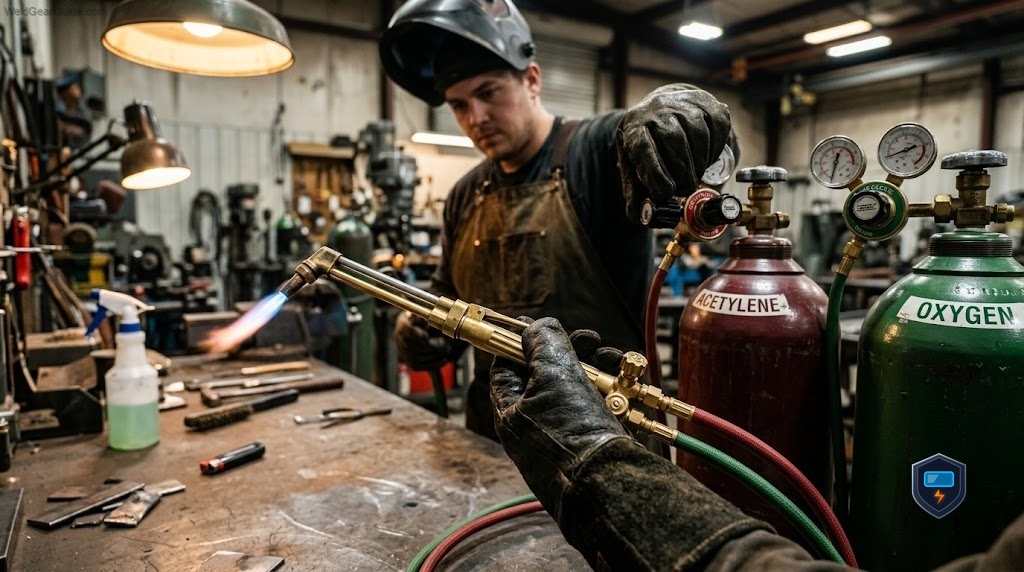
A complete oxy acetylene outfit is a small system, and each part has a job.
Two cylinders. One holds oxygen, one holds acetylene. They use different valve fittings on purpose so the regulators cannot be swapped by mistake.
Two regulators. Each cylinder gets its own regulator to step the high cylinder pressure down to a low working pressure, with gauges for tank and line pressure.
Hoses. Color coded twin hoses carry each gas to the torch, green for oxygen and red for acetylene by convention, again with different fittings so they cannot be crossed.
The torch and tips. A torch body mixes the two gases, and interchangeable tips set it up for welding, heating, or cutting.
Flashback arrestors and check valves. These are the safety heart of the setup. They stop a flame or a reverse flow of gas from traveling back up a hose toward a cylinder.
A complete package like the Forney 1707 oxy acetylene torch kit bundles the torch, regulators, and tips in one Victor style outfit, which is a straightforward way to get a matched set. The honest note is that a kit like this does not include the gas cylinders themselves, which you source and fill separately through a gas supplier.
Flashback arrestors are not optional
Of everything in the kit, the flashback arrestors deserve the most attention. A flashback is a flame burning back into the torch or hose, and it is exactly as dangerous as it sounds. Arrestors and check valves stop that from reaching a cylinder.
Many outfits include them, but if yours does not, add them. A set like the JZWELD oxygen and acetylene flashback arrestor set installs at the regulators and is color coded for each gas. This is a small purchase that guards against a serious accident, and there is no good reason to run a torch without this protection.
Setting the gas and flame
With the equipment connected and leak checked, setting up follows a fixed order.
Open each cylinder valve slowly, the acetylene only a fraction of a turn as is standard practice, and set each regulator to the low working pressure the torch tip calls for. Acetylene is run at low pressure for a specific safety reason, so follow the tip chart rather than guessing.
Light the acetylene first with a spark lighter, never an open flame from a match held close, then add oxygen and adjust to the flame you want. A neutral flame, with balanced oxygen and acetylene, is the general purpose setting for welding steel. Too much oxygen or too much fuel changes how the flame behaves and how clean the weld is.
When you finish, shut off the torch valves, close the cylinders, and bleed the lines. Leaving pressurized gas in the hoses overnight is poor practice.
Leak checking and safety
- Leak test every connection with soapy water after assembly. Bubbles mean escaping gas, and with a fuel gas that is a fire risk, not just waste.
- Keep oil and grease away from oxygen fittings. Oxygen and petroleum can react violently. Never lubricate an oxygen regulator or fitting.
- Secure the cylinders upright with a chain, and keep the caps on when regulators are off.
- Work in ventilated space away from anything flammable, with a fire extinguisher within reach.
Final read
Acetylene gas welding equipment gives a small shop one tool that welds, cuts, brazes, and heats, but it asks for respect in return. Use a matched outfit, never run without flashback arrestors, follow the fixed order for lighting and shutting down, and leak check every joint. Treat the setup carefully and the oxy acetylene torch remains one of the most useful flames you can own.
Frequently asked questions
What gases does oxy acetylene welding use? Oxygen and acetylene. They mix at the torch and burn in a flame hot enough to melt steel. Unlike MIG or TIG gases, these are the heat source, not a shield.
Do I need flashback arrestors? Yes. They stop a flame or reverse gas flow from traveling back toward a cylinder. If your kit does not include them, add a set before using the torch.
Does a torch kit come with the gas cylinders? Usually not. Kits include the torch, regulators, hoses, and tips. You source and fill the oxygen and acetylene cylinders through a gas supplier.
Why is acetylene run at low pressure? For safety reasons tied to the gas itself, acetylene is used only at low working pressures. Always follow the torch tip chart rather than raising the pressure.
Which do I light first? Light the acetylene first with a spark lighter, then add and adjust the oxygen to reach a neutral flame for general welding.
Why keep oil away from oxygen fittings? Oxygen can react violently with oil and grease. Never lubricate oxygen regulators or fittings, and keep oily hands and rags away from them.
References
- OSHA 1910.253, Oxygen fuel gas welding and cutting: https://www.osha.gov/laws-regs/regulations/standardnumber/1910/1910.253
- OSHA, Welding, Cutting, and Brazing: https://www.osha.gov/welding-cutting-brazing
- National Institute for Occupational Safety and Health, Welding safety: https://www.cdc.gov/niosh/welding/about/index.html