Aluminium Spool Gun Welding: How It Works
Anyone who has tried to MIG weld aluminium through a standard gun learns the same painful lesson: the soft wire kinks, tangles, and jams into a bird’s nest before you get a decent bead. This is not a skill problem; it is a feeding problem, and the spool gun exists to solve it. Understanding why a spool gun works, and how to use it, is the key that turns aluminium from a frustrating fight into a genuinely achievable weld.
This guide explains how spool gun welding works, why it beats a standard gun for aluminium, and the technique that produces clean results.
Why aluminium needs a spool gun
To see why the spool gun matters, you have to understand what goes wrong without one.
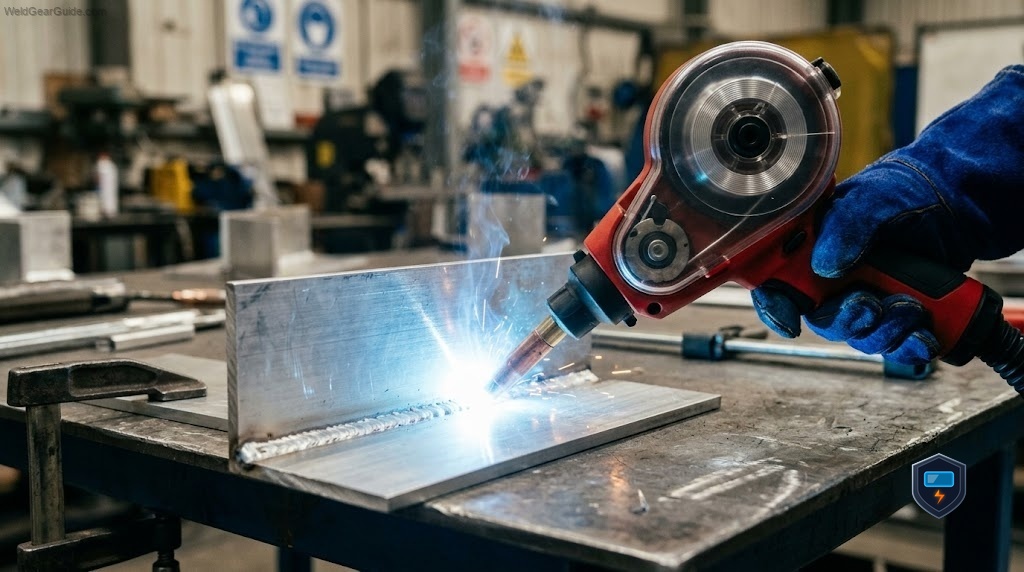
In a standard MIG setup, the wire is pushed from a spool inside the machine, through several feet of cable, and out the gun. That works fine for stiff steel wire, but aluminium wire is soft and springy. Pushed through a long cable, it buckles and tangles like trying to push a piece of cooked spaghetti through a straw. The result is the infamous bird’s nest of wire jammed at the drive rolls. The spool gun fixes this by moving the wire spool into the gun itself, just inches from the contact tip, so the wire only travels a short, straight distance and never has the chance to buckle. That short feed path is the whole reason spool guns exist.
How a spool gun works
With the why clear, here is what the tool actually is and how it connects.
A spool gun is a MIG gun with a small motor and a compartment that holds a four-inch spool of aluminium wire right in the handle. Its own drive motor feeds the wire the short distance from that onboard spool to the tip, so the machine no longer has to push wire through a long cable. The gun plugs into a spool-gun-ready welder, which supplies power and gas and controls the feed. A common example is the Lincoln Magnum 100SG spool gun, which pairs with compatible Lincoln machines. Because the design is self-contained, using a spool gun is not complicated; you load the small spool, plug it in, and weld.
Setting up for aluminium
A spool gun is necessary but not sufficient; a few other pieces have to be right for aluminium.
Load aluminium wire, either ER4043 for forgiving general work or ER5356 for stronger welds. Connect 100 percent argon gas, since the C25 blend used for steel will not weld aluminium. Make sure your welder has enough power, because aluminium sinks heat quickly and needs more amperage than the same thickness of steel. And clean the aluminium thoroughly right before welding, wiping with acetone and scrubbing with a stainless brush used only for aluminium, because the metal’s high-melting oxide layer must come off or the weld will be contaminated. Get these right alongside the spool gun and you have removed the major obstacles to a good aluminium weld.
The welding technique
With the gear set, the technique differs from steel in a couple of important ways.
Aluminium runs hot and fast. Start with more heat than you would use on equivalent steel, and on thicker pieces preheat gently, because aluminium pulls heat away so quickly. Then push the gun, angling it forward into the direction of travel rather than dragging it, which gives better gas coverage and a cleaner aluminium weld. Move at a steady, brisk pace, watching for the surface to turn shiny and wet rather than glowing red, since aluminium does not change color before it melts. Because it melts suddenly, keep your travel moving to avoid burning through, and practice on scrap of the same thickness first to calibrate your settings. The spool gun handles the feeding; your job is heat and speed.
What to take away
Spool gun welding is what makes aluminium MIG practical, by solving the soft-wire feeding problem that defeats a standard gun.
Three things to remember. Aluminium needs a spool gun because its soft wire buckles and bird’s-nests when pushed through a long standard cable, and the spool gun’s short feed path from an onboard spool prevents that. Beyond the gun, aluminium needs the right supporting setup: aluminium wire, 100 percent argon gas, enough machine power, and obsessively clean metal. And the technique runs hot and fast, pushing the gun and watching for a shiny wetted puddle, with scrap practice first because aluminium melts suddenly.
Frequently asked questions
Why do I need a spool gun to weld aluminium? Aluminium wire is soft and buckles when pushed through a long standard MIG cable, causing bird’s-nesting. A spool gun holds the wire in the handle, feeding it a short distance so it cannot tangle.
How does a spool gun work? It houses a small spool of aluminium wire and its own drive motor in the gun handle, feeding wire the short distance to the tip. It plugs into a spool-gun-ready welder for power and gas.
What wire and gas do I use with a spool gun? Aluminium wire, ER4043 for general work or ER5356 for stronger welds, and 100 percent argon gas. The C25 blend used for steel will not weld aluminium properly.
Should I push or pull the spool gun on aluminium? Push it, angling the gun forward into the direction of travel. Pushing gives better shielding gas coverage and a cleaner weld, and it is the standard aluminium technique.
Do I need to clean aluminium before spool gun welding? Yes. Wipe with acetone and scrub with a stainless brush used only for aluminium, right before welding, to remove the high-melting oxide layer that would otherwise contaminate the weld.
Can any MIG welder use a spool gun? No, only spool-gun-ready machines with the correct connection and control. Check that your welder is rated for a spool gun before buying one.
Why does aluminium burn through so easily? It melts suddenly without glowing red first and sinks heat quickly. Keep travel speed brisk, avoid dwelling, and practice on matching scrap to calibrate your heat and speed.
References
- American Welding Society, AWS
- Occupational Safety and Health Administration, Welding, Cutting, and Brazing
- National Institute for Occupational Safety and Health, Welding Safety
- Miller Electric, MIG Welders