Arc Welding Process Types Explained: SMAW, GMAW, GTAW, FCAW, SAW
Open any welding book and you get hit with an alphabet: SMAW, GMAW, GTAW, FCAW, SAW. They look like a secret code, but each one is just a formal name for a process you may already know by a nickname. Stick, MIG, TIG, flux core, and submerged arc are all here, and knowing the real names helps you read specs, buy the right gear, and talk to inspectors. This guide decodes the five main arc welding process types, what each abbreviation means, and how they differ.
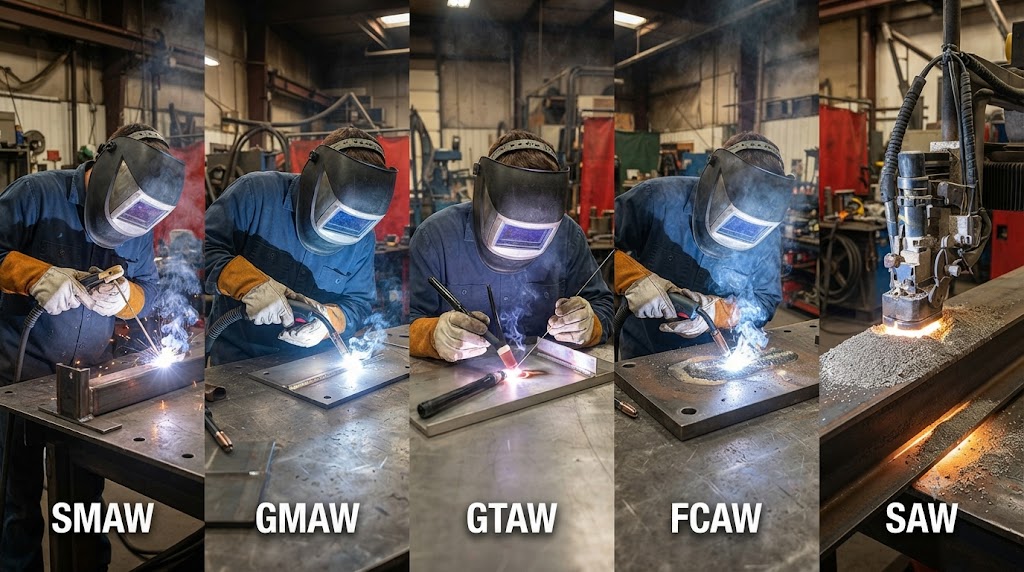
SMAW is stick welding, GMAW is MIG, GTAW is TIG, FCAW is flux-cored welding, and SAW is submerged arc welding. All five use an electric arc to melt and fuse metal, but they differ in the electrode and shielding method. Here is each one explained.
The five main process types
Here are the abbreviations and their plain-language names:
- SMAW: shielded metal arc welding, better known as stick.
- GMAW: gas metal arc welding, better known as MIG.
- GTAW: gas tungsten arc welding, better known as TIG.
- FCAW: flux-cored arc welding, better known as flux core.
- SAW: submerged arc welding, a high-production factory process.
All are arc welding, so they share the electric arc as a heat source and differ in how they feed the electrode and shield the weld.
Direct answer: what the abbreviations mean
Here is the quick decode:
- SMAW = stick: a flux-coated rod that melts into the weld and makes its own slag.
- GMAW = MIG: a continuous solid wire fed with a shielding gas.
- GTAW = TIG: a non-melting tungsten electrode with hand-fed filler and inert gas.
- FCAW = flux core: a tubular wire filled with flux for self-shielding or gas-shielding.
- SAW = submerged arc: an arc buried under a blanket of granular flux.
The common thread is the arc; the differences are electrode type and shielding.
SMAW, GMAW, and GTAW
The three most common processes cover most everyday welding. SMAW, shielded metal arc welding, is stick welding: a consumable flux-coated rod melts into the joint, and the burning flux shields the weld and leaves slag. It is rugged, portable, and great outdoors. GMAW, gas metal arc welding, is MIG: a machine feeds a continuous solid wire through a gun while a shielding gas protects the pool. It is fast and easy to learn, the usual first process. GTAW, gas tungsten arc welding, is TIG: a non-melting tungsten electrode makes the arc, argon shields the weld, and the welder feeds filler by hand for the cleanest, most precise results. These three, stick, MIG, and TIG, are what most welders learn and use day to day, and knowing their formal names makes reading procedures and specs much easier.
FCAW and SAW
The other two processes handle productivity and heavy work. FCAW, flux-cored arc welding, is flux core: it feeds a tubular wire packed with flux instead of a solid wire. In self-shielded form it needs no gas and works outdoors like stick, and in gas-shielded (dual-shielded) form it adds an external gas for smoother indoor welds. It blends MIG’s continuous feed with flux-based shielding and slag. SAW, submerged arc welding, is the factory heavyweight: the arc and weld are buried, or submerged, under a blanket of granular flux, which shields the weld and hides the arc entirely. SAW lays down a lot of metal quickly with deep penetration, which makes it popular for thick plate, large structural work, and pipe mills, though it is generally limited to shop settings and flat or horizontal positions rather than field or overhead work.
How the processes compare
Seeing them side by side makes the pattern clear. All five use an electric arc, and the real differences come down to the electrode and the shielding. Stick (SMAW) uses a consumable coated rod that shields with flux. MIG (GMAW) uses a continuous solid wire that shields with external gas. TIG (GTAW) uses a non-melting tungsten with hand-fed filler and inert gas. Flux core (FCAW) uses a tubular flux-filled wire that can shield itself or use added gas. Submerged arc (SAW) uses a wire under a flux blanket for high-volume shop work. Once you see that the arc is constant and only the electrode and shielding change, the whole alphabet makes sense, and choosing a process becomes a matter of matching those traits to the metal, the position, and the setting.
The bottom line
The arc welding alphabet is less intimidating once decoded: SMAW is stick, GMAW is MIG, GTAW is TIG, FCAW is flux core, and SAW is submerged arc. All five rely on an electric arc to melt and fuse metal, and they differ mainly in two things, the electrode they use and how they shield the weld. Stick, MIG, and TIG cover most everyday welding, while flux core adds outdoor and productive options and submerged arc handles heavy, high-volume shop work. Learn the formal names alongside the nicknames and you will read specs, pick gear, and talk shop with far more confidence.
FAQ
What do SMAW, GMAW, and GTAW stand for? SMAW stands for shielded metal arc welding, which is stick welding. GMAW stands for gas metal arc welding, which is MIG welding. GTAW stands for gas tungsten arc welding, which is TIG welding. All three are arc welding processes that use an electric arc, differing in their electrode and how they shield the weld from the air.
Is stick welding the same as SMAW? Yes. SMAW, shielded metal arc welding, is the formal name for stick welding. It uses a consumable flux-coated rod that melts into the joint, and the burning flux shields the weld and forms slag. The nickname stick comes from the stick-shaped electrode, while SMAW is the technical term used in specifications and codes.
Is submerged arc welding used outside factories? Rarely. Submerged arc welding (SAW) buries the arc under a blanket of granular flux and lays down a lot of metal quickly, which suits thick plate and high-volume production. But that flux blanket and its setup generally limit it to shop settings and flat or horizontal positions, so it is not used for field, overhead, or on-site work the way stick or flux core are.
What is the difference between GMAW and FCAW? GMAW (MIG) uses a solid wire and relies on an external shielding gas. FCAW (flux core) uses a hollow, flux-filled wire, so it can shield itself without gas (self-shielded) or add gas (dual-shielded). FCAW leaves slag to chip off and works better outdoors, while GMAW leaves little slag but needs gas and struggles in wind.
Which arc welding process is best for beginners? GMAW (MIG) is usually best for beginners because the machine feeds the wire automatically, so decent welds come quickly. SMAW (stick) is a moderate step up, and GTAW (TIG) is the hardest because it demands coordinating torch, filler, and amperage at once. Many welders start with MIG and add the others over time.
Why are there so many arc welding processes? Because different jobs need different strengths. Some need speed, some need precision, some need to work outdoors or on thick plate. Each process, stick, MIG, TIG, flux core, and submerged arc, delivers the electrode and shielding in a way that suits certain metals, positions, and settings, so having several processes lets welders match the tool to the task.
References
- American Welding Society process classifications and definitions (industry), aws.org.
- The Welding Institute (TWI) references on arc welding process types (industry), twi-global.com.
- Lincoln Electric and Miller Electric process resources for SMAW, GMAW, GTAW, FCAW, and SAW (manufacturers), lincolnelectric.com, millerwelds.com.