Automatic Welding Machines: Who Needs Them and Why
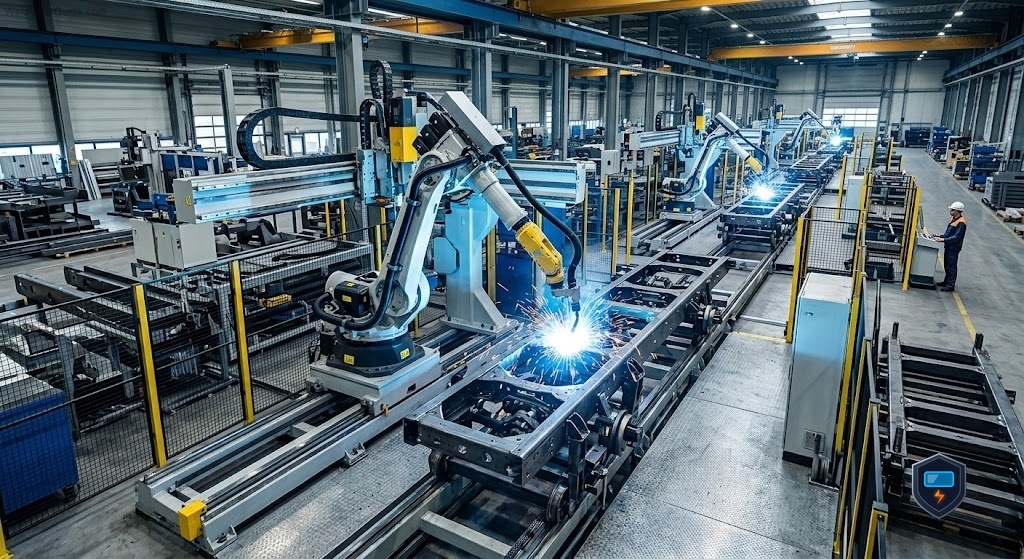
A robot arm lays a perfect bead down a tube joint, pauses, repositions, and lays another one exactly like the first. Same travel speed, same wire feed, same arc length, same penetration. It does this 200 times a shift without fatigue, without coffee breaks, and without the bead drifting when the operator’s wrist gets tired. That is the promise of an automatic welding machine, and in the right setting, it delivers. The question is whether your setting is the right one.
What an Automatic Welding Machine Actually Is
An automatic welding machine is a system that performs welding operations with minimal or no human intervention during the weld itself. The category covers a range of technologies: fully automatic systems that load, weld, and unload parts without an operator; semi-automatic systems where an operator loads parts and the machine welds; robotic welding cells with programmable arms; and collaborative robots (cobots) that work alongside human welders with safety sensors that stop them on contact.
The common thread is that the machine controls the travel speed, arc length, wire feed, and positioning during the weld. The human either steps back entirely or supervises while the machine does the work.
Do You Need an Automatic Welding Machine
If you are running the same weld on the same part hundreds or thousands of times, yes. If you are doing repair work, custom fabrication, or one-off projects, no. The dividing line is repeatability. Automatic welding machines need consistent parts, consistent fixturing, and consistent joint geometry to produce consistent welds. If your parts vary, the machine cannot adapt the way a human welder can.
The Types: Which One Fits Your Work
Fully Automatic Welding Systems
Fully automatic systems handle the entire process from loading to welding to unloading. They are used in high-volume production environments: automotive manufacturing, pipe mills, and structural steel fabrication. These systems are engineered for a specific part or family of parts and are not easily reconfigured for different work.
The advantage is maximum throughput and consistency. The limitation is that the system is only as good as the parts it receives. If the parts vary in dimension or fit-up, the weld quality drops because the machine cannot adapt.
Semi-Automatic Welding Systems
Semi-automatic systems are the middle ground. An operator loads the part into a fixture, the machine welds it, and the operator unloads it. The welding itself is fully automated, but the loading and unloading are manual. This is common in medium-volume fabrication shops where the part volume justifies automation but not full material handling.
Robotic Welding Cells
Robotic welding cells use programmable robot arms to weld parts. The robot can be reprogrammed for different parts, which makes it more flexible than a fully automatic system. Industrial robots typically have repeatability of plus or minus 0.02 to 0.04 millimeters, which is better than any human welder can achieve consistently.
According to TWI (The Welding Institute), automated welding guarantees high repeatability because robots adhere to the same precise process each time, ensuring more consistent results. The limitation is that industrial robots require safety fencing, programming expertise, and consistent fixturing. They are fast and precise but not flexible. If a part is out of position by a quarter inch, the robot will weld in the wrong place with perfect consistency.
Cobot Welding
Cobot welding is the most accessible form of welding automation for small and medium shops. Cobots are collaborative robots designed to work alongside humans without safety fencing, using force sensors that stop the arm on contact. They can be programmed by manually guiding the arm through the weld path, which means you do not need a robotics engineer to set them up.
According to the American Welding Society, cobot welding is one of the biggest advancements in welding automation, making automation accessible to fabrication shops of all sizes. Cobot packages are within reach for small shops that have enough repetitive work to justify the commitment.
The advantage of cobots is flexibility. You can redeploy a cobot between jobs, and a less-experienced operator can run automated welds under supervision. The limitation is speed: cobots are generally slower than industrial robots and are limited to lower amperage (typically 350 amps and below).
Orbital Welding
Orbital welding is a specialized form of automatic welding used for pipe and tube joints. The welding head rotates continuously around the pipe, producing a continuous weld bead without the start-and-stop that manual pipe welding requires. ESAB notes that orbital welding has a level of consistency that even master manual welders cannot match, especially in pipe welding where the welder must change positions.
Orbital welding is used in industries with critical weld requirements: pharmaceutical, semiconductor, aerospace, and food-grade piping. The limitation is that it requires precise joint preparation and fit-up, and the equipment is specialized.
Handheld Laser Welders
Handheld laser welders are the newest category in welding automation. These machines use a fiber laser to weld thin to medium-gauge metal with minimal heat input and almost no post-weld grinding. The learning curve is short compared to TIG welding, with some manufacturers claiming proficiency in 5 to 30 minutes.
The advantage is speed and finish quality on thin materials. The limitations are significant: laser safety requirements are strict, the machines require a substantial commitment, and the welder head can be bulky for tight spaces. YouTube testing by experienced welders has shown that the reality of handheld laser welding is more complicated than the marketing suggests, with setup challenges and safety concerns that are not always disclosed.
Manual vs Automatic: Where Each Wins
Manual welding wins when:
- Parts vary in size, position, or fit-up
- The work is custom, repair, or one-off
- The welder needs to adapt to what they see in the puddle
- The volume does not justify the commitment to fixturing and programming
Automatic welding wins when:
- The same weld is repeated hundreds or thousands of times
- Parts are consistent in dimension and fit-up
- The shop has a welder shortage and needs to put less-skilled labor to work
- Weld quality and repeatability are critical to the product
The key insight from fabrication industry sources is that a welding robot is more precise but definitely more repeatable than manual welding. That only matters if the pieces it is welding are very consistent. If the parts vary, the robot will consistently weld the wrong spot.
What to Check Before Investing
Before you invest in any automatic welding machine, ask these questions:
-
Are your parts consistent enough? Automatic welding needs parts that fit the same way every time. If your parts vary by more than the machine can compensate for, you will get bad welds at high speed.
-
Can you fixture the parts? Fixturing is half the battle in welding automation. If you cannot hold the part in the same position every time, the machine cannot weld it correctly.
-
Do you have the volume to justify it? A cobot cell earns its keep when you have enough repetitive welds to keep it running. If it sits idle most of the week, it is an underutilized asset.
-
Who will program and maintain it? Cobots are easier to program than industrial robots, but someone still needs to learn the interface. And maintenance on automated systems is different from maintaining a manual welder.
-
What safety requirements apply? Industrial robots require fencing and light curtains. Cobots have built-in safety but still require risk assessment. OSHA addresses robotic welding safety, and you need to comply.
Where This Leaves You
An automatic welding machine is not a replacement for a skilled welder. It is a tool that excels at repetition and consistency, which are things humans are bad at. The shops that benefit most are the ones with high-volume, repetitive work and consistent parts. The shops that waste money on automation are the ones that buy a robot and then discover their parts are not consistent enough for it to weld them properly.
If you are a small shop considering cobot welding, start with one cell on your most repetitive job. Train one person to manage it. Measure the throughput improvement before you expand. The technology works, but only if your parts and processes are ready for it.
Three things to take with you:
- Automatic welding is about repeatability, not skill. The machine does not weld better than a master welder. It welds the same way every time.
- Part consistency is the prerequisite. If your parts vary, no machine can compensate for that.
- Cobots are the entry point for small shops. They are slower than industrial robots but easier to deploy and do not require fencing.
Frequently Asked Questions
What is an automatic welding machine?
An automatic welding machine is a system that performs welding operations with minimal human intervention during the weld. Types include fully automatic systems, semi-automatic systems, robotic cells, and collaborative robots (cobots).
How does a cobot welder differ from an industrial robot?
Cobots are designed to work alongside humans without safety fencing, using force sensors to stop on contact. Industrial robots are faster and more precise but require safety fencing and programming expertise. Cobots are easier to program but slower.
Can an automatic welding machine replace a human welder?
Not entirely. Automatic machines excel at repetitive welds on consistent parts but cannot adapt to varying fit-up or joint conditions the way a human can. They are best used to augment skilled labor, not replace it.
What are the main types of automatic welding?
The main types are fully automatic systems, semi-automatic systems, robotic welding cells, cobot welding, orbital welding, and handheld laser welding. Each suits different production volumes and part types.
How do you justify a cobot welding cell?
Cobot welding cells vary in configuration, but basic packages are accessible to small and medium fabrication shops. The commitment is justified by throughput improvements on repetitive tasks, not by one-off or custom work.
What is orbital welding used for?
Orbital welding is used for pipe and tube joints where a continuous, consistent weld is critical. It is common in pharmaceutical, semiconductor, aerospace, and food-grade piping applications.
Are handheld laser welders worth it?
Handheld laser welders offer speed and finish quality on thin materials, but they require strict safety measures, a significant commitment, and careful setup. Experienced welders report that the learning curve and safety requirements are more demanding than marketing suggests.
What safety standards apply to robotic welding?
OSHA addresses robotic welding safety in its welding standards. Industrial robots require fencing and light curtains. Cobots have built-in safety sensors but still require risk assessment and compliance with applicable standards.