A Practical Look at Bakers Gas and Welding Supply: Flow Rates, Troubleshooting and Safety
The way welders buy gear has changed. Alongside the local gas house, online welding retailers now put helmets, wire, consumables, and machines a few clicks away, often with the kind of buying guides and support that used to require a trip to the counter. Bakers Gas and Welding Supplies is one example of an online focused welding retailer, and the shift it represents raises a practical point: the parts arrive by mail, but the setup still happens in your shop.
That is where this guide comes in. Whatever supplier you buy from, the flow rates, troubleshooting, and safety habits that make a gas setup work are the same, and they are worth getting right regardless of where the box came from.
What you can and cannot buy online
Online retailers ship almost everything except the filled gas cylinder itself. You can order regulators, hoses, wire, tips, helmets, gloves, and machines, and have them at your bench in days. What still comes from a local source is the compressed gas, since filled cylinders are not shipped like ordinary parcels.
That split is worth planning around. Buy your regulator, hose, and consumables online, and arrange the cylinder and its fill through a local gas supplier. Match the regulator to the gas and the cylinder inlet before it arrives, so the two halves meet cleanly.
Setting flow rate correctly
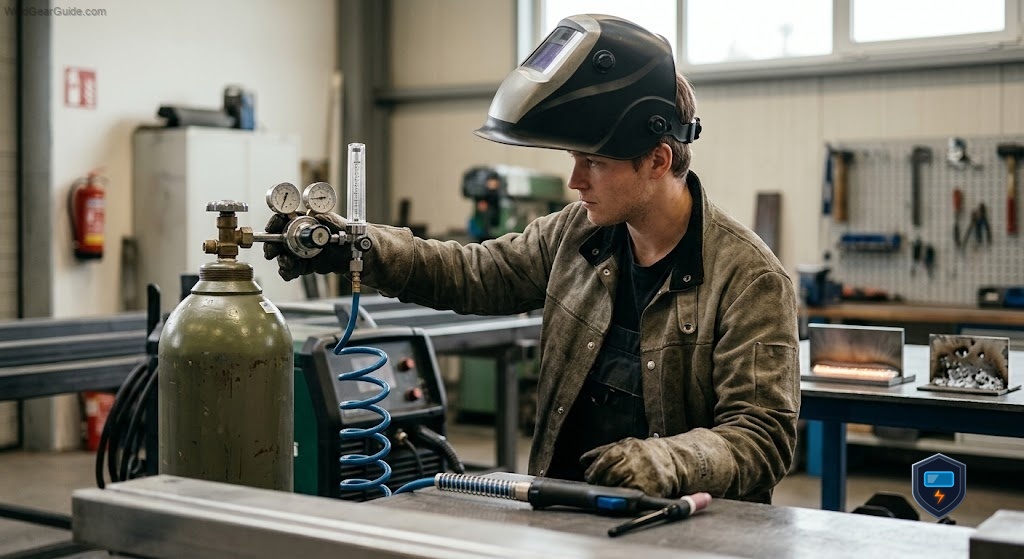
Once the regulator is on the bottle, the setup rules are universal. Mount a flowmeter regulator, matched to the CGA-580 inlet on argon and mixed gas cylinders, and set a moderate flow. For indoor steel MIG that is commonly around 20 to 30 CFH, and for TIG with argon closer to 15 to 20 CFH.
Do not run the flow high for extra safety. Turbulent gas pulls air into the shield and causes porosity, and it drains the bottle fast. Set a moderate flow, run a test bead, and let the result guide any adjustment. Budget flow indicators can read slightly off, so trust a clean bead over the exact number.
Troubleshooting common problems
- Porosity in the weld. Look to a draft, a leak, or a clogged nozzle before adding gas. Block drafts, soapy water test the fittings, and clean the nozzle.
- Bottle empties fast. Usually a leak or too high a flow. A hissing fitting quietly drains a cylinder, so check connections first.
- No gas at the torch. Confirm the cylinder valve is fully open and the regulator is seated on the correct inlet for that gas.
- Dull or discolored TIG weld. Often a shielding coverage issue: a draft, too small a cup, or missing post flow rather than a machine fault.
- Regulator icing on CO2. Some chilling is normal at high flow, but heavy frost suggests the flow is too high for the setup.
Cylinder safety
The gear you order online is only as safe as how you handle the cylinder it connects to. Secure every cylinder upright with a chain or strap to a cart, bench, or wall. Keep the protective cap on when the regulator is off, never move a bottle with the regulator attached, open the valve slowly, and store cylinders away from heat and out of enclosed living spaces. A tipped cylinder can shear its valve, which is a serious hazard, so restraint comes first.
Getting good advice online
One genuine advantage of established online retailers is their buying guides and support. Use them to confirm the regulator inlet, the right consumables for your machine, and the correct wire and gas pairing before you order. A short read up front prevents the common mismatch of ordering a regulator that does not fit the cylinder you will fill locally.
Final read
Buying welding supplies online is convenient, but the setup that decides weld quality still happens at your bench. Order the equipment and consumables online, source the filled cylinder locally, match the regulator to the gas and inlet, and set a moderate flow. Handle the cylinder safely and troubleshoot problems at their real causes, and it makes no difference whether your gear came from a counter or a courier.
Frequently asked questions
Can I buy a filled gas cylinder online? Generally no. Online retailers ship regulators, hoses, consumables, and machines, but filled compressed gas cylinders come from a local supplier.
What flow rate should I set? Around 20 to 30 CFH for indoor steel MIG and 15 to 20 CFH for argon TIG. Set a moderate flow and confirm with a test bead rather than running it high.
Why does my weld have porosity? Most often a draft, a leak, or a clogged nozzle rather than too little gas. Fix those before increasing flow.
How do I make sure a regulator fits my cylinder? Match it to the gas and inlet. Argon and mixed gas use CGA-580 commonly, while CO2 often needs a different adapter. Check before ordering.
How should I store cylinders safely? Upright, chained or strapped, cap on when the regulator is off, away from heat and enclosed living spaces. Never move one with the regulator attached.
Is buying welding gear online reliable? Yes, from established retailers, and their buying guides help you match parts. Just remember to source the filled cylinder locally and confirm fittings before ordering.
References
- OSHA 1910.253, Oxygen fuel gas welding and cutting: https://www.osha.gov/laws-regs/regulations/standardnumber/1910/1910.253
- OSHA, Welding, Cutting, and Brazing: https://www.osha.gov/welding-cutting-brazing
- National Institute for Occupational Safety and Health, Welding safety: https://www.cdc.gov/niosh/welding/about/index.html