Best Angle Grinder for Weld Cleanup and Prep
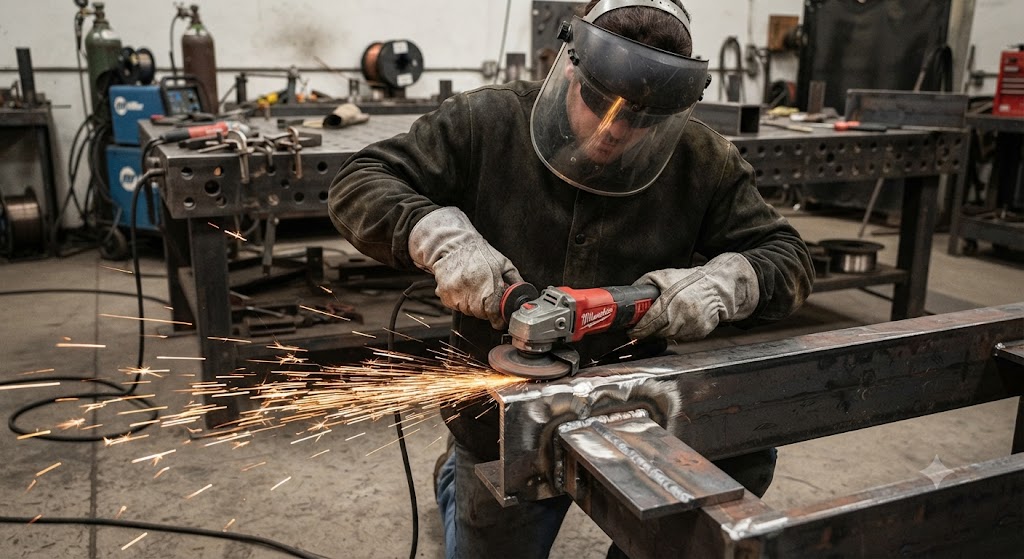
Ask a room of welders which tool they reach for most and a surprising number will say the angle grinder, not the welder. Weld prep, cutting, gouging, cleanup, blending: the grinder touches every job. Which is exactly why the wrong one is such a daily annoyance. A grinder that overheats, has an awkward switch, or fills with metal dust and dies becomes the tool you dread picking up. The good news is that a handful of grinders have earned welders’ trust for real reasons.
The best angle grinder for weld cleanup and prep is a 4.5 to 5 inch paddle-switch model with a durable, well-sealed motor, with the DeWalt DWE402, Metabo WEV15-125, and Makita 9557PB all earning strong reputations among welders. Here is what to look for and how the top picks compare.
Why the grinder matters so much
For a welder, the grinder is a constant companion, so small annoyances add up fast. A grinder that runs hot on long grinding sessions, has a switch that is awkward to hold, or sucks in metal dust until the motor fails will slow you down every single day. The features that separate a good welder’s grinder from a generic one are all about running cool, staying controllable, and surviving a metal-dust environment. Get those right and the grinder disappears into the work, which is what you want.
Direct answer: what to look for and top picks
Buy a 4.5 to 5 inch corded paddle-switch grinder with a strong, dust-protected motor. The features that matter:
- Paddle switch with a safety lock-off, so the grinder stops the instant you let go.
- 11 amp class motor (or strong 8.5 amp) for enough power to grind without bogging.
- Dust protection (sealed or dust-ejecting motor) to survive grinding grit.
- Tool-free guard and wheel change for quick disc swaps.
Top picks welders trust: the DeWalt DWE402 for power and dust ejection, the Metabo WEV15-125 for a strong variable-speed motor, and the Makita 9557PB for a compact, sealed, lightweight body.
The paddle switch: why welders insist on it
If there is one feature welders agree on, it is the paddle switch. A paddle switch runs along the body and must be held down to run, so the moment you release your grip the grinder shuts off. Compare that to a slide or toggle switch that stays on: if you drop a slide-switch grinder, it keeps spinning across the floor. The paddle switch is a genuine safety feature, and once you work with one, the constant contact and instant shutoff feel natural. For a tool you pick up dozens of times a day, insist on a paddle switch with a lock-off.
Power and dust: surviving the shop
Two things kill grinders in a welding shop, and the good ones are built against both:
- Power: an 11 amp class motor (around 11,000 RPM) has the muscle to grind welds and cut without bogging down under pressure. Underpowered grinders stall and overheat on heavy cleanup.
- Dust: grinding throws abrasive grit and metal dust straight into the motor. Good welders’ grinders use a dust-ejection system (DeWalt) or sealed-bearing construction (Makita) to keep that grit away from the bearings and windings, which is often what determines how long the tool lasts.
A grinder that runs cool and keeps dust out will outlive several lesser ones.
The top picks compared
Each of these has a following for a reason:
- DeWalt DWE402: an 11 amp, 11,000 RPM grinder with a dust-ejection system, over-sized brushes for long life, a one-touch rotating guard, and a quick-change wheel release. A do-everything workhorse.
- Metabo WEV15-125: a 13.5 amp, 5 inch variable-speed grinder with Metabo’s long-life motor and safety slip clutch, praised for strong torque and control. The variable speed helps on different materials.
- Makita 9557PB: a compact, 7.5 amp, 4.5 inch grinder with sealed-bearing construction and a small barrel grip, favored for its light weight and comfort on long sessions.
How they differ: the DeWalt leans on dust ejection and all-around capability, the Metabo on torque and variable speed, and the Makita on compact, sealed comfort.
Which angle grinder to buy
Here are the trusted picks.
- DeWalt DWE402 angle grinder (4.5 inch, 11 amp, paddle switch) is the all-around workhorse, with a dust-ejection system, one-touch guard, and quick-change wheel release for daily weld cleanup. Its limitation is that it is a single-speed grinder, so it lacks the variable speed some materials benefit from.
- Metabo WEV15-125 variable-speed angle grinder (5 inch, 13.5 amp) brings strong torque, variable speed, and a safety slip clutch for control on demanding grinding. The trade-off is that it is heavier and a step up from a basic single-speed grinder.
- Makita 9557PB angle grinder (4.5 inch, 7.5 amp, paddle switch) is the compact, lightweight choice with sealed-bearing construction for comfort on long sessions and dust protection. Its limitation is the lower amperage, so it has less muscle than an 11 amp grinder for the heaviest removal.
How to choose: for an all-around daily grinder, the DeWalt DWE402 is hard to beat. For maximum torque and variable speed, the Metabo WEV15-125. For a light, comfortable, sealed grinder for long sessions, the Makita 9557PB. All three use the paddle switch welders want.
Who should skip these corded picks: someone who needs true jobsite mobility with no outlet nearby, who may prefer a quality cordless grinder, accepting shorter run time between batteries.
The bottom line
The grinder is the tool a welder touches most, so buy one built for the shop: a 4.5 to 5 inch corded paddle-switch grinder with an 11 amp class motor and real dust protection. The DeWalt DWE402 is the all-around workhorse with dust ejection, the Metabo WEV15-125 brings torque and variable speed, and the Makita 9557PB is the light, sealed, comfortable pick. Insist on the paddle switch, prioritize dust protection, and the grinder will disappear into your work instead of fighting you.
FAQ
What angle grinder do professional welders recommend? Welders commonly trust 4.5 to 5 inch corded paddle-switch grinders like the DeWalt DWE402, Metabo WEV15-125, and Makita 9557PB, chosen for strong motors, paddle-switch safety, and dust protection that survives a grinding environment.
Why do welders prefer a paddle switch grinder? A paddle switch must be held down to run, so the grinder stops the instant you release it. That is safer than a slide switch that stays on, which keeps spinning if the tool is dropped. The instant shutoff is why welders insist on it.
What size angle grinder is best for weld cleanup? A 4.5 or 5 inch grinder is the standard for weld cleanup and prep, balancing power, control, and disc availability. Larger 7 or 9 inch grinders are for heavy cutting and big stock removal, not detailed cleanup.
How many amps do I need in a welder’s grinder? An 11 amp class motor (around 11,000 RPM) has the muscle for heavy grinding without bogging down. A strong 7.5 to 8.5 amp grinder works for lighter work and offers a more compact, lighter body.
Is a cordless grinder good enough for daily weld cleanup? A quality cordless grinder can handle daily cleanup and offers real mobility, but corded grinders still lead on sustained power and run time. If you have an outlet nearby, corded is the dependable choice for heavy daily use.
Why does dust protection matter in a grinder? Grinding throws abrasive grit and metal dust into the motor, which wears bearings and windings. Dust-ejection systems or sealed-bearing construction keep that grit out, which is often what decides how long the grinder lasts in a welding shop.
References
- DeWalt DWE402, Makita 9557PB, and Metabo WEV15-125 official product specifications and feature documentation (manufacturers), dewalt.com, makitatools.com, metabo.com.
- Home Depot and manufacturer listings confirming amperage, RPM, and paddle-switch and dust-protection features, homedepot.com.
- Welding community discussion of preferred grinders and paddle-switch safety (WeldingWeb and welder forums).