CNC Plasma Cutter Explained: Air Supply, Amperage and Practical Limits
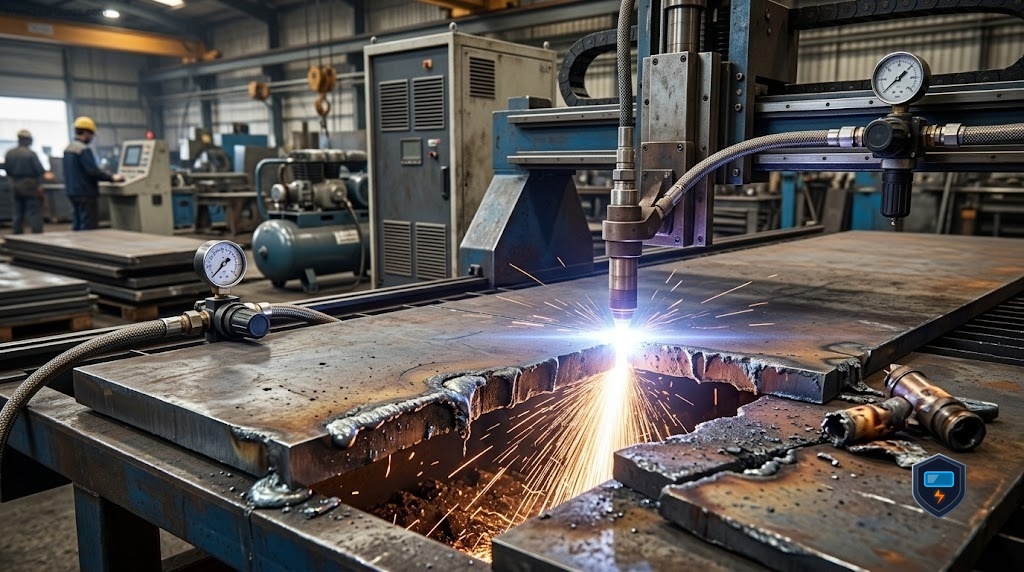
A CNC plasma cutter turns a plasma torch into a machine that cuts precise shapes from steel plate on its own, following a computer program across a table. It is one of the most transformative tools a fabrication shop can own. But the glamorous part, the moving gantry cutting perfect parts, depends entirely on the unglamorous parts: the power source feeding it, the air supply behind it, and the duty cycle that decides how long it can run. Here is how a CNC plasma system actually works and where its real limits lie.
What a CNC plasma cutter is
A CNC (computer numerical control) plasma cutter is a plasma cutting system mounted on a motorized table or gantry that moves the torch along programmed paths. It has three core pieces: the plasma power source (the cutter itself), the machine torch carried by the gantry, and the CNC table with its motion controller and software. A torch height control keeps the nozzle at the right standoff as the plate warps from heat. The software converts a drawing into the tool path the table follows.
The power source sets the ceiling
Everything the table can do is capped by the plasma power source driving it. Its amperage sets how thick it can cut: entry systems around 45 amps handle thinner plate, while 65 to 125-amp systems cut progressively thicker material at production speed. Its cut capacity (rated versus severance) tells you the clean-cut thickness versus the absolute maximum. And crucially, a machine-torch-capable source with a CNC interface port is required to connect to the table at all. A great table with an undersized power source cuts thin and slow.
Air supply is the hidden bottleneck
This is where home and small-shop CNC builds most often fall short. Plasma cutting consumes a steady volume of clean, dry, oil-free air, and a CNC table cuts continuously, far longer than a handheld operator making short cuts. That means the compressor must supply the machine’s full air flow (CFM) at the required pressure (PSI) without falling behind, for the whole cut.
- Handheld use might tolerate a small compressor between cuts; a CNC table cutting long programs does not.
- Size the compressor generously (a common rule is at least 1.5 times the machine’s rated CFM) so it keeps up continuously.
- Air must be dry and oil-free, since moisture and oil wreck cut quality and consumables. A good dryer or filter matters.
Running a CNC plasma on undersized or dirty air produces angled edges, excess dross, and rapid electrode and nozzle wear.
Duty cycle sets how long you cut
Because a CNC table cuts continuously, duty cycle matters far more than it does for handheld work. A power source rated for 100% duty cycle at its cutting amperage can run all day; a lower duty cycle forces cool-down pauses that stall production. Professional systems built for tables, such as Hypertherm’s Powermax125 with its 100% duty cycle, are designed exactly for this continuous mechanized use.
Practical limits to plan around
- Thickness: governed by the power source’s rated cut capacity, not the table. Match amps to your thickest regular part.
- Continuous run time: governed by duty cycle and by whether your air supply keeps up.
- Cut quality: governed by consumable condition, correct air pressure, torch height control and cut speed. Worn consumables and wrong pressure degrade edges fast.
- Consumable cost: a real operating cost; higher-quality systems often deliver longer consumable life, lowering cost per cut.
The verdict
A CNC plasma cutter is a system, and its real capability is set by the least glamorous parts, the power source, the air supply and the duty cycle, not by the table’s motion. Plan the whole system and it cuts precise parts reliably; ignore the support pieces and even a good table cuts poorly.
Three things to plan around. Size the power source to your thickest regular plate, because its amperage and rated cut capacity, not the table, set the thickness ceiling, and it must be machine-torch and CNC-port capable. Feed it enough clean, dry air continuously, since a CNC table cuts far longer than handheld work and undersized or moist air ruins edges and consumables. And match duty cycle to continuous cutting, choosing a source rated at or near 100% duty at your cutting amperage so the table runs without forced cool-downs.
Get the power, air and duty cycle right, and the moving gantry does exactly what makes a CNC plasma worth owning: cuts accurate parts, hour after hour.
Frequently asked questions
What is a CNC plasma cutter? A plasma cutting system mounted on a motorized table or gantry that moves the torch along computer-programmed paths to cut precise shapes from metal plate. It combines a plasma power source, a machine torch, and a CNC table with motion control and software.
What amperage do I need for a CNC plasma table? It depends on your thickest regular plate. Around 45 amps handles thinner material, while 65 to 125-amp systems cut thicker plate at production speed. The power source’s amperage, not the table, sets the thickness ceiling.
Why does a CNC plasma cutter need so much air? Because it cuts continuously along long programs, unlike handheld work with short cuts and pauses. The compressor must supply the machine’s full air flow and pressure without falling behind for the entire cut, or edge quality and consumables suffer.
What size air compressor for a CNC plasma cutter? One that continuously meets or exceeds the machine’s rated CFM at the required PSI, commonly sized at least 1.5 times the rated CFM so it keeps up. The air must also be dry and oil-free to protect cut quality and consumables.
Why does duty cycle matter more on a CNC table? Because the table cuts continuously rather than in short handheld bursts. A 100% duty cycle at the cutting amperage lets it run all day, while a lower duty cycle forces cool-down pauses that stall production.
Can I use a handheld plasma cutter on a CNC table? Only if it is machine-torch capable and has a CNC interface port to connect to the table’s controller. Many entry handheld machines lack these, so check for machine-torch and CNC compatibility before building a table around one.
What is torch height control on a CNC plasma? A system that automatically keeps the torch nozzle at the correct standoff distance from the plate as it warps from cutting heat. It maintains consistent cut quality and protects consumables across the whole cut.
What limits cut quality on a CNC plasma cutter? Consumable condition, correct air pressure and dryness, torch height control, and cut speed. Worn electrodes and nozzles, wrong pressure, or moist air quickly cause angled edges and excess dross even on a good machine.