Complete Joint Penetration: Meaning, Method and Where It Applies
Complete Joint Penetration: Meaning, Method and Where It Applies
In structural and critical work, there is a phrase that carries real weight: complete joint penetration. It is the difference between a weld that is as strong as the metal it joins and one that only looks that way. For load bearing connections, bridges, pressure equipment, and anything where a failure would be serious, complete joint penetration is often not a preference but a requirement, so it is worth understanding exactly what it means and what it takes to achieve.
Complete joint penetration, often shortened to CJP, means a weld that fuses through the entire thickness of the joint, with no unfused portion left anywhere in the cross section. The weld metal extends fully from one side of the joint to the other, so the joint is continuous, solid metal all the way through. Done correctly, a CJP weld makes the joint as strong as the base metal itself.
Complete versus partial penetration
The contrast that gives the term meaning is partial joint penetration, or PJP. In a partial penetration weld, the weld fuses only part way through the thickness, leaving an unfused portion inside the joint by design. That is perfectly acceptable for many connections that do not carry high or critical loads, and it uses less weld metal and time.
A complete penetration weld leaves no such unfused region. Every part of the joint cross section is fused, so there is no built in gap or notch inside the metal to act as a starting point for a crack. This is why CJP is specified where the joint must carry the full load or must not fail: the absence of any unfused area is the whole point.
| Feature | Complete penetration (CJP) | Partial penetration (PJP) |
|---|---|---|
| Fusion depth | Full thickness | Part of the thickness |
| Strength | Up to full base metal strength | Less than full, by design |
| Unfused region | None | Present by design |
| Typical use | Critical, load bearing joints | Non critical connections |
What it takes to achieve CJP
A complete penetration weld is built through preparation, not just skill at the arc.
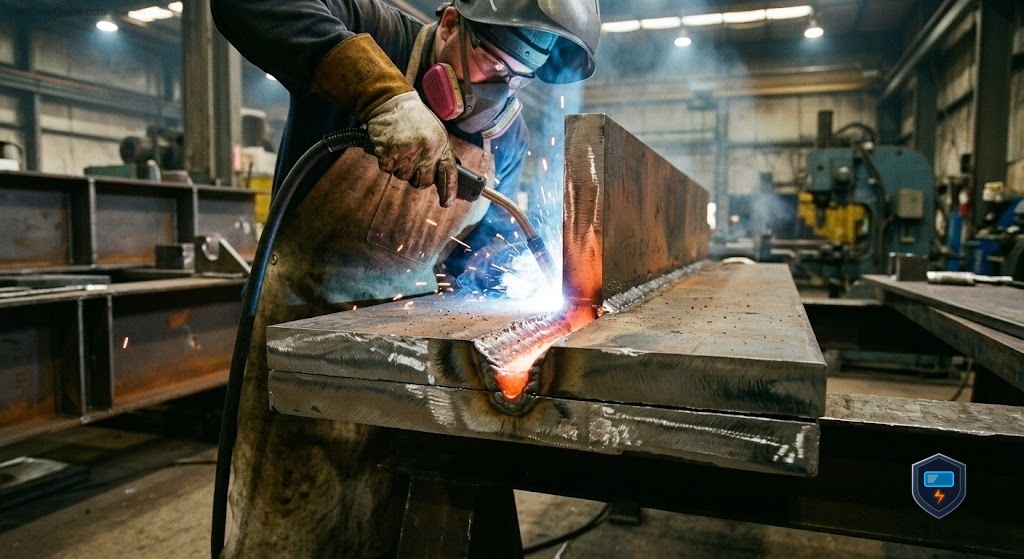
Edge preparation. The joint edges are usually beveled or grooved so the arc can reach all the way to the root. On thicker metal you cannot fuse the full depth from the surface, so the groove gives the weld access to the bottom of the joint. The groove shape and angle are chosen to allow full fusion.
Root treatment. The root, the bottom of the joint, is the critical zone. Achieving fusion there may involve an open root welded carefully from one side, a backing bar that supports the molten metal so it fuses fully, or back gouging, where the first side is ground out from the back and rewelded to guarantee the root is sound.
Multiple passes. Thicker CJP joints are filled in several passes, a root pass to fuse the bottom, then fill passes, then a cap, with cleaning between passes so no slag is trapped.
How it is verified
Because complete penetration is invisible from the surface, critical CJP welds are often inspected without cutting them open. Nondestructive testing methods, such as ultrasonic or radiographic inspection, can reveal whether the weld actually fused through and whether any flaws hide inside. This is why CJP is tied so closely to codes: the requirement comes with ways to prove it was met.
Reading it on a drawing
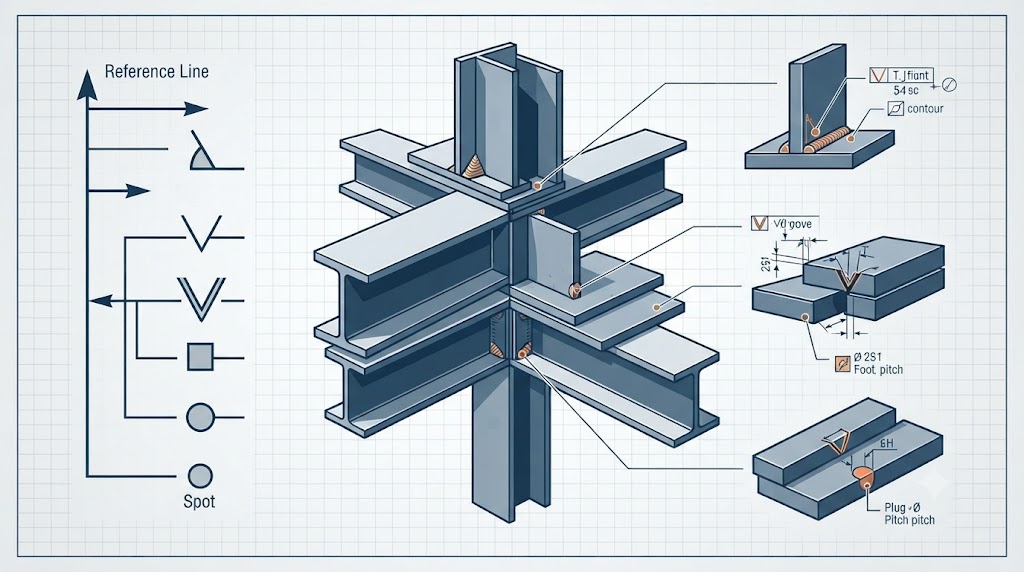
On a drawing, complete joint penetration is called out through the welding symbol, using groove weld symbols and notations that specify full penetration rather than a partial depth. When you see a CJP requirement, it tells you the joint must be prepared and welded to fuse through the entire thickness, and often that it will be inspected. Reading that correctly changes how you prepare the joint before you ever strike an arc.
Where it applies
Complete joint penetration is specified where a joint carries the full load or where failure carries serious consequences: structural steel connections in buildings and bridges, pressure vessels and piping, heavy equipment, and anywhere a code or engineer requires the joint to match the strength of the base metal. For lighter, non critical work, partial penetration is often entirely appropriate and more economical. Knowing which the job demands is part of welding to the right standard.
To sum up
Complete joint penetration means a weld fused through the full thickness of the joint, leaving no unfused area and giving the joint the strength of the base metal. It is achieved through proper edge preparation, sound root fusion, and multiple passes, and it is verified by inspection on critical work. Where loads are high or failure is unacceptable, CJP is the standard, and understanding it tells you how to prepare and weld the joint to meet it.
Frequently asked questions
What does complete joint penetration mean? A weld that fuses through the entire thickness of the joint with no unfused portion, making the joint continuous solid metal and as strong as the base metal.
How is it different from partial penetration? Partial penetration fuses only part way through by design, which suits non critical joints. Complete penetration fuses the full thickness with no unfused region.
Why does CJP need beveled edges? On thicker metal the arc cannot reach the root from the surface. Beveling or grooving the edges gives the weld access to fuse all the way to the bottom.
What is the root and why does it matter? The root is the bottom of the joint. If it does not fuse, the joint has a built in notch that can start a crack, so sound root fusion is essential for CJP.
How do you know a CJP weld actually penetrated? Critical welds are checked with nondestructive testing, such as ultrasonic or radiographic inspection, which reveals full fusion and hidden flaws without cutting the weld.
When is complete penetration required? On critical, load bearing joints: structural steel, bridges, pressure vessels and piping, and anywhere a code or engineer requires base metal strength. Lighter work often uses partial penetration.
References
- OSHA, Welding, Cutting, and Brazing: https://www.osha.gov/welding-cutting-brazing
- American Welding Society, standards and codes: https://www.aws.org/standards-and-publications/codes-and-standards/d1-1/